It has no model of the equipment
Axle positions in millimetres from the front, tire specifications and ratings, kingpin offset, slider hole spacing and travel limits. Without that geometry there is nothing to solve against.
Head to head
McLeod LoadMaster is one of the deepest transportation management systems in North America, and carriers run on it for decades for good reasons. None of those reasons is axle physics.
Who it is for
Order to invoice, driver to settlement, document to audit. That is a very large amount of software and it works.
Take an order, price it, assign a tractor and a driver, tender it, track it, prove delivery, bill for it, pay the driver, and account for all of it at month end. LoadMaster does that across thousands of loads a week without dropping any of them, with the imaging, electronic data interchange and reporting a large customer expects around it.
Fleets stay on it for a long time, and that is not inertia. A system that holds your rate history, your settlement rules and your customer relationships has accumulated genuine value that a newer product cannot simply offer to replicate.
Weight travels through all of it as a single number, because a single number is all the business process ever needed. It is on the order, in the rate, on the bill of lading and on the delivery paperwork, and it is correct every time it appears.
The weight on the order is correct every time it appears. It is simply not the quantity anybody measures at the roadside.
The number that is right and not enough
The job it was not built for
Three reasons a dispatch system cannot close this gap by adding a column.
Axle positions in millimetres from the front, tire specifications and ratings, kingpin offset, slider hole spacing and travel limits. Without that geometry there is nothing to solve against.
Each item, its weight, its dimensions, whether it is stackable and where it physically sits on the deck. That is what turns a declared weight into five axle numbers.
The bridge formula across every consecutive group, the tandem exception, the tire and axle ratings, in the jurisdiction on the route rather than a global setting.
900 lb over the tandem limit
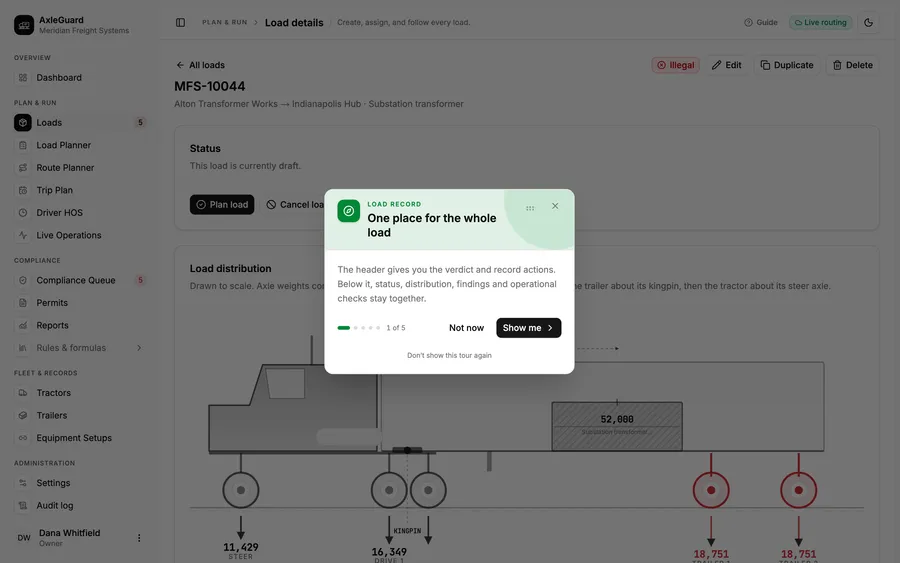
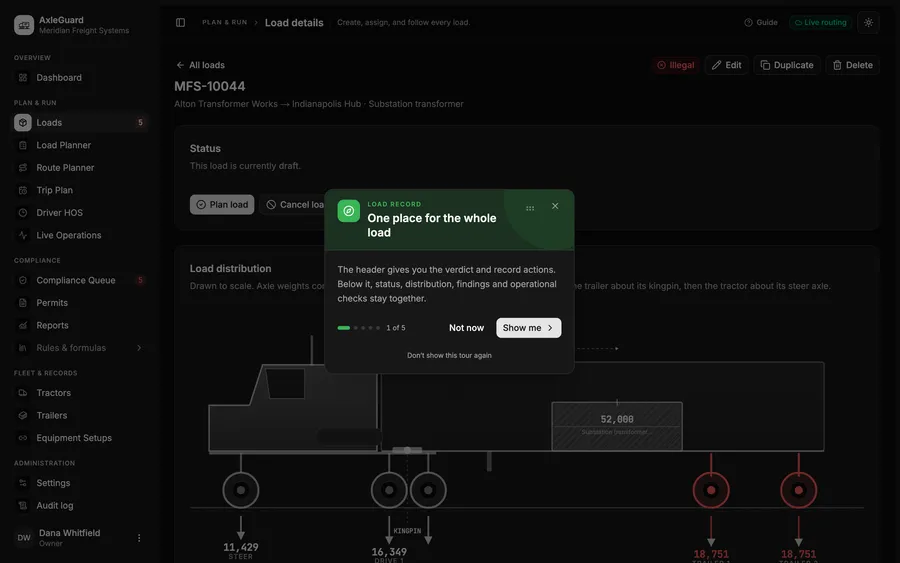
A worked example. The order said 44,000 lb of freight and 74,300 lb gross, nearly six thousand pounds under the federal limit. Every screen in the office would have shown that load as fine.
The order was right, the rate was right, the dispatch was right and the declared weight was right. The pallets went on fourteen inches too far forward, and there is no field on a load record where that fact could have appeared.
Side by side
Orders, rating, imaging, data interchange and accounting all belong to the other column, and we have no ambition to contest any of them.
The whole dispatch and TMS category| Capability | AxleGuard | McLeod LoadMaster |
|---|---|---|
| Order entry, tendering and the dispatch board | No | Yes |
| Rating, invoicing and driver settlements | No | Yes |
| Document imaging and paperwork workflow | No | Yes |
| Electronic data interchange with shippers | No | Yes |
| Accounting and financial reporting | No | Yes |
| Gross weight stored on the order | Yes | Yes |
| Truck-legal routing from real vehicle dimensions | Yes | part |
| Axle weights solved from where the freight sits | Yes | No |
| Bridge formula on every consecutive axle group | Yes | No |
| Tire and axle-rating limits layered on statute | Yes | No |
| Corrective move in slider holes and inches | Yes | No |
| Jurisdiction rule set attached to the load | Yes | n/p |
| Dispatch blocked while a load is over limit | Yes | n/p |
| Before-and-after audit on the physical load model | Yes | n/p |
Methodology
When to pick them instead
You need a system to run the company. Orders, rates, settlements, accounting and the history behind all of it — that is a transportation management system's job and nothing here replaces it.
Your problem is administrative rather than physical. If loads are late because paperwork is slow, a dispatch system is what fixes that.
You need electronic data interchange with large shippers who will not work any other way.
You are choosing your first real system. Do that first. Adding axle checking to a good dispatch system is easy; the reverse is not.
Working together
Reference, shipper, consignee, commodity, dates and the equipment assigned. Nobody re-keys anything, and the record of the business stays in the system that keeps the record of the business.
Where that freight has to sit for the steer, the drives and the trailer group to come back legal in the jurisdictions on the route, and what to move if one of them is over.
Legal, over, or permit required, with the binding rule named. The planner reads it on the board and the driver reads the same thing in the cab.
Rating, settlements, invoicing, imaging and reporting all carry on exactly as they do today. One screen is added to a workflow. Nothing is migrated.
Related
Category
Dispatch and TMS
Six systems that run a freight company properly.
ReadHead to head
vs Samsara
The best record of the truck, arriving after the decision.
ReadHead to head
vs TruckScience
The nearest neighbour we have on the axle question.
ReadCompare
The full matrix
Twenty-four rows across six categories.
ReadNext step
A real order with the weight your customer declared and the trailer you would have used. Forty-five minutes, and you find out whether the board and the scale would have agreed.