Skip to content
AxleGuard
Demo

Compliance

The same truck is legal in one state and not in the next.

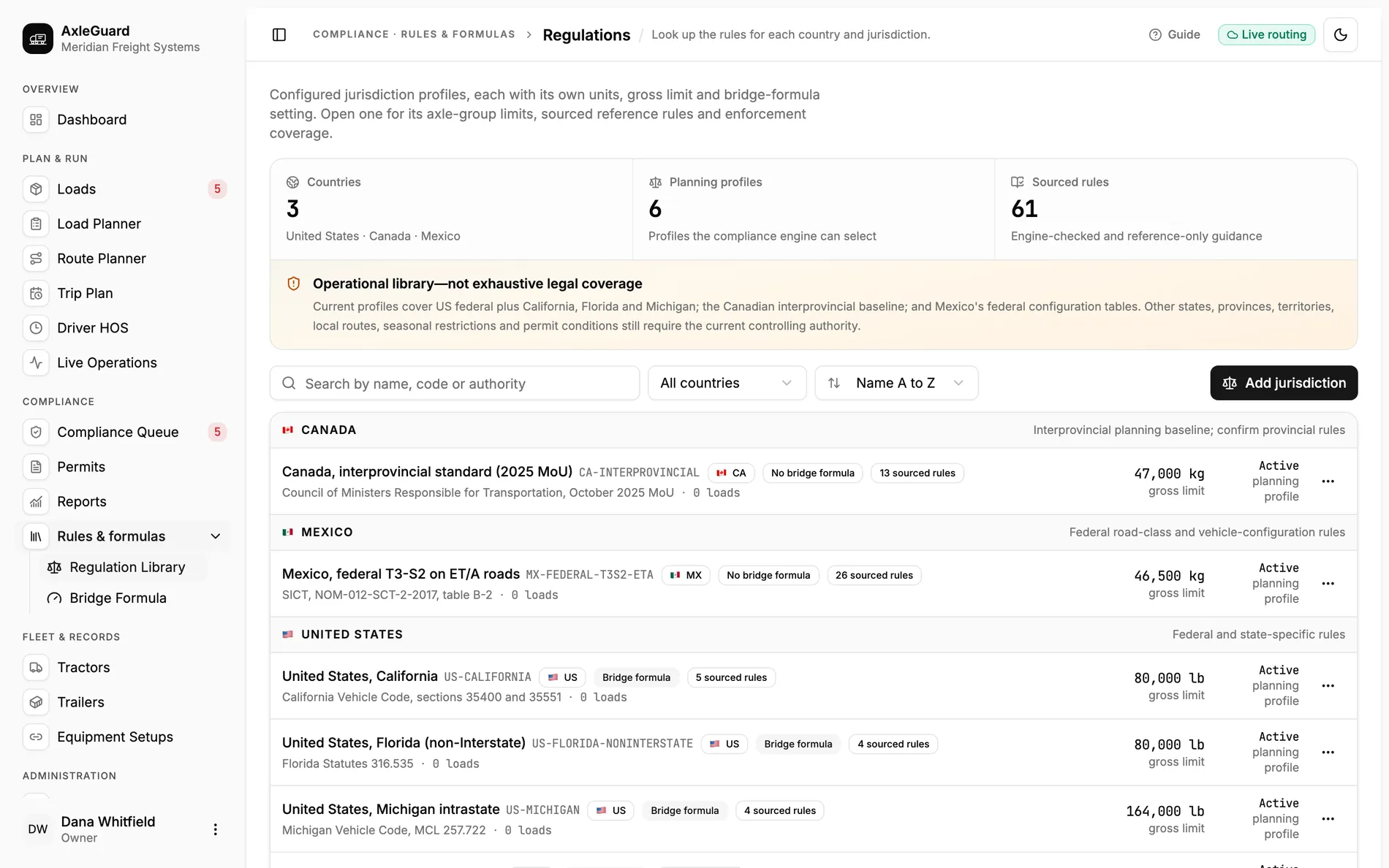
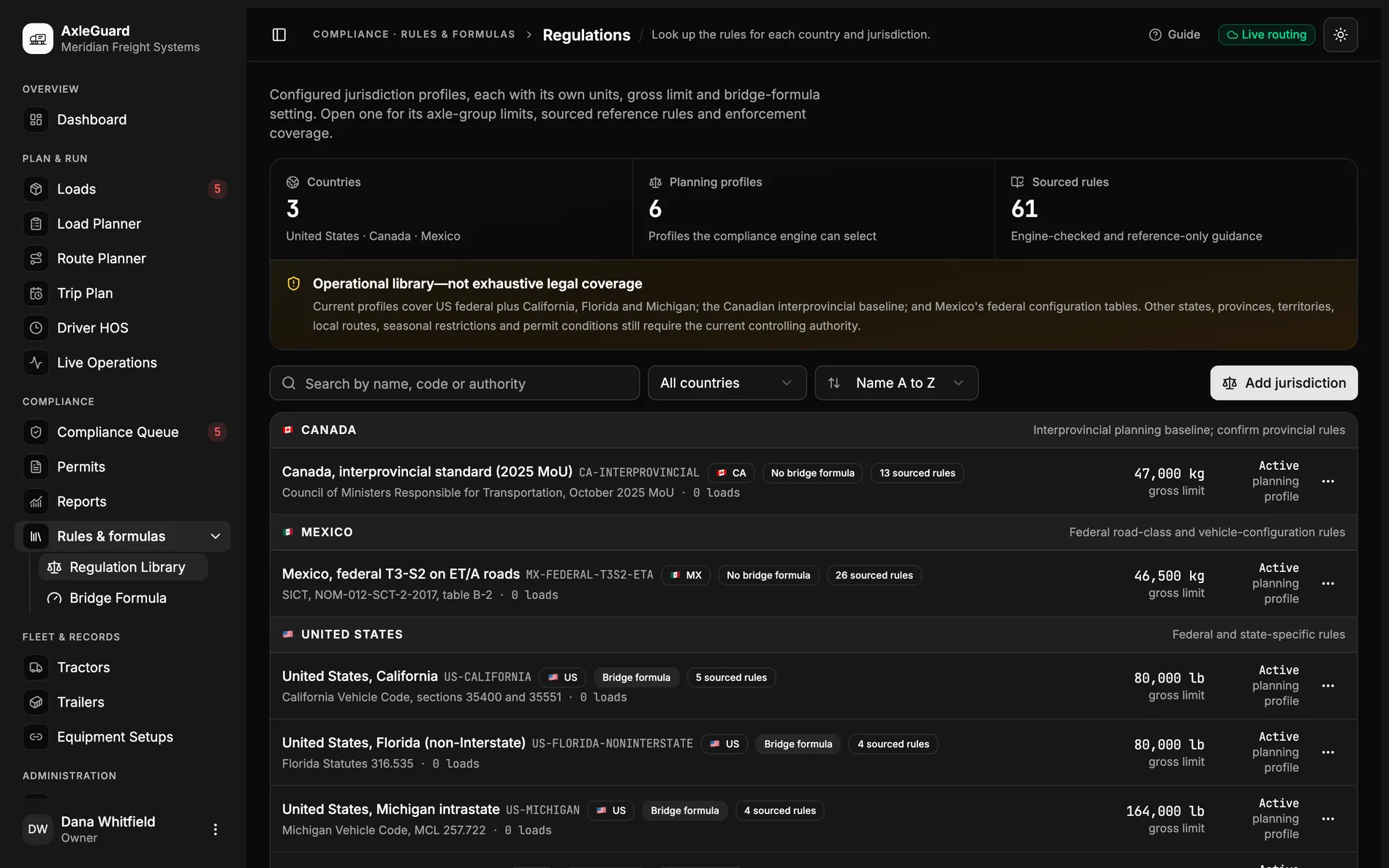
Limits are not national. Neither are units, date formats or time zones. AxleGuard stores the jurisdiction on the load. A 44,000 lb configuration can therefore be legal under one rule set and over under another. The page names the rule that bound it.

Jurisdictions seeded
5
each producing genuinely different verdicts
Editable rule types
Axle, gross, bridge, geometry
all as data
Locale presets
US, Canada, ISO
units, dates, time zone

In the product

The screen where this work happens.

Open AxleGuard
Rule sets are data, not code. Limits, formulas and geometry rules are edited in the product and versioned.

What changes

Three outcomes that matter in the operation.

Each outcome connects what the software does to the decision a planner, loader or driver can actually make.

01

A rule change is a form, not a software release

Axle limits, gross limits, where the bridge formula applies, and shape rules such as California's 40 ft kingpin-to-rear-axle are all held as records that can be edited. Someone who does not write software can change them.

Why this is different

When limits are written into the software itself, a legislature's change turns into a ticket, a release and a rollout. In the meantime the yard runs off a printed table taped inside a cupboard door, and nobody is sure when it was printed.

A state drops a tandem allowance on the first of the month

The change is one record, edited that morning, and every load planned from then on is judged against the new number. The alternative is a memo that some planners read, a reprinted table that reaches four of the five yards, and a fortnight of loads planned to a limit that no longer exists.

02

A Canadian planner and a US driver read the same load correctly

Distances, weights, dates and times follow the jurisdiction and the person reading them: miles or kilometres, pounds or kilograms, mm/dd/yyyy or dd/mm/yyyy, in the right time zone.

Why this is different

Most tools pick one locale and leave everyone else converting in their head. A conversion done in a hurry, on a phone, in a yard, is how the wrong week gets written on a bill of lading.

A load booked for 07/08

The planner in Ontario reads that as 7 August. The driver in Michigan reads it as 8 July. One of them is a month out, and neither has any reason to doubt themselves. Each of them sees the date written the way they read dates, and the appointment is simply the appointment.

03

A load can be cited for its shape, not just its weight

Shape rules are checked next to the weight rules — overall length, kingpin to rear axle, overhang — because some limits are about how the combination is laid out rather than how heavy it is.

Why this is different

A weight-only check passes a load that will be pulled over for a dimension, and the planner has no reason to look any further, because every gauge on the screen was green.

A 53 ft trailer with the tandems slid back for weight

The trailer tandem is 900 lb over, so the planner slides it rearward, which moves weight forward onto the drives and clears the tandem. It also pushes the kingpin-to-rear-axle distance past the 40 ft California allows. Every weight gauge is green and the load is still citable, unless something checks the shape too and names which rule bound.

How it works

From input to answer.

The logic is visible. There is no “AI decided” step between the load and the verdict.

Important boundary

Five jurisdictions are seeded as worked examples. A production deployment would carry all fifty states plus the provinces, entered through the same editor.

  1. 01

    Pick the jurisdiction on the load

    It is a field on the load, not a global setting, because a fleet runs in more than one.

  2. 02

    The engine reads its rules

    Limits, formula applicability and geometry rules are resolved before the solve, not after.

  3. 03

    The verdict names the binding rule

    Not 'illegal' — 'over on the drive tandem by 1,850 lb against the Florida axle rating'.

  4. 04

    Formats follow

    Every weight, distance, date and time on the page renders in that jurisdiction's convention.

Where to test it

Hard cases worth checking.

  • A load legal federally and over in a single state it passes through.
  • An axle rating that binds below the statutory limit.
  • A geometry rule that fails a load with no weight problem at all.
  • A route that crosses two jurisdictions with different limits on the same leg.