Telematics tells you what happened. The dock is where it could have been prevented.
Samsara, Motive, Geotab, Verizon Connect and Omnitracs give a fleet the clearest picture of its trucks it has ever had. Every part of that picture is of a trailer that is already loaded.
Five platforms
14 capabilities checked
Public documentation, August 2026
What the category is for
Knowing what the truck did, with evidence.
This category changed trucking, and a fleet without it is flying blind on safety, hours and maintenance. Nothing here argues otherwise.
Hours of service as a defensible log rather than a paper book. A camera that settles what happened at an intersection. An engine fault that reaches the shop before it reaches the shoulder. Fuel and mileage by jurisdiction, calculated instead of estimated. These are enormous operational wins and they are all real.
The category has one structural property, and it is not a criticism: everything it knows, it learns from a vehicle. The vehicle has to exist, be loaded, and usually be moving, before there is anything to report. Telematics is the instrument panel. It is superb at telling you the state of the aircraft and it is not where the flight plan is written.
For overweight axles that timing is the whole story. Once the freight is strapped and the doors are shut, every remaining option is expensive: break the load down, pay a crew, lose the dock slot, miss the window. The moment when a fix costs two minutes has already gone.
A sensor can only report the load that exists. At seven in the morning the useful question is about a load that does not.
The one place they meet
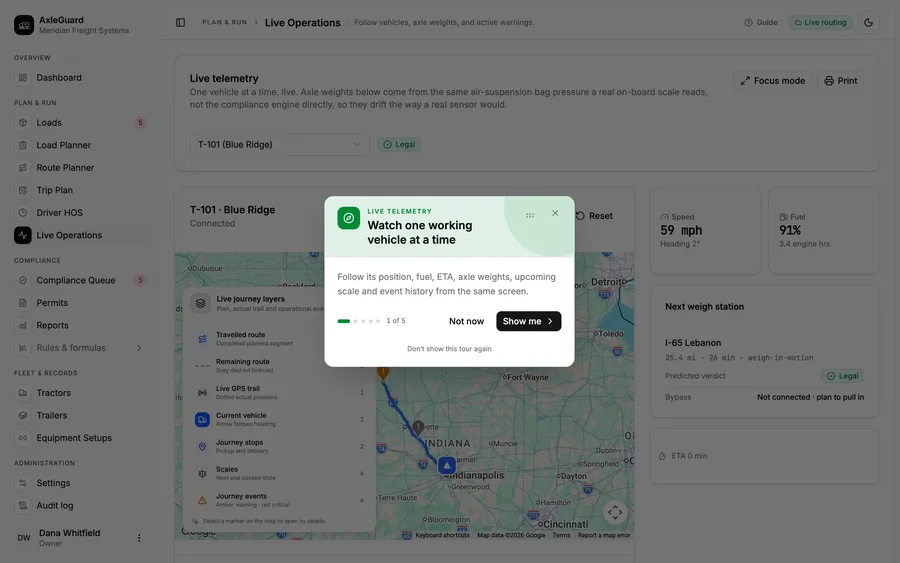
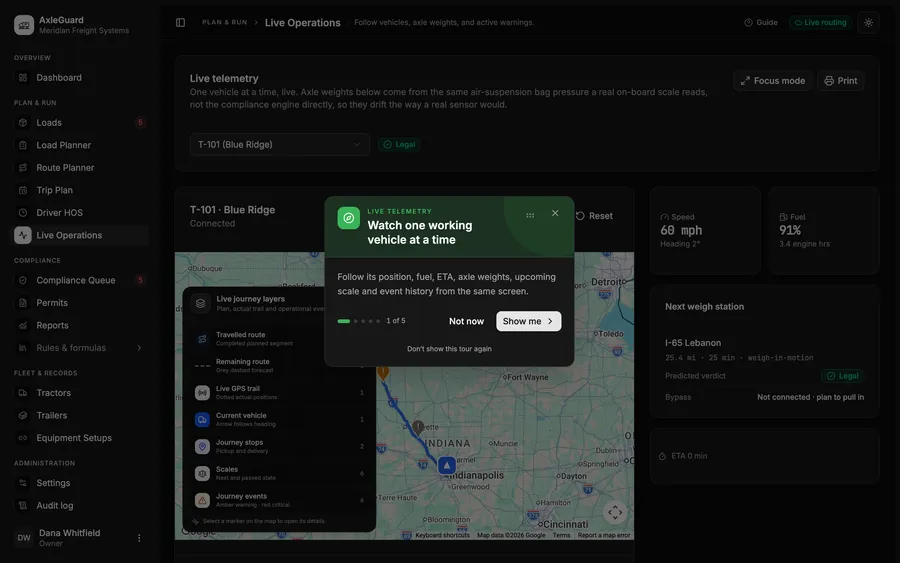
After a trailer gateway passes commissioning, its suspension signal can be converted to an operating axle estimate and drawn along the journey. That is the honest check on a plan made hours earlier, and it is the part of this category we actively want fleets to have.
axleguard.app/telemetry
The live workflow uses derived replay in the audited workspace. Physical axle signals require an approved truck gateway.
The platforms
Five names, and what each one is genuinely good at.
These platforms differ more from each other than any of them differs from us. Choosing between them is a real decision and this page is not it.
Samsara
Fleets that want tracking, cameras, hours and equipment on one screen.
What it does well
A broad connected-operations platform. Vehicle tracking, hours of service as the log of record, camera-based safety with driver coaching, engine diagnostics, trailer and equipment monitoring, and a developer platform that lets other software read the same data. The breadth is the point, and it is executed well.
Where the scope ends
Everything it reports concerns a vehicle that is already loaded and usually already moving. That is not a flaw — it is what telematics is — but it means the information arrives after the decision that determined whether the load was legal.
Motive
Carriers who want safety and compliance to be simple for drivers.
What it does well
Hours of service, vehicle tracking and camera-based safety, with a very strong focus on the driver experience and on making the compliance side unfussy. Spend management and fuel card integration sit alongside it, which for many carriers turns two vendors into one.
Where the scope ends
The subject is the driver and the vehicle. What is inside the trailer, and how it is distributed across the axles, is outside it.
Geotab
Fleets that want the data open and the hardware their own choice.
What it does well
An unusually open telematics platform. A large marketplace of third-party applications, expansion hardware that lets other devices feed data in from the vehicle, deep fuel, engine and electrification analytics, and a data model other software can build on. For a fleet that wants to own its telematics data rather than rent a view of it, this is the strongest position in the category.
Where the scope ends
It is a platform for getting data off vehicles and making sense of it. It does not plan a load, and the axle question begins before there is a vehicle to read.
Verizon Connect
Mixed fleets, including plenty that are not long-haul trucking.
What it does well
Fleet tracking, hours of service, dash cameras and field service scheduling under one roof, with the reach and support structure of a very large carrier network behind it. For a mixed fleet of trucks and service vehicles, having one tracking system across all of it is worth real money.
Where the scope ends
Its breadth is across vehicle types rather than down into freight physics. Load distribution is not a published capability.
Omnitracs
Long-haul trucking operations with a long history in the cab.
What it does well
One of the oldest names in trucking telematics, with hours of service, in-cab communication, safety programmes and route planning heritage. Fleets that have run it for years have deep operational process built around it, and that continuity has genuine value.
Where the scope ends
Route and compliance planning here is about the trip and the driver. Per-axle load distribution from cargo position is not part of what the vendor publishes.
Side by side
Fourteen capabilities, with four plain no and three partial.
Cameras, engine diagnostics and fuel-tax reporting remain outside AxleGuard. HOS and physical sensor ingestion now have guarded development workflows, but are not presented as registered ELD or certified scale functions.
Telematics and ELD platforms compared with AxleGuard across fourteen capabilities
Capability
AxleGuard
Samsara
Motive
Geotab
Verizon Connect
Omnitracs
Vehicle location and trip history
part
Yes
Yes
Yes
Yes
Yes
Hours of service log of recordAxleGuard development workflow is not yet an FMCSA-registered ELD
part
Yes
Yes
Yes
Yes
Yes
Camera-based safety and driver coaching
No
Yes
Yes
part
Yes
n/p
Engine diagnostics and maintenance alerts
No
Yes
Yes
Yes
Yes
n/p
Third-party sensors fed in from the vehicle
part
Yes
n/p
Yes
n/p
n/p
Fuel tax and mileage-by-jurisdiction reporting
No
Yes
Yes
Yes
n/p
n/p
Physical axle signal after truck commissioning
part
n/p
n/p
part
n/p
n/p
Weight known before the freight is on the trailer
Yes
No
No
No
No
No
Axle weights solved from cargo position
Yes
No
No
No
No
No
Bridge formula on every consecutive axle group
Yes
No
No
No
No
No
Corrective move in slider holes and inches
Yes
No
No
No
No
No
Truck-legal route from real vehicle dimensions
Yes
n/p
n/p
n/p
n/p
part
Jurisdiction rule set on the individual load
Yes
n/p
n/p
n/p
n/p
n/p
Hardware fitted to the vehicle required
No
Yes
Yes
Yes
Yes
Yes
supportedpart partly, or with limits not supportedn/p not published by the vendor
How to read this table
Drawn from publicly published product documentation as of August 2026. Weight sensing through telematics usually depends on the hardware a given fleet has fitted, which is why those rows read not published rather than no. Ask your provider what your own trailers report.
Where the category stops
Three things a truck cannot tell you, because it has not been loaded yet.
What the load would weigh if it were built differently
A sensor reports the load that exists. The useful question at seven in the morning is about the load that does not exist yet, and there is nothing to measure.
Which rule is about to bind
A weight reading is a number without a verdict. Whether that number is a problem depends on the axle spacing, the bridge formula subset it falls in, the tire rating and the state the truck is about to enter.
What to physically do about it
The output a yard can act on is a move: which pallets, which direction, how many slider holes. That comes from a model of where the freight sits, and no amount of resolution on a pressure sensor produces it.
Capabilities published as supported, of 14
rows
AxleGuard7 rows
Plus three part, and four plain no
Samsara7 rows
Three rows not published
Motive6 rows
Four rows not published
Geotab6 rows
Plus two part, two not published
Verizon Connect5 rows
Five rows not published
Omnitracs3 rows
Plus one part, six not published
Counted from the table above. The totals sit close together and they are counting different rows: theirs are about the truck and the driver, ours are about the freight before any of it is aboard.
The rows we never intend to win
Cameras, engine diagnostics, fuel-tax reporting and mandatory vehicle hardware are four plain no rows in our own column. HOS and sensor ingestion are partial because the software controls exist but the external registration and real-hardware gates have not been crossed. A fleet still needs a production telematics/ELD platform.
Eleven hours of driving, after ten consecutive hours off duty.
49 CFR 395.3, hours of service for property-carrying drivers
The pairing that actually works
Plan the load at the dock so every axle group comes back legal. Let the telematics you already run prove it on the road. When the two disagree, that is worth knowing on the first trailer rather than on the fiftieth.
Questions
What fleets with telematics ask.
01Our trailers already report air-bag pressure. Is that not live axle weight?
It is the raw material for it, and if your telematics reads it you are further ahead than most. Two things are still missing. The pressure has to be converted to a load using the calibration of that specific suspension, and the number that comes out describes a trailer that is already loaded. It is a very good check and a very poor plan.
02Do you replace our ELD?
Not in production today. AxleGuard has an append-only duty-event journal, driver-owned corrections and certification, diagnostics and a development transfer export. Telematic and local roadside transfer stay locked until registration evidence is recorded. The other readiness checks are tracked, but the current code does not yet enforce every one as a transfer prerequisite. Keep your registered ELD as the legal system of record.
03Then what do you do with telematics data?
Position shows where the truck is against the route that was planned. The current AxleGuard workspace replays derived signals through that live workflow. A physical axle estimate is available only after a truck gateway is installed, compared with a certified reference and approved.
04Why is so much of the axle row marked not published?
Because weight sensing through telematics usually depends on what hardware a particular fleet has fitted and which marketplace application is reading it, and the platform vendors do not generally publish a blanket capability statement about it. Marking it no would be unfair to platforms whose whole design is that third parties can feed data in. Ask your telematics provider what your specific trailers report.
Start with the dock answer, then compare the road record.
Choose one completed run from your fleet history. AxleGuard will reconstruct its departure state so the planned axle verdict can be checked against the telemetry that arrived later.