Skip to content
AxleGuard
Demo

Category · Onboard scales

A scale measures. It cannot weigh a load that does not exist yet.

Air-Weigh, Right Weigh, Vulcan and Stemco make hardware that tells a driver the truth about the trailer underneath them. That truth arrives after the freight is on, which is exactly when fixing it stops being cheap.

  • Four makers
  • 14 capabilities checked
  • Public documentation, August 2026

What the category is for

The number, measured, on the vehicle.

This is the only category on the site that reads the real quantity rather than a proxy for it, and for some operations it is indispensable.

If you run refuse, bulk, aggregate or anything else where the truck is loaded to the line on every pick-up, an onboard scale is not a nice extra. It is the instrument the whole operation runs on. The loader watches it, the driver watches it, and the difference between a profitable load and a citation is the last two thousand pounds.

The technology splits roughly two ways. Air-pressure systems read the suspension bags and convert that pressure to a load, which is cheap, simple and works beautifully on air-ride equipment. Load-cell systems measure force directly, which costs more and works where there is no air bag to read — mechanical suspensions and hard vocational service.

Both give you a genuine axle reading. Neither of them is a plan. The reading exists because the freight is already aboard, and by then the decisions that produced it have all been taken.

An instrument tells the truth about a trailer that is already loaded. That is the honest half of the answer, arriving in the expensive half of the day.

The moment the cost changes

Before the forklift moves, a badly positioned pallet is a two-minute conversation. After the doors are shut it is a crew, a dock slot and somebody else's delivery window. The scale reading almost always arrives on the wrong side of that line.
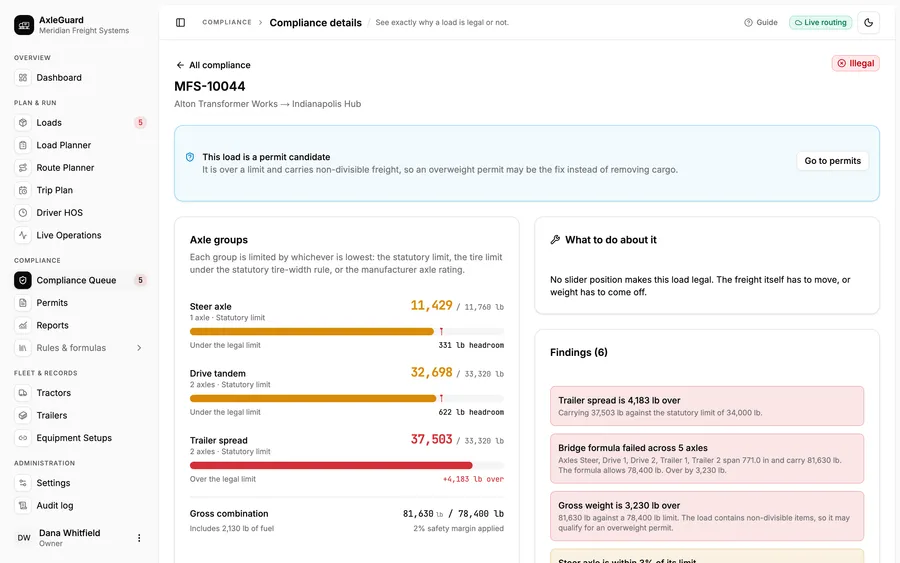
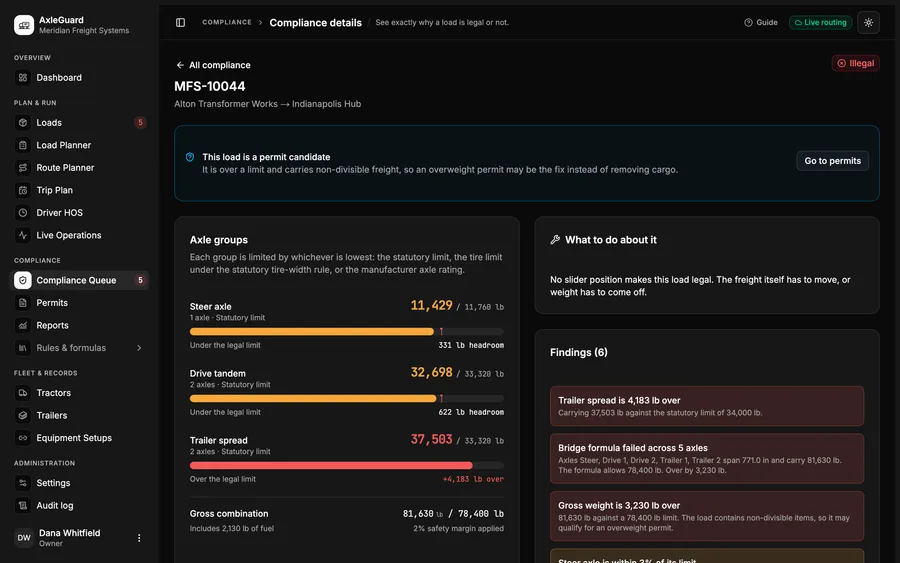
The same five numbers a scale would give you, produced before anything is lifted, with the rule that binds each group named.

The makers

Four names, and where each one fits.

These are hardware companies with real engineering behind them, and the differences between them are mostly about suspension type and service conditions.

Air-Weigh

Fleets that want a real axle reading in the cab, on tractor and trailer.

What it does well

Onboard scale systems built specifically for commercial vehicles, covering both air-ride and mechanical suspensions, with in-cab display of axle group weights and data output to other systems. For an operation loading to the limit every day, having the number on the dash instead of at a certified scale ten miles away is the difference between confidence and hope.

Where the scope ends

It reports the vehicle as it is now. It is not a planning tool, and it does not have a view of the load you have not built yet.

Right Weigh

Owner-operators and fleets who want a straight answer for very little money.

What it does well

Load scales for air-ride suspensions that are about as unfussy as hardware gets. The analog exterior gauges need no power at all, mount on the trailer, and are read by looking at them. Digital models add in-cab reading. For a large part of the market this is the right amount of technology, and the simplicity is a genuine engineering achievement rather than a limitation.

Where the scope ends

It reads air pressure on an air suspension. Anything that is not that — a spring-suspension trailer, a planning question, a jurisdiction rule — is outside what it is for.

Vulcan On-Board Scales

Refuse, bulk and vocational fleets where every load is weighed.

What it does well

Load-cell based onboard weighing from a precision weighing company, which means it works where air-pressure sensing does not — mechanical suspensions, vocational bodies, and the kind of hard-service application that eats consumer-grade hardware. In refuse and bulk operations where the truck is weighed on every single pick-up, this class of system is the operational core.

Where the scope ends

Load cells measure what is on the vehicle. The arithmetic about what the state will say, and the instruction about what to move, are not part of the instrument.

Stemco

Fleets standardising trailer hardware with one supplier.

What it does well

A long-established wheel-end and trailer components manufacturer, with a monitoring and trailer telematics line alongside the mechanical products. For a fleet already specifying its hubs, seals and tire monitoring from one place, keeping trailer sensing in the same family has real practical value in the shop.

Where the scope ends

We could not confirm the specifics of an onboard weighing product in the published material, so the weighing rows below are marked not published rather than guessed at. Ask the vendor directly about your trailer specification.

Side by side

Fourteen capabilities, with two plain no and three partial.

AxleGuard can commission and ingest a signed vendor reading, but it does not make the sensor or work without power. Suspension coverage remains the hardware vendor's claim, so those rows stay partial.

See the full capability matrix
Onboard scale systems compared with AxleGuard across fourteen capabilities
CapabilityAxleGuardAir-WeighRight WeighVulcanStemco
Axle load measured by hardware on the vehicleAxleGuard ingests a commissioned vendor reading; it does not make the instrumentpartYesYesYesn/p
Works on air-ride suspensionpartYesYesYesn/p
Works on mechanical or spring suspensionpartYesn/pYesn/p
Readable with no power on the trailerNon/pYesn/pn/p
Axle weights shown in the cabYesYesYesYesn/p
An answer before the freight is on the trailerYesNoNoNoNo
Axle weights solved from planned cargo positionYesNoNoNoNo
Bridge formula on every consecutive axle groupYesn/pn/pn/pn/p
Tire and axle-rating limits layered on statuteYesn/pn/pn/pn/p
Binding rule and jurisdiction named on the verdictYesn/pn/pn/pn/p
Corrective move in slider holes and inchesYesn/pn/pn/pn/p
Truck-legal route planned for the same loadYesNoNoNoNo
Weight history plotted across the whole runYesn/pn/pn/pn/p
Hardware, fitting and calibration requiredNoYesYesYesYes
supportedpart partly, or with limits not supportedn/p not published by the vendor

How to read this table

Drawn from publicly published product documentation and specification material as of August 2026. Product ranges here vary a great deal by model and by suspension type, so not published is common and honest. Specify against the vendor's own material for your exact equipment.

Where the category stops

Measured is not planned, and measured is already loaded.

Three gaps, none of which is a criticism of an instrument that is doing exactly what an instrument does.

No verdict, only a value

A gauge reads 35,140 lb on the drives. Whether that is legal depends on the axle spacing, on every consecutive group the bridge formula covers, on the tire rating, and on which state the truck is in at the time. The instrument does not know any of that.

No instruction

Knowing you are over does not tell the yard what to do. The useful output is a move — these pallets, that far, or the tandems back four holes — and it comes from a model of where the freight sits, not from a reading.

No view of the rest of the run

The load changes at every drop and the fuel burns off the steer axle all afternoon. A scale can tell you what is true right now, in the yard. It cannot tell you what will be true at the scale house you reach at four o'clock.

One worked load, as a gauge would read it

lb
  • Steer axle11,820 lb

    180 lb of room

  • Drive tandem35,140 lb

    1,140 lb over the tandem limit

  • Trailer tandem30,760 lb

    3,240 lb of room

A worked example rather than a measurement. Gross is 77,720 lb, comfortably under the federal 80,000. A gauge would show all three of these numbers honestly and could not tell you which pallets produced them.

The reading is right. The instruction is missing.

Nothing on that chart is a criticism of the hardware. The three numbers are exactly what a good onboard system would report. What is absent is the next sentence: which rule bound the middle bar, in which state, and how far back the tandems have to go to clear it.

Keep the scales

If you already have onboard scales, do not take them off. Plan the load so it comes back legal before anything is lifted, then let the hardware confirm it. When the plan and the gauge disagree on your trailers, that disagreement is worth more than either number on its own.

Questions

What fleets with scales fitted ask.

01We have onboard scales. Why would we need anything else?
Because a scale answers the question at the wrong end of the process. It tells you, accurately, that the drive tandem is over once the freight is already strapped and the doors are shut. At that point the fix is a forklift, a crew and a dock slot. The same answer at seven in the morning, before anything was lifted, would have cost nothing. The two are complementary: plan it at the dock, prove it with the scale.
02Is a calculated number as trustworthy as a measured one?
For deciding whether to roll, the measured number is the one to trust, and we would never tell a fleet with onboard scales to stop reading them. A calculation is a model of the load: it depends on the equipment data being right, the freight weights being right, and the slider being where the record says it is. What the calculation gives you that the scale cannot is an answer before the load exists, and an instruction about what to change.
03Can you read our scales rather than replace them?
That is the supported deployment path after a physical gateway passes commissioning. The current workspace uses derived replay data. A real installation must be compared with a certified reference and approved before AxleGuard describes its axle signals as measured.
04Would an onboard reading stand up at a roadside inspection?
The scale that decides a citation is the enforcement scale, not the one on your trailer. Onboard systems are operational instruments — they exist so you find out before the officer does. Treat any onboard number as your own early warning, and check your vendor's published accuracy specification for the tolerance you should plan against.

Next step

Use the scale as the witness, not the planner.

Bring one completed load and the readings from your installed hardware. We will rebuild the departure plan, compare each axle and isolate where the two answers separate.