Skip to content
AxleGuard
Demo

Routing

The run as the driver will actually live it.

A route is a distance. A trip is eleven hours of driving inside a fourteen-hour window that does not pause for lunch, a thirty-minute break after eight, a fuel stop that changes the steer axle weight, two weigh stations, and a night halt. AxleGuard plans the second one.

Driving limit
11 h
US FMCSA property-carrying
Duty window
14 h
does not pause for breaks
Break rule
30 min
after 8 hours of driving

In the product

The screen where this work happens.

Open AxleGuard
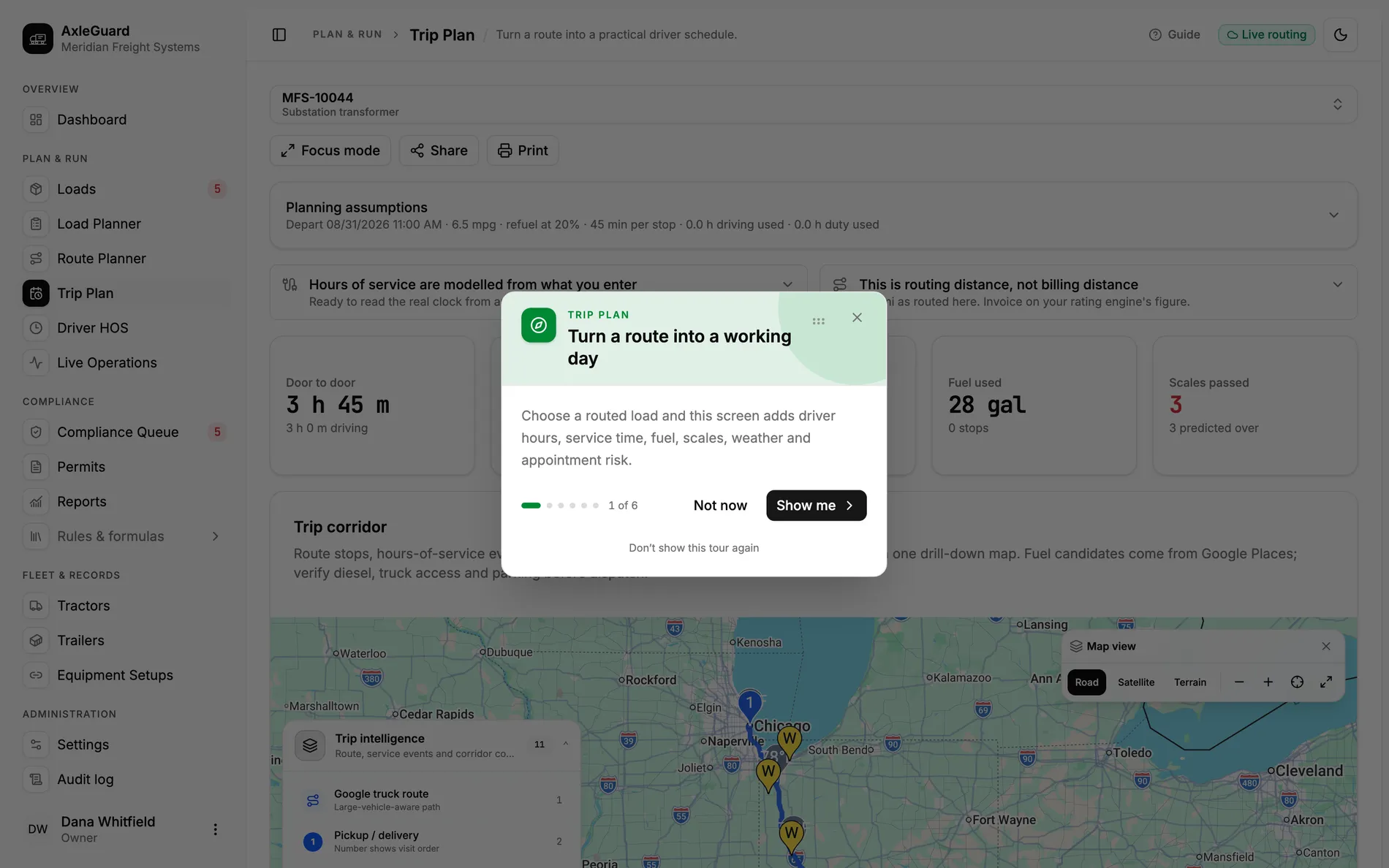
Driving hours, duty window, break placement, fuel stops and predicted weigh-station encounters on a single timeline.

What changes

Three outcomes that matter in the operation.

Each outcome connects what the software does to the decision a planner, loader or driver can actually make.

01

The plan the dispatcher builds is the plan the log accepts

The driver's clock is planned the way it really runs: 11 hours of driving, inside a 14-hour duty window that keeps counting whether the truck moves or not, with a 30-minute break after 8 cumulative hours of driving.

Why this is different

Most planning treats the duty window as something that pauses for lunch or a long wait at a dock. It does not pause. A plan built on that assumption looks fine on paper and gets refused by the log at four in the afternoon, on the shoulder.

A run that needs ten and a half hours of driving

Driving time is not the problem: ten and a half hours sits inside the 11-hour limit. Add a four-hour wait at the pickup and the mandatory 30-minute break, and the day needs fifteen hours of window against the fourteen that exist. The driver runs out about an hour short of the consignee. Planned honestly, that hour becomes a night halt arranged the evening before.

02

The scale 400 miles out stops being the one that catches you

Fuel is followed along the route, and the axle verdict is worked out again at departure, at the midpoint and at arrival — not once in the yard and never again.

Why this is different

Fuel weight sits on the tractor and changes all day. A load that is legal leaving the yard can be over after a fill, and a check done once at the dock has no way of knowing that.

A fuel stop at the halfway point

The truck leaves on half tanks and reads 33,600 lb on the drives — 400 lb of room. Two hundred miles later it takes on 150 gallons, about 1,050 lb, and the tanks sit ahead of the drive axles, so roughly 700 lb of it lands there. The drives now read 34,300 lb. The weigh station is thirty miles past the truck stop.

03

You know which scale you will hit, and whether you will pass

Weigh stations along the corridor are placed on the timeline, each with a time you will reach it and the axle verdict as it will stand at that moment.

Why this is different

Scale locations are normally a static layer on a map with no connection to the load. Knowing a scale is there is not the same as knowing you will be over when you get to it.

Two scales, and only the second one matters

The first is forty miles out, before the second pickup, with the truck at 61,000 lb gross and room on every group. The second is 210 miles out, after the pickup, with the drives at 35,100 lb. Both are on the timeline, and the second one is red at 2:40 in the afternoon — while the freight is still on the dock.

04

One page says whether this run can be done today, legally

Weather along the corridor and the night halt the hours force sit on the same timeline as the driving, the break and the fuel stop.

Why this is different

Weather is normally a separate tab and a separate decision, made by someone who cannot see the driver's clock. The two get reconciled by telephone, late in the day.

Snow on a mountain grade at hour nine

The driver has two hours of driving left and three hours of window. The grade is forecast to turn bad from mid-afternoon. On one timeline it is obvious the halt belongs before the grade rather than after it, and the appointment at the far end is the thing that has to move. That is a conversation for nine in the morning, not four in the afternoon.

How it works

From input to answer.

The logic is visible. There is no “AI decided” step between the load and the verdict.

Important boundary

Trip Plan uses US property-carrying assumptions for planning. It is not the driver’s legal HOS log; the separate HOS record workflow remains development-gated and is not yet an FMCSA-registered ELD.

  1. 01

    Start from the route

    Legs, distances and durations come from the planned truck route.

  2. 02

    Lay the clock over it

    Driving time accumulates against the 11-hour limit; the 14-hour window runs regardless.

  3. 03

    Place the stops

    The 30-minute break, fuel stops, weigh stations, and any night halt the hours force.

  4. 04

    Re-check the axles at each

    Fuel level and freight aboard change, so the verdict is recomputed at every point on the timeline.

Where to test it

Hard cases worth checking.

  • A run that cannot be completed legally in one shift, and the halt that fixes it.
  • A fuel stop that pushes the steer axle over.
  • A weigh station reached inside the 30-minute break window.
  • Delivery windows that the hours of service cannot meet.