Skip to content
AxleGuard
Demo

Compliance

Gross weight is one number. Enforcement is five.

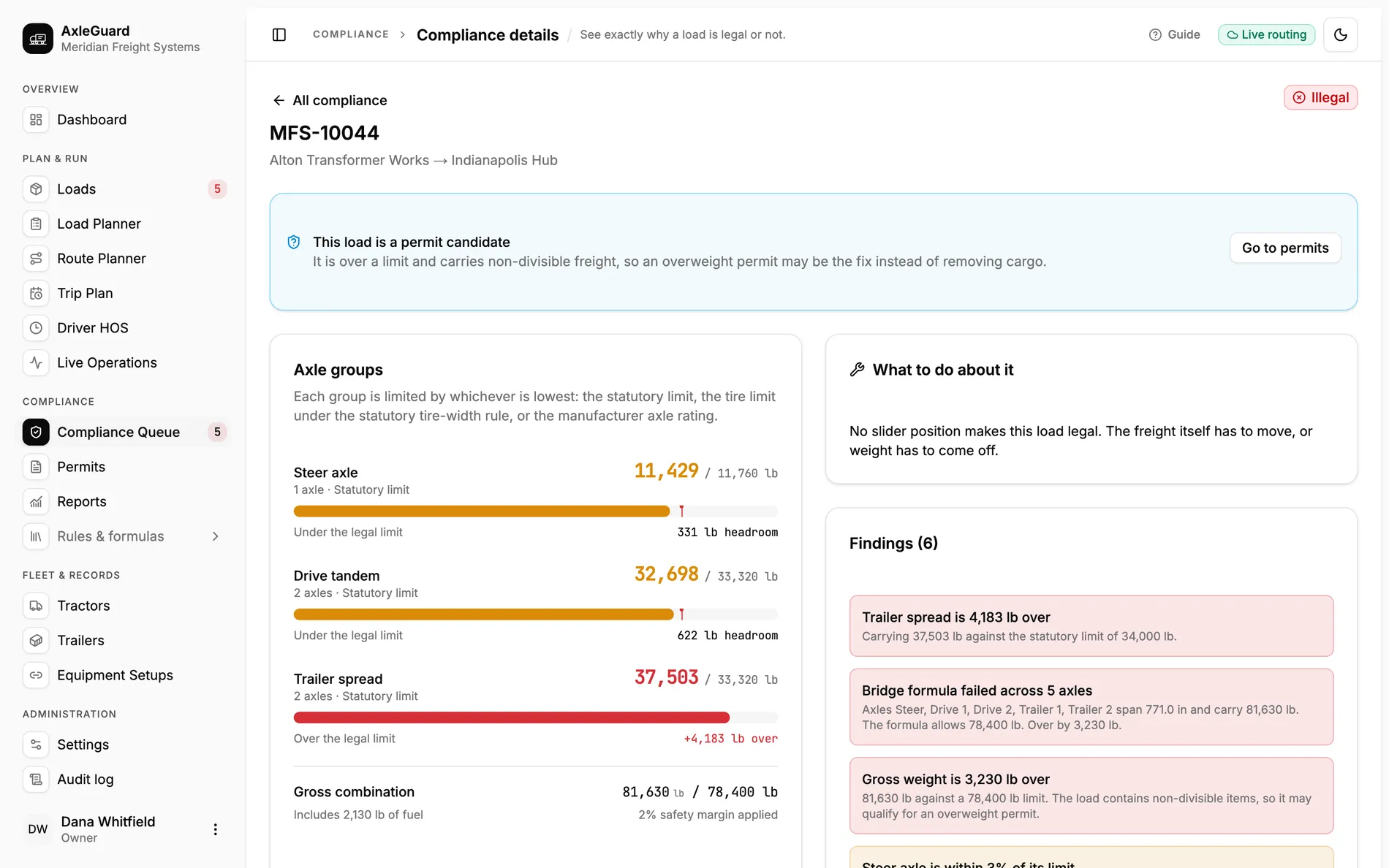
A truck can be perfectly legal at 80,000 lb gross and still be fined at the scale, because the freight sits too far forward and the drive axles carry more than 34,000 lb. AxleGuard solves the statics — trailer about the kingpin, kingpin onto the tractor, tractor about the steer axle — and returns a reading for every axle group.

Axle groups solved
5
steer, drive tandem, trailer tandem, plus any lift or spread
Limits per axle
3
statutory, tire, manufacturer rating
Engine unit tests
76
the physics is tested before anything renders

In the product

The screen where this work happens.

Open AxleGuard
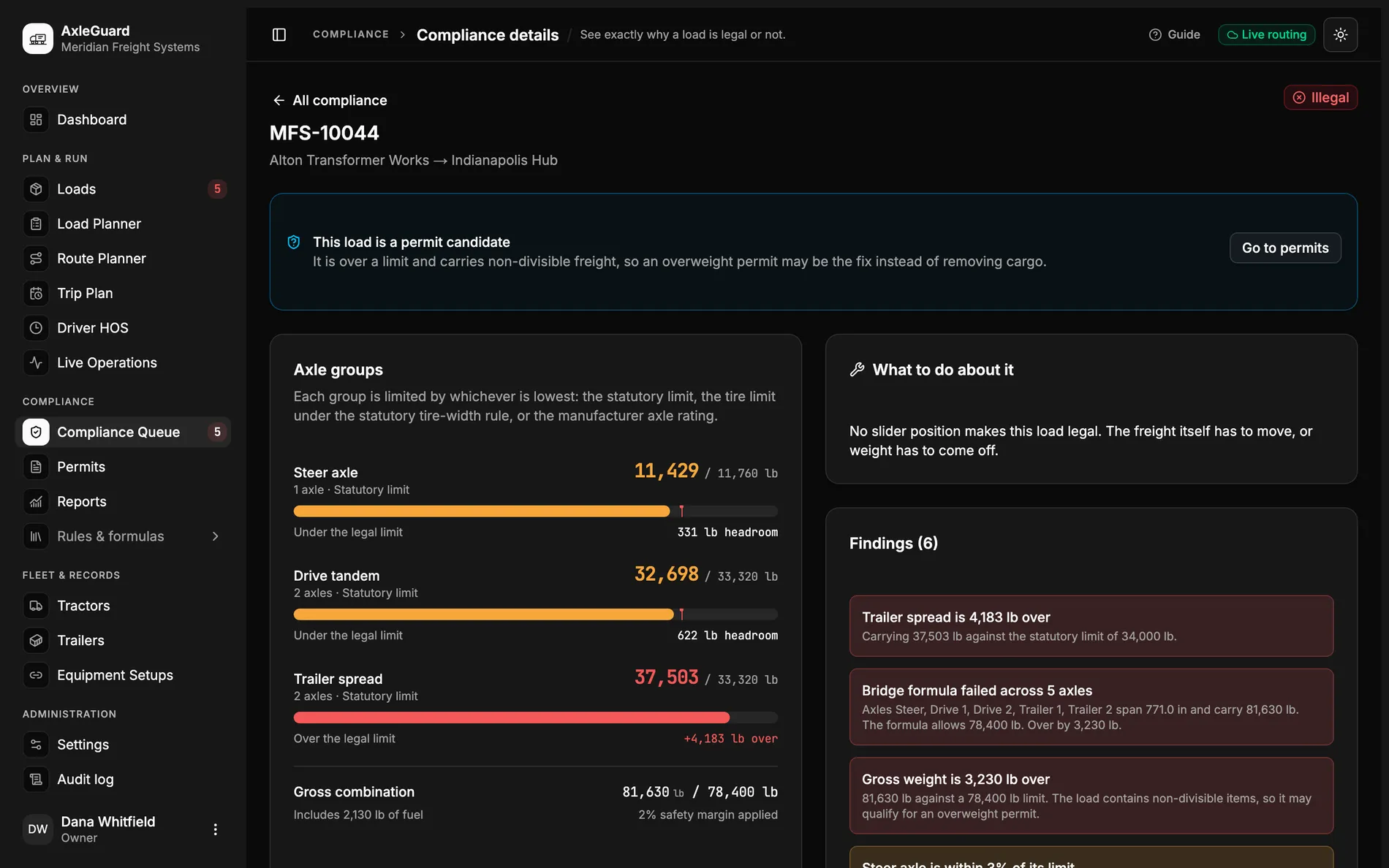
A live compliance read-out: steer, drive and trailer groups with their margin to the limit, and the binding rule named on each.

What changes

Three outcomes that matter in the operation.

Each outcome connects what the software does to the decision a planner, loader or driver can actually make.

01

You catch the overweight while moving a pallet is still free

Tell it what freight is going on the trailer and where each piece sits, and you get a weight back for every axle group on the combination — steer, drives, trailer tandem — before anything is loaded.

Why this is different

Gross weight is the only number most systems carry. The usual way to find out about the rest is a scale ticket after the trailer is sealed, or a driver's judgement from the feel of the truck. By then the fix is a re-load, not a nudge.

A 46,000 lb paper load built nose-first

Tractor 17,500 lb, trailer 14,500 lb, freight 46,000 lb. That is 78,000 lb gross, comfortably under 80,000, and it would pass any check that stops at the gross. But the pallets start at the nose, so the drives read 35,200 lb against a 34,000 lb limit. On the dock that is five holes on the tandem slider. At the scale it is a citation and a trailer that has to come apart.

02

You know your real ceiling before the load is built on it

Every axle is measured against three ceilings at once: the legal limit, what the tires can carry at 600 lb per inch of tread width, and what the axle itself is rated for. The lowest of the three is the one you are told about.

Why this is different

A printed limit table only carries the statutory number. It will call a load legal that your own tires are not allowed to carry, and the officer at the scale reads the sidewall, not the table.

A single axle the statute allows 20,000 lb on

The rule book says 20,000 lb on a single axle. That axle runs four tires with 7.5 inches of tread each, and the tire rating is 600 lb per inch: 4 × 7.5 × 600 = 18,000 lb. So 18,000 lb is the real ceiling, not 20,000. A load built to the number in the book is 2,000 lb over on rubber, and nothing on a statutory table would ever say so.

03

The answer comes back as an instruction the loader can follow

When a load fails you are not left holding the failure. You get the correction in the units the yard works in: slide the trailer tandems forward five holes, or the fifth wheel forward two.

Why this is different

A red ILLEGAL banner tells a loader nothing they can do. What normally follows is a phone call to a planner who has gone home, and a sealed trailer sitting on the dock until morning.

1,200 lb over on the drives, ten minutes before the driver arrives

The trailer tandem slides in 6-inch holes, and on this combination each hole moves about 250 lb between the tandem and the drive axles. Five holes forward takes roughly 1,250 lb off the drives and puts it on the trailer group, which had 3,000 lb of room. The loader pulls the pin, rolls the trailer, and the load leaves on time.

How it works

From input to answer.

The logic is visible. There is no “AI decided” step between the load and the verdict.

Important boundary

The engine models a tractor-semitrailer. B-trains, doubles and self-steering multi-axle trailers are modelled in the data schema but not yet in the solver.

  1. 01

    Solve the trailer

    The trailer is a beam supported at the kingpin and the trailer axles. Every cargo item contributes a moment about the kingpin.

  2. 02

    Hand the kingpin load to the tractor

    The kingpin reaction becomes a downward point load on the tractor at the fifth-wheel position.

  3. 03

    Solve the tractor

    The tractor is a beam supported at the steer axle and the drive group, carrying its own tare, its fuel, and the kingpin load.

  4. 04

    Apply the layered limits

    Each group is checked against statute, tire rating and axle rating. The verdict names which one bound, and by how much.

Where to test it

Hard cases worth checking.

  • Legal on gross weight and illegal on the drive tandem at the same time.
  • Tire rating binding below the statutory axle limit.
  • A heavy nose load pushing the steer axle over 12,000 lb.
  • A negative kingpin reaction — a load that is physically impossible as described.
  • Bobtail and empty-trailer states, which are still weighed.