Skip to content
AxleGuard
Demo

Operations

See the run without pretending the demo is a sensor.

AxleGuard replays route position, operating events and derived axle signals through the same normalized ingest contract a commissioned physical gateway uses. The audited workspace is explicit about its source: the current samples are derived, not measured on a truck.

Current sample source
Derived
clearly labelled in the audited workspace
Physical path
Commissioned
device credential, certified reference and approval
Event types
6
geofence, scale approach, braking, rollover, overweight, offline

In the product

The screen where this work happens.

Open AxleGuard
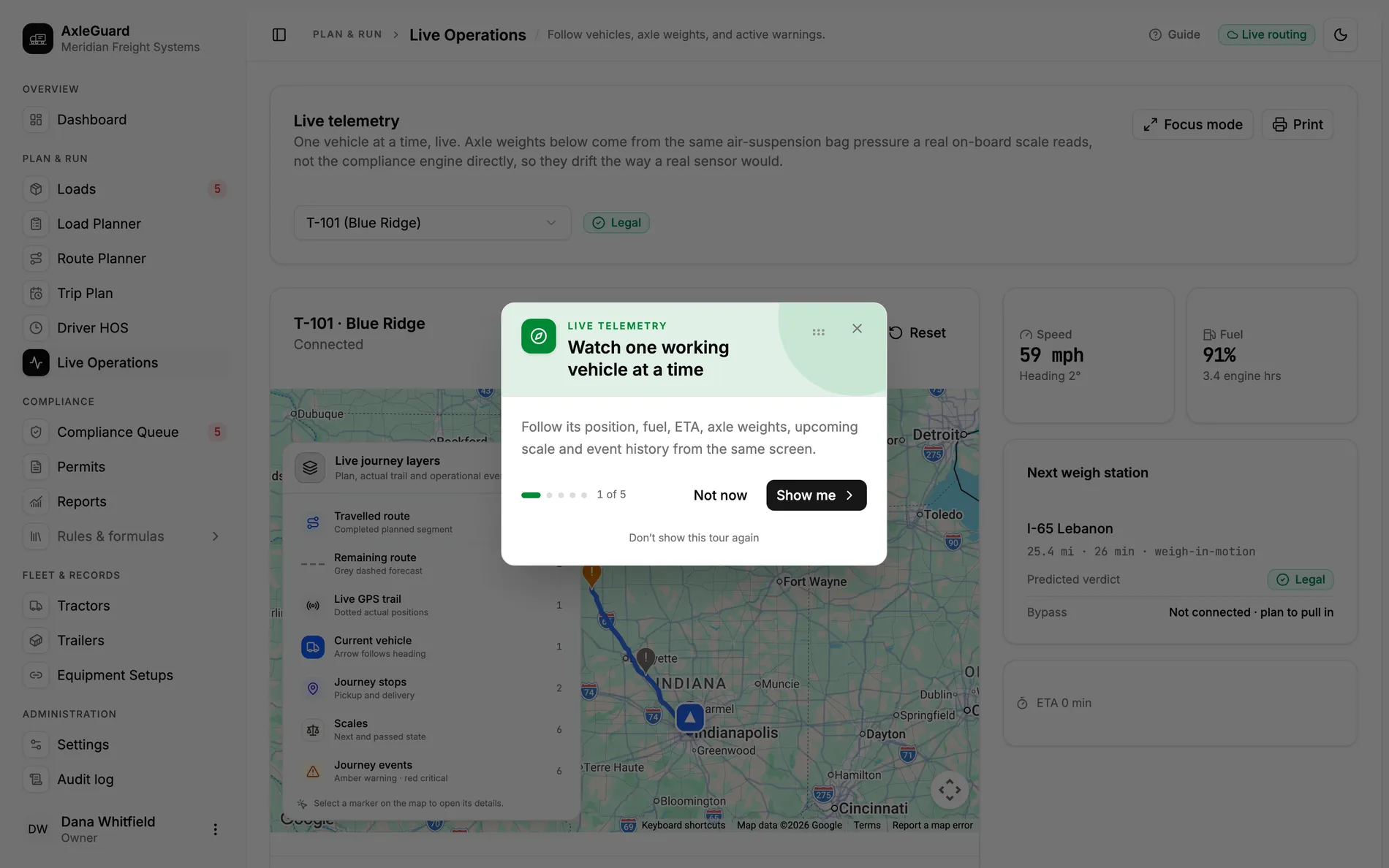
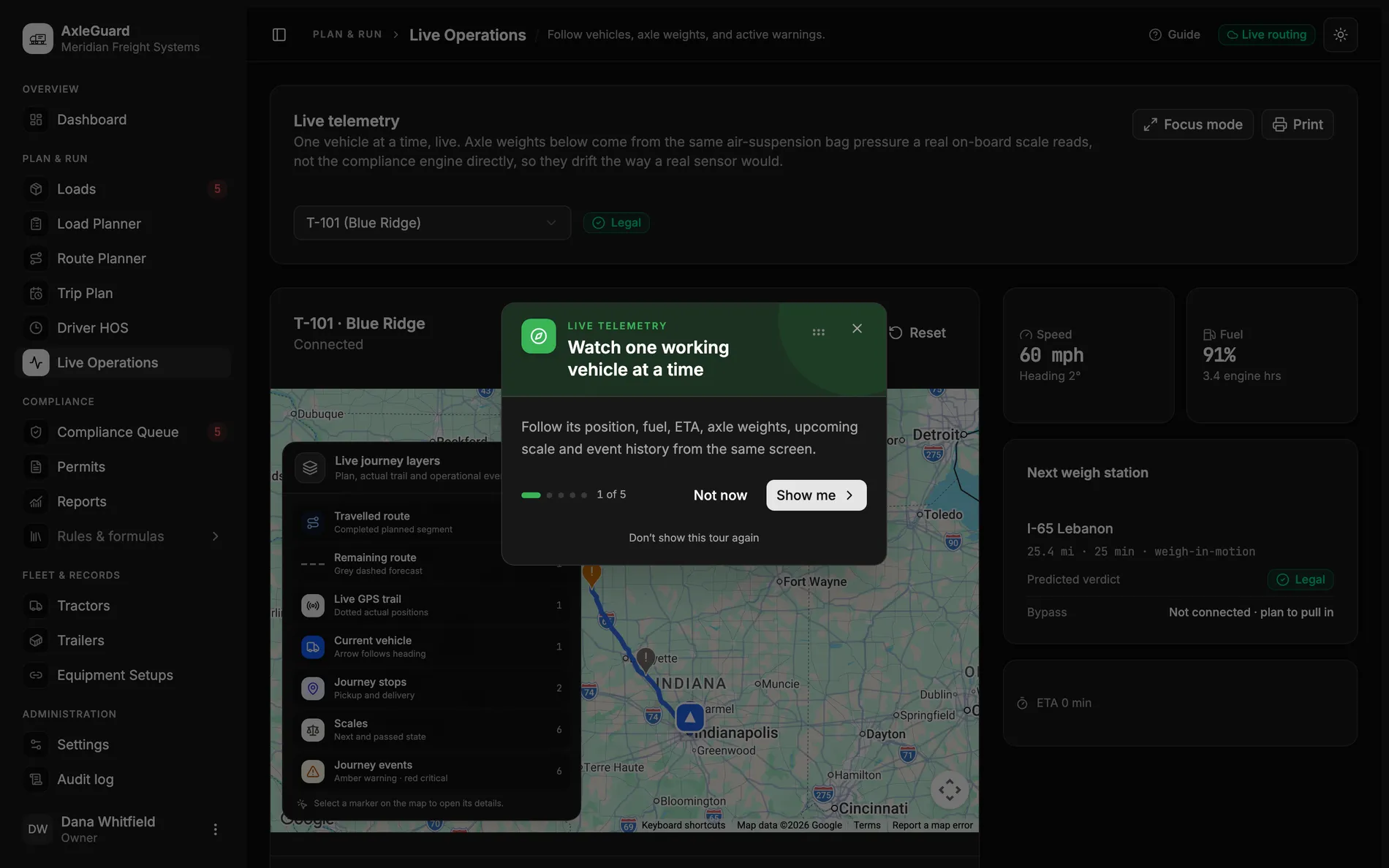
Live Operations with the travelled route, current position, remaining road, derived axle signals and event playback controls.

What changes

Three outcomes that matter in the operation.

Each outcome connects what the software does to the decision a planner, loader or driver can actually make.

01

The run can be tested before hardware is approved

Derived samples move through the real ingest, stream, map and event surfaces. They exercise the software path without being labelled as physical measurements.

Why this is different

A separate demo path proves very little about the deployment path. Reusing the normalized contract exposes integration problems before a gateway reaches a truck.

A derived replay crosses a configured limit

The replay moves a drive-tandem signal from 33,200 lb to 34,400 lb while the map and event stream continue. It proves the alert and review flow. It does not claim the value came from suspension hardware.

02

You see how the truck got there, not just where it is

The map separates the road already travelled, current position and the route still to come. A recorded run can be replayed at a selected speed.

Why this is different

An arrow with no trail behind it answers one question and raises three. The usual way to find out about an unplanned two-hour stop is to ask the driver, tomorrow.

Ninety minutes that are not on the plan

The trail shows the truck left the corridor at 11:20, sat for an hour and forty minutes, and rejoined. Nobody has to accuse anyone of anything. The dispatcher can see it happened, ask what it was, and move the delivery window before the consignee is the one making the call.

03

The alert that reaches a person is one that needed a person

Operational events can distinguish threshold crossings, rollover review, scale approach, harsh braking, geofence changes and an offline vehicle.

Why this is different

A raw tracking feed produces thousands of events a day, and the two that mattered are somewhere in the middle of them. What happens next is that people stop reading it at all.

Six hundred events in a shift, and two phone calls

The event stream can group a configured axle threshold and the next scale approach on the same vehicle. With derived data this tests the workflow; with approved physical data it becomes an operating signal.

04

Physical data stays gated until the truck passes validation

A registered gateway can use the normalized hardware contract only after device credentials and physical validation evidence are recorded for that truck.

Why this is different

Connectivity is not accuracy. The commissioning gate compares group readings with a certified reference and checks repeatability before owner approval.

A gateway posts successfully and still remains unapproved

The message reaches the server and passes the ingest schema. The truck stays unvalidated until empty and loaded comparisons meet the agreed error and repeatability thresholds.

How it works

From input to answer.

The logic is visible. There is no “AI decided” step between the load and the verdict.

Important boundary

The audited workspace uses derived samples and has no approved physical gateway. Physical axle readings require a commissioned device and remain planning signals rather than legal-for-trade scale certification.

  1. 01

    Choose the source

    Replay uses derived samples; a physical source starts from a registered truck gateway.

  2. 02

    Normalize the sample

    Position, vehicle identity and supported signals enter through one versioned ingest contract.

  3. 03

    Keep physical data gated

    A device remains unapproved until certified-reference and repeatability checks pass.

  4. 04

    The journey is drawn

    Travelled path, current position and remaining route render as three distinct states on the map.

Where to test it

Hard cases worth checking.

  • A vehicle that goes offline mid-route, and the gap it leaves in the trail.
  • A derived axle signal crossing a configured threshold during replay.
  • Approach to a weigh station while over on an axle.
  • Replay of a completed trip at speed, for an incident review.