Skip to content
AxleGuard
Demo

Routing

A route is only a route if the truck can legally drive it.

Car directions send an 80,000 lb combination under a 12-foot bridge. Truck directions do not. But even a truck-legal road does not tell you whether your load will pass the scale sitting on it. AxleGuard plans the road around the height, length, width and weight of the actual combination, then checks every leg of it against the freight that is aboard for that leg.

Checked per route
Every leg
not just the origin and the destination
Planned around
Height, length, width, weight
of the real combination, not a generic truck
Provider exception
Surfaced
partially ignored restrictions require manual review

In the product

The screen where this work happens.

Open AxleGuard
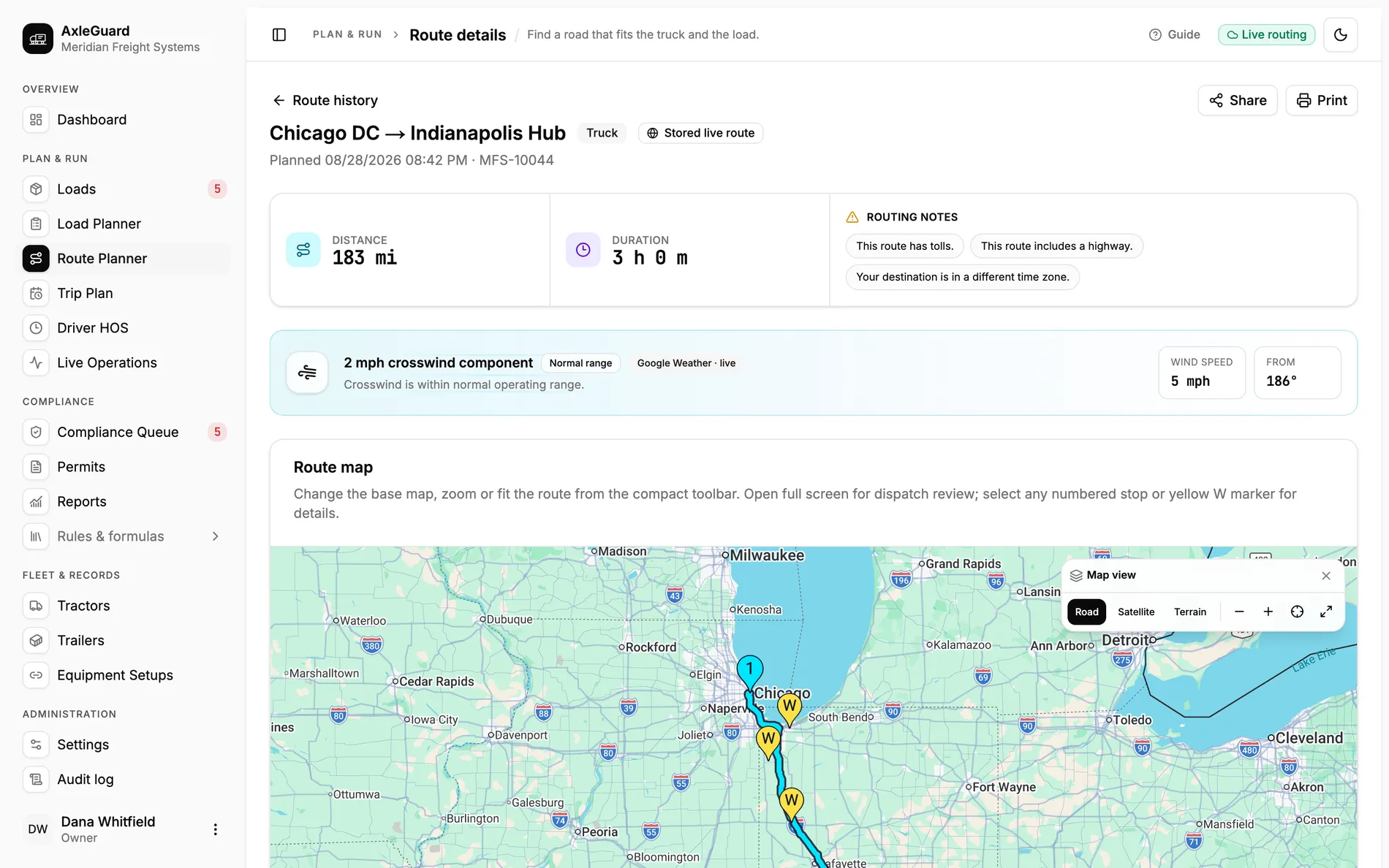
A planned route with the compliance verdict for every leg underneath it, not just a line on a map.

What changes

Three outcomes that matter in the operation.

Each outcome connects what the software does to the decision a planner, loader or driver can actually make.

01

The road and the load are checked together, not separately

The road is planned around the height, length, width and weight of the combination you are actually running. Then every leg of that road is checked against the freight aboard for that leg.

Why this is different

Truck navigation stops at the road. It has no idea how your weight sits across the axles, so it will happily route you onto a corridor where you fail the scale. Today those are two questions, answered by two people, usually on the phone.

A three-stop run that goes illegal at stop two

The truck leaves the yard at 61,000 lb gross with the drives at 31,400 lb, and every road on the plan is truck-legal. At stop two it picks up 14,000 lb of steel, loaded forward of the tandems, and the drives read 35,100 lb — 1,100 lb over — for the whole leg to stop three. The road was legal the entire time. The load was not.

02

When restrictions were relaxed, the route cannot look clean

When the provider returns a best-effort route with restrictions partially ignored, AxleGuard places a manual-verification warning above the road and preserves the technical response.

Why this is different

A line on a map can look authoritative after the provider has made a compromise. The warning keeps that road out of the clean dispatch queue until a person reviews it.

A 13 ft 6 in trailer into a town with one 12 ft underpass

The provider returns a route but reports that truck restrictions were partially ignored. The response does not name the exact segment, so the screen requires manual review of clearances, restricted roads and permit conditions before dispatch.

03

The run is planned the way it is actually driven

Stops go in sequence on a single run: several cities, pickups and drops mixed together, a night halt in the middle. The compliance verdict follows the freight from leg to leg.

Why this is different

Point-to-point tools turn a five-stop milk run into five separate trips, each checked on its own. Nobody checks the middle of the day, which is exactly where the truck is heaviest.

Two drops and three pickups on one board

The truck is lightest at the last drop and heaviest between pickup two and pickup three. Planned as five separate trips, every one of them passes. Planned as one run, leg four comes back 900 lb over on the drives, and it gets fixed with a slider the evening before rather than at a scale house.

How it works

From input to answer.

The logic is visible. There is no “AI decided” step between the load and the verdict.

Important boundary

Toll cost and fuel-optimal routing are not modelled, and neither is optimising one road across a whole fleet at once. Those are on the roadmap, not in the product.

  1. 01

    Take the real equipment

    Height, length, width and weight come from the tractor and trailer on file, not from a generic truck profile.

  2. 02

    Plan the road

    Stops in sequence, around low bridges, weight-restricted roads and vehicle prohibitions.

  3. 03

    Surface the provider exception

    A best-effort result with partially ignored restrictions is marked for manual verification.

  4. 04

    Re-solve every leg

    Freight aboard changes at every stop, so the axle verdict is recomputed for each leg. A run can be legal at leg one and illegal at leg three.

Where to test it

Hard cases worth checking.

  • A best-effort road returned without the exact relaxed segment identified.
  • No legal road exists for this combination at all.
  • A run that crosses two jurisdictions with different limits on the same leg.
  • A milk run that goes illegal at stop three, because that is where the freight was picked up.