Skip to content
AxleGuard
Demo

Operations

You cannot solve the axles without knowing the truck.

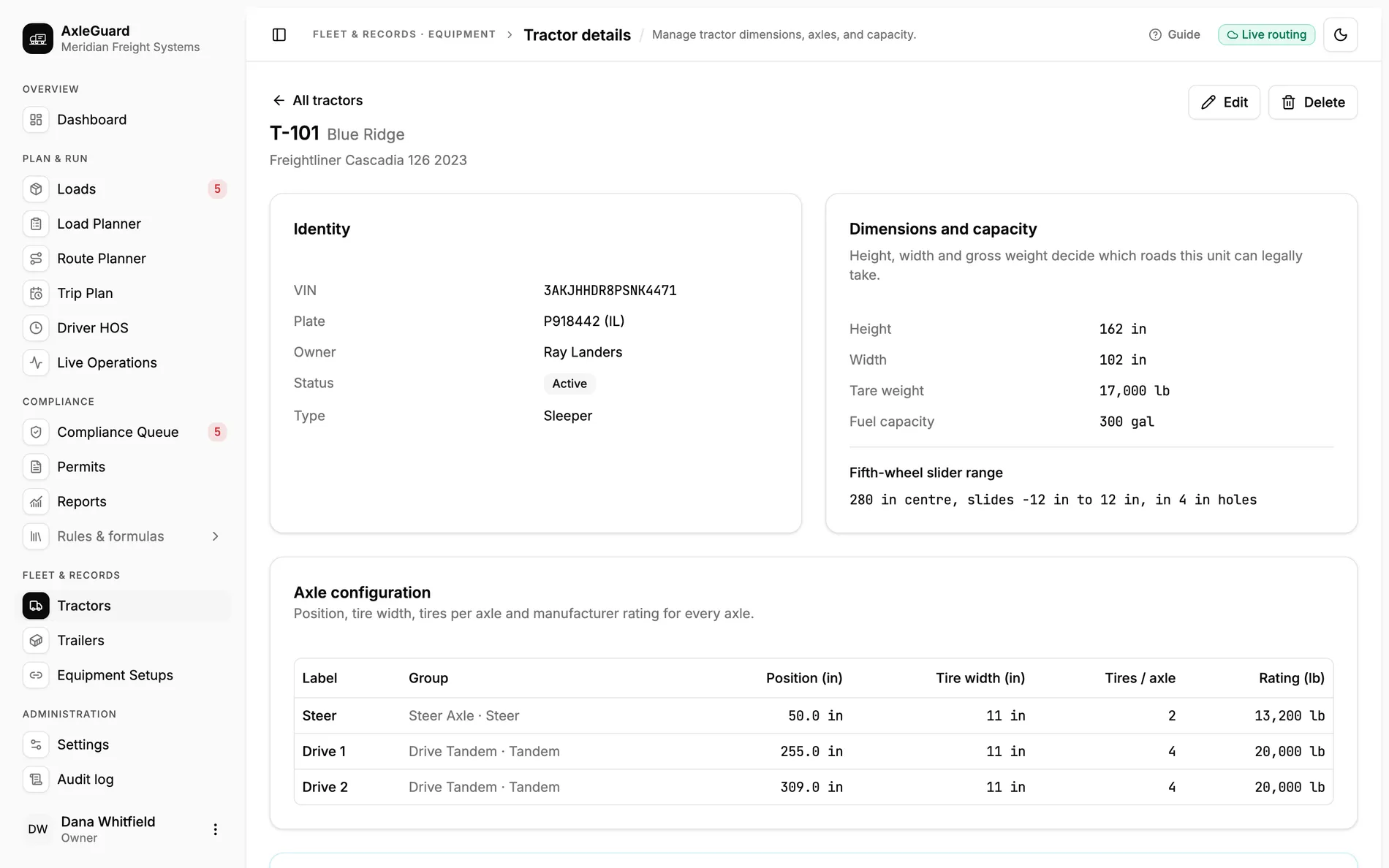
Every compliance answer depends on geometry that most fleet systems never record: where each axle sits, what its tires are rated for, how far the fifth wheel can slide, how many holes the trailer tandem has. AxleGuard stores that properly, per unit, and pairs tractors with trailers into saved combinations.

Per-axle fields
8
position, group, tare, max, tires, width, rating, index
Slider model
Holes + inches
trailer tandem and fifth wheel
Ownership
1 user → many vehicles
with roles enforced on the API

In the product

The screen where this work happens.

Open AxleGuard
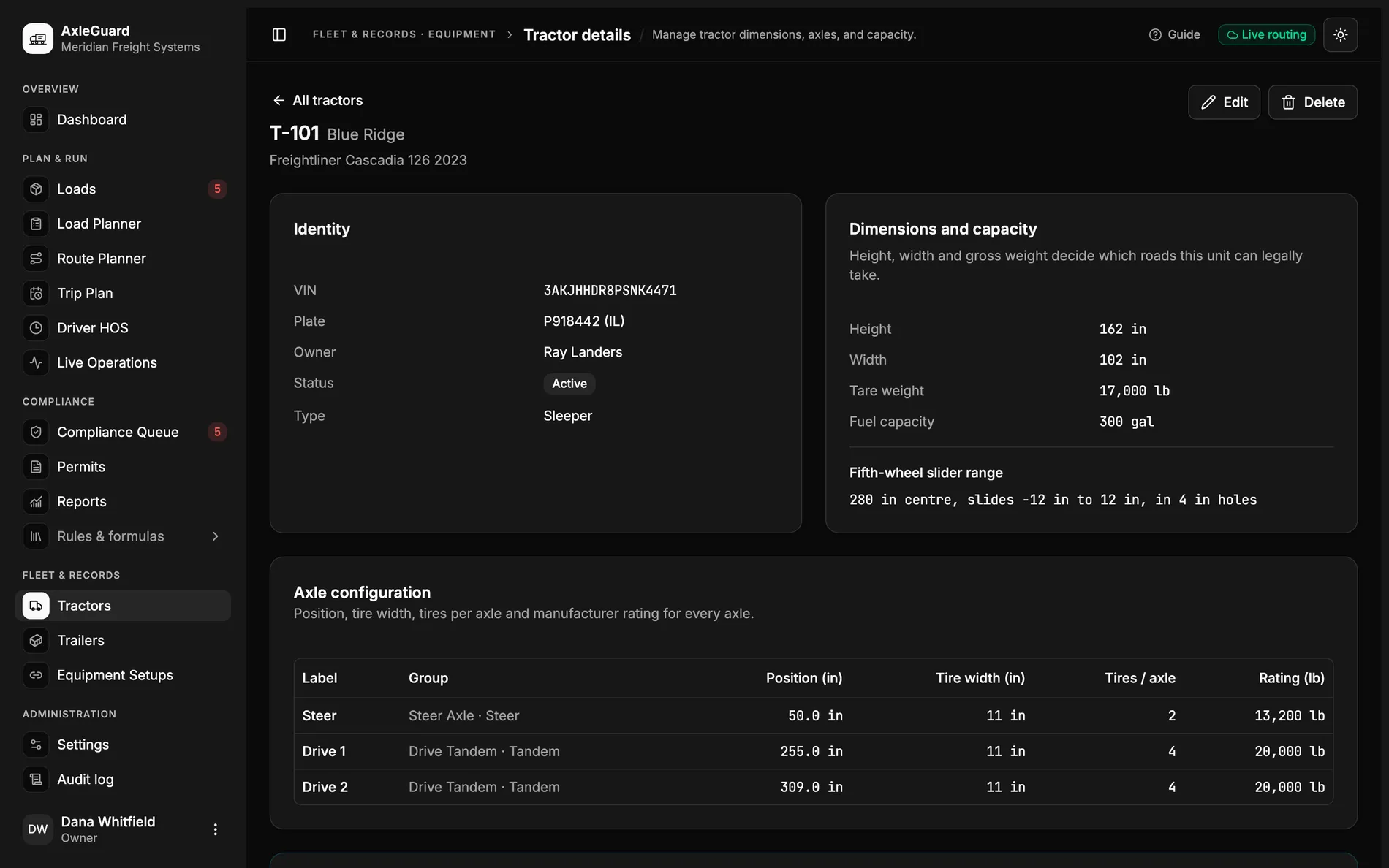
A tractor with its axle positions, tare distribution, tire ratings and fifth-wheel travel — the inputs the solver runs on.

What changes

Three outcomes that matter in the operation.

Each outcome connects what the software does to the decision a planner, loader or driver can actually make.

01

The answer is about your truck, not a truck like yours

Each axle has its own record. It stores the axle position, group, empty-weight share and legal maximum. It also stores tire count, tread width and tire rating.

Why this is different

Most fleet systems store 'tractor, three axles' and a tare weight. That is enough to bill from and nowhere near enough to work out where the weight actually lands.

Two tractors, same model, different answers

One has a 245-inch wheelbase, the other 220. Same trailer, same freight, same placement — and the shorter tractor puts around 900 lb more on its drive axles, because the fifth wheel sits closer to them. A generic truck profile gives both units the same verdict, and one of those verdicts is wrong.

02

The correction reads in holes, because that is what the slider has

Slider travel is stored the way the equipment is built: the hole spacing, and how far forward and back it can actually go — for the trailer tandem and for the fifth wheel.

Why this is different

Advice in inches is not something a loader can act on. Trailer tandems move in 6-inch holes, so 'forward 14 inches' has to be translated by somebody standing in the cold, and translation in a hurry is where mistakes come from.

1,000 lb over, and only three holes left

The fix needs four holes forward on the trailer tandem, at roughly 250 lb a hole. The slider is already three holes from its forward stop, so the fourth does not exist. Knowing that on the dock means the freight moves instead — rather than the loader sliding it, checking, and sliding it again.

03

Pick one thing, and the geometry is right by construction

Tractors and trailers are paired into named combinations that carry their fifth-wheel setting, so a planner chooses a combination rather than assembling one from scratch on every load.

Why this is different

Re-picking equipment on each load is where a wrong tare weight gets in, and a wrong tare weight is a wrong answer on every axle underneath it.

T-101 plus DV-4412

The saved combination is a 17,600 lb tractor and a 14,300 lb trailer with the fifth wheel where it normally runs: 31,900 lb before any freight. Assembled by hand under pressure it becomes 32,000, or 30,000, or last week's trailer. At 30,000 the load looks 1,900 lb lighter than it is, and every axle number below inherits the error.

How it works

From input to answer.

The logic is visible. There is no “AI decided” step between the load and the verdict.

Important boundary

Tractor-semitrailer configurations. Multi-trailer and self-steer configurations are in the schema but not yet in the solver.

  1. 01

    Add the tractor

    Unit number, VIN, plate, make, model, type, tare weight and the position of its centre of gravity.

  2. 02

    Lay out the axles

    Each axle placed in millimetres from the front, with its tire specification and rating.

  3. 03

    Add the trailer

    Length, kingpin offset, tare, and the slider's hole spacing and travel limits.

  4. 04

    Save the combination

    Tractor plus trailer plus fifth-wheel setting, ready to attach to a load.

Where to test it

Hard cases worth checking.

  • A tractor whose centre of gravity puts 11,200 lb on the steer axle while bobtail.
  • A trailer whose slider is already at its physical limit, so no fix exists.
  • Mixed tire ratings within one axle group.
  • Equipment retired mid-plan, with loads still referencing it.