Skip to content
AxleGuard
Demo

Platform

Connect the product without creating a second answer.

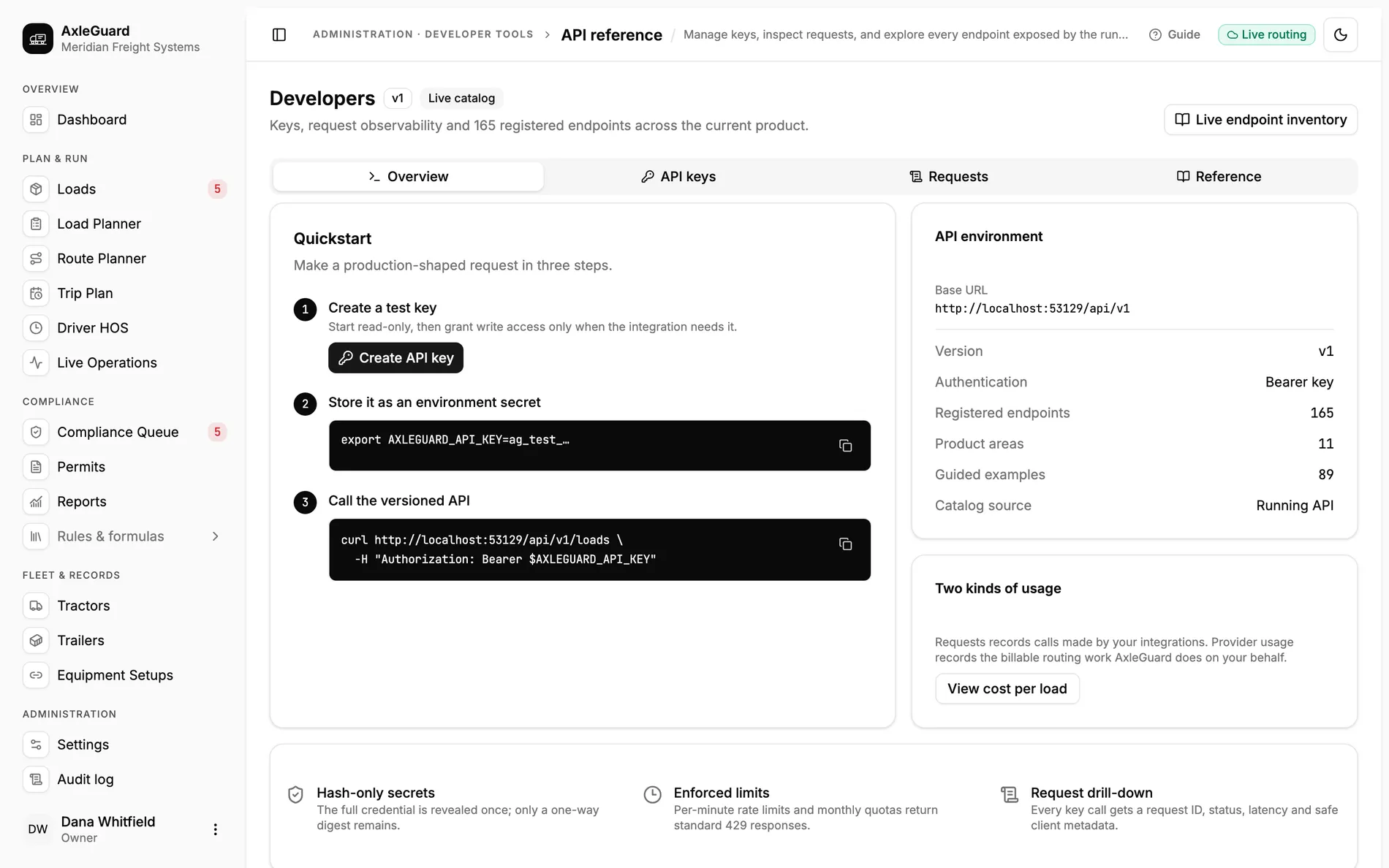
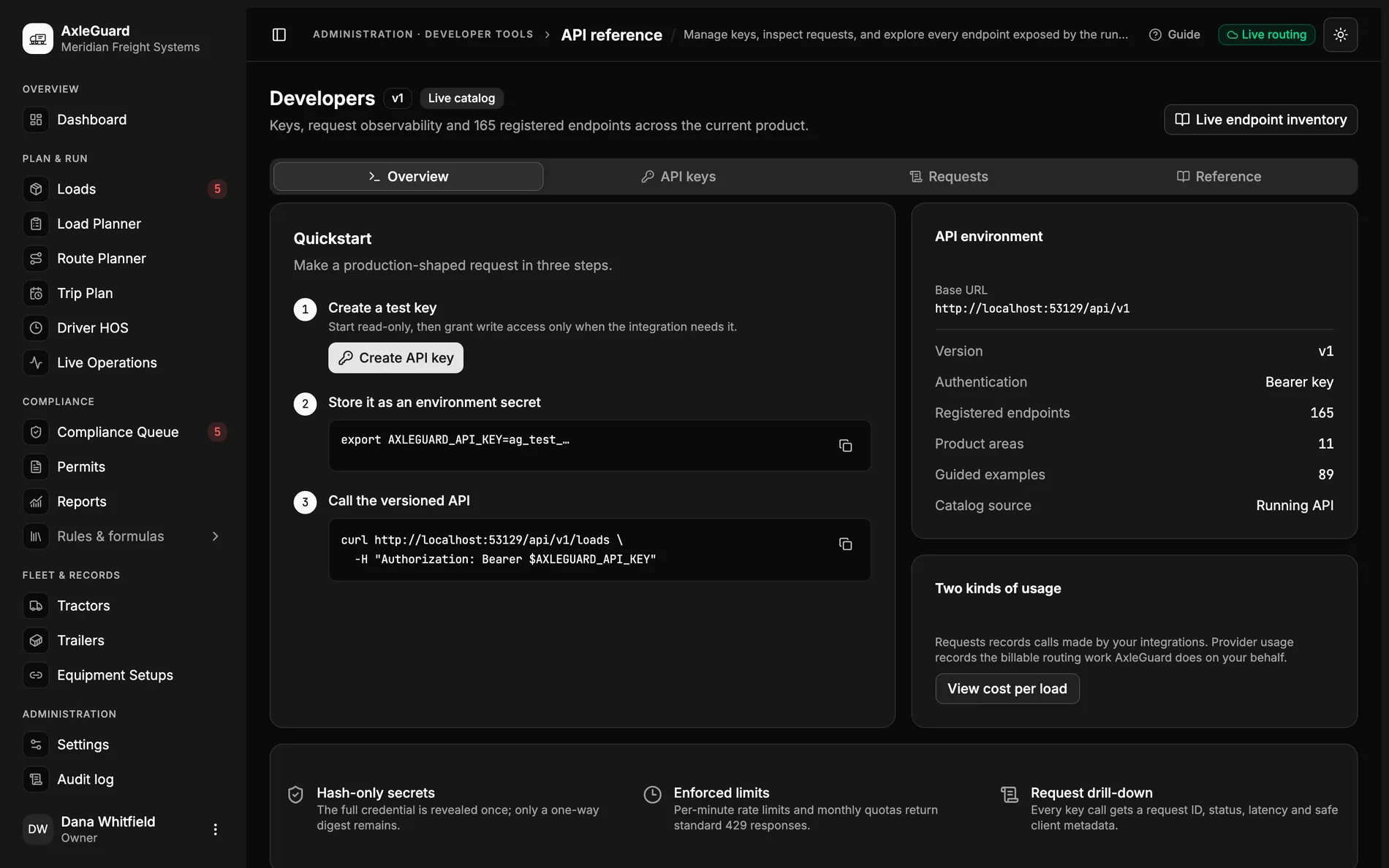
AxleGuard exposes the product through versioned Bearer access, a live operation catalog, request logs and enforced quotas. Loads, routes, rules, HOS records, hardware, provider connections and master data use the same records the signed-in workspace uses.

Registered operations
165
verified against the live catalog on August 29, 2026
Product areas
11
from loads and routing through HOS, hardware and audit
Secret storage
Hash only
the complete API credential is shown once

In the product

The screen where this work happens.

Open AxleGuard
The live API catalog with keys, scopes, rate limits, request evidence and every registered product area.

What changes

Three outcomes that matter in the operation.

Each outcome connects what the software does to the decision a planner, loader or driver can actually make.

01

There is one answer, so nobody has to pick which to believe

The rules live in one place, and the desk, the phone in the cab and the dispatch system you already run all read from that same place.

Why this is different

Most yards run a spreadsheet on the desk and a rule of thumb in the cab. The two agree until a load is close to a limit, which is exactly the moment they stop agreeing.

The desk says legal and the driver says no

The spreadsheet is working from a 34,000 lb drive tandem. The driver has run a 30,000 lb rule of thumb since a citation years ago. The load sits on the dock until somebody senior picks a side, and whoever picks is guessing. When both are reading the same record there is nothing left to pick.

02

When a state changes its limits, you are right that morning

A limit is changed once and applies everywhere immediately. There is nothing for anyone to install, download or reprint.

Why this is different

Rules baked into an app wait for the next version, and rules on a laminated card wait until somebody reprints the card. In between, part of the yard is working from the old number and does not know it.

The first of the month

A limit changes overnight. In the morning it is entered once, and every load planned that day on every screen is judged against the new figure. Done as a memo, a reprint and a round of phone calls, the same change takes about three weeks to reach everybody, and the loads planned in between are the exposure.

03

The fix happens where the freight is, in two minutes

The driver sees the same verdict on a phone that the planner saw on the desk, including the correction — which holes, which direction.

Why this is different

A verdict that never reaches the person holding the forklift changes nothing. The usual route is a phone call to the office, and the office closes before the last load goes out.

A 6:40 pm load with the drives 800 lb over

The planner has gone home. The driver opens the load on a phone, sees the drives at 34,800 lb and the instruction to slide the trailer tandem three holes forward, does it, and watches the number come back at 34,050 lb. Nothing waits until morning and nobody is woken up.

04

It fits the office you already have, so people keep using it

Anything you can do on the screen, the dispatch system you already run can do too. Loads arrive from it and status changes go back to it, so nothing is typed twice.

Why this is different

A compliance tool that sits beside the system of record becomes a second data-entry job. In a busy week the second job is the one that gets skipped, and a tool nobody enters loads into is not telling anyone anything.

Forty loads on a Monday

Entered into two systems, that is forty loads typed twice, and by mid-morning somebody is typing them into one. Arriving from the system that already holds them, the compliance answer is on all forty — including the eleven nobody would have found time to check.

How it works

From input to answer.

The logic is visible. There is no “AI decided” step between the load and the verdict.

Important boundary

The API surface is live, but a connection to a named TMS, ELD or customer backend still needs mapping, credentials, test cases and an agreed rollout scope.

  1. 01

    Create a scoped key

    Start read-only, then grant write access only where the integration needs it.

  2. 02

    Call the versioned API

    Use the same loads, routes, rules and operating records the workspace reads.

  3. 03

    Inspect every request

    Request ID, key, status, latency and safe client metadata remain searchable.

  4. 04

    Enforce the contract

    Rate limits and monthly quotas return standard responses rather than failing silently.

Where to test it

Hard cases worth checking.

  • A dispatch attempt on an over-limit load, refused by the system rather than hidden by the screen.
  • A read-only account that cannot change a limit, no matter how it asks.
  • A share link that lets a customer see one load without an account.
  • Two people editing the same load at once.