One real lane
A run you make often enough to have opinions about. Where it starts, where it ends, and which state lines it crosses. If it has a scale you dislike, mention it.
A lane you argue about beats a lane that always works.
Forty-five minutes
We do not demonstrate on a sample fleet. Your tractor and trailer go into AxleGuard on the call, your freight goes on the deck, and you watch the axles solve. If the answer disagrees with your process, we work through it together.
Book in this page
Choose any open forty-five minute slot in the calendar. The confirmation and meeting link arrive from Calendly; no separate form or back-and-forth is required.
Cannot find a suitable time? Send the lane details and we will reply with options.
Choose a time
What happens
It is the same shape every time, because it is the order that gets to a real answer fastest. If your questions take it somewhere else, that is fine — the last five minutes are the only part we insist on.
Nothing is staged
Two thirds of the call is your own freight on the screen. There is no deck, and no part of this is a recording.
You describe one run you actually make. Origin, destination, what rides on it, which states it crosses and what usually goes wrong on it. We do not open a deck.
We build your tractor and trailer on the call: axle positions, slider travel, tare distribution, tire ratings. You watch it happen and correct us where we have it wrong, which is the point.
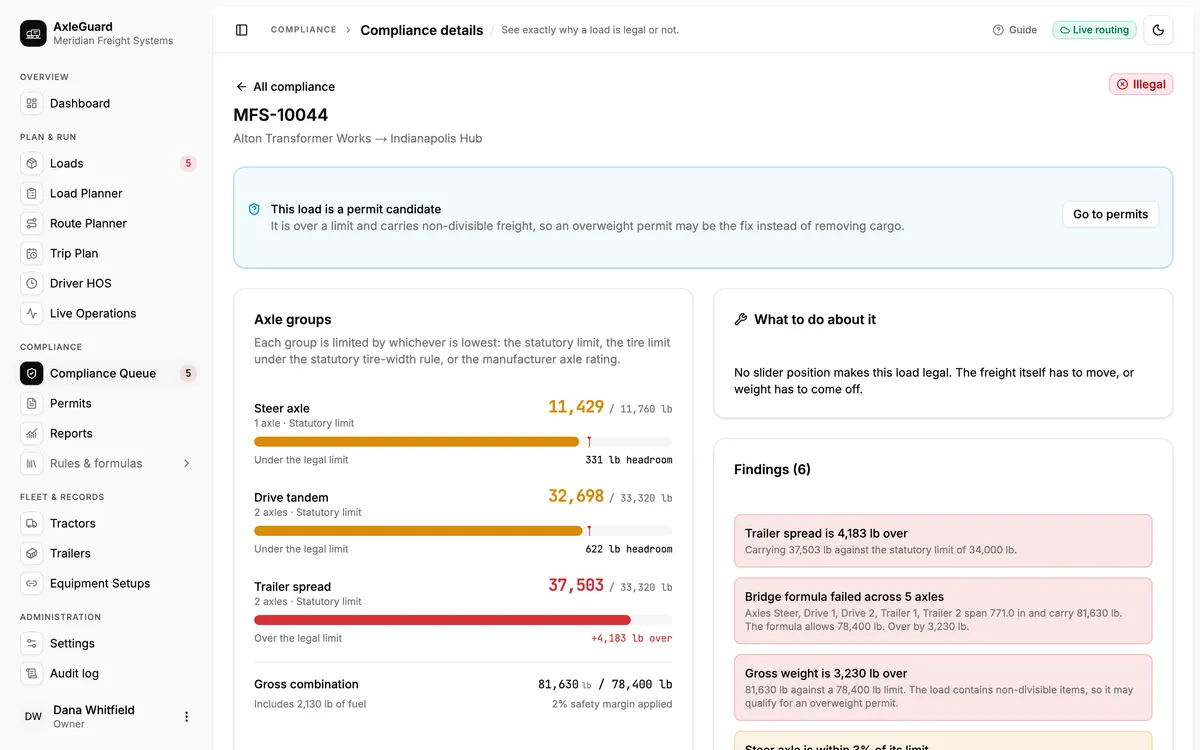
Your freight goes on the deck. Every axle reads out against the lowest limit that binds it, every consecutive axle group is checked, and if something is over you get the correction in holes and inches rather than a red banner.
The same load routed on a road the truck can legally take, re-checked at each stop as freight comes off, with fuel burn moving the steer axle over the distance. This is where most loads change verdict.
What a pilot on that lane would cost, what we would need from you, and an honest read on whether it is worth running. Sometimes the answer is that your yard already has this covered.
What to bring
A demo on invented equipment proves nothing. These three make the difference between watching software and finding out something about your own operation.
A run you make often enough to have opinions about. Where it starts, where it ends, and which state lines it crosses. If it has a scale you dislike, mention it.
A lane you argue about beats a lane that always works.
The make, the axle positions, how far the slider travels and how many holes it has, and what it weighs empty across its axles. A photo of the plate is usually enough to start.
This is the number that decides whether the answers are any good.
What went on it last time. Pallet weights, roughly where they sat, and whether the freight can be split. A bill of lading from last week is perfect.
Bring a load that got written up, if you have one.
What you will see
Not a feature tour. These are the eight moments that tend to change somebody's mind, and they all happen on the load you brought.
Bring the load that got written up. Explaining that one is the fastest way to find out whether any of this is worth your time.
What we will ask you
These decide whether a pilot is worth running. If the answers say your yard already handles this well, we will tell you that on the call.
How many loads a week go out where somebody is not completely sure
What happens today when a load comes back over at a scale
Who is allowed to overrule a planner, and how that decision gets recorded
Which system the load lives in before it reaches the dock
What a re-load actually costs you in crew, dock time and the missed window
Whether the person holding the forklift ever sees the plan
Who should be on it
The forgotten one is the person who knows where the axles actually sit. Without them the equipment data is a guess, and everything downstream of a guess is a guess.
The dispatcher or planner who builds the load today. If the tool does not fit the way they already work, nothing else on the call matters.
Safety, compliance or the operations manager who takes the call when a truck is out of service. They ask the questions that decide this.
A shop lead or a driver who can tell us where the axles actually sit on your trailers, rather than where the brochure says they sit.
Three is the useful number. If it has to be one person, make it the planner, and have them bring a photo of the trailer plate.
Ask for a slot
We reply within one business day, from a person, with two or three slots and a short note on what to have ready. Nothing here goes to a mailing list.
Would rather just write?sales@spaceotechnologies.com
Before you book
If your yard already has this covered, we would rather say so in the last five minutes than sell you a pilot.
Next step
That is everything we need to make this useful. The rest of the forty-five minutes is yours to spend on whatever you actually want to know.