The nearest neighbours we have, and the honest difference.
TruckScience, Load Xpert, MaxLoad Pro, Goodloading and EasyCargo all work on the problem we work on. This is the comparison worth arguing about, so it gets the fairest treatment on the site.
Five tools
15 capabilities checked
Public documentation, August 2026
What the category is for
Working out where the weight goes before anyone lifts anything.
Every product on this page exists because somebody understood that gross weight is not the number that matters. That is the right instinct and it is the same one we started from.
These tools split roughly into two families. One family calculates axle loads from a vehicle specification and a payload, and is aimed at people deciding how a vehicle should be built or configured. The other family packs cargo into a space efficiently, and is aimed at people deciding what goes on the trailer and in what order.
Both families are useful and the strongest products in each are very good. A dealer speccing a chassis, a forwarder filling a container, a planner sequencing a multi-drop trailer — all of them are better off with one of these than without.
What they have in common is that they are tools you open. Somebody decides this load is worth checking, opens the software, describes the load, reads the answer and closes it again. That works, and it works exactly as often as somebody decides a load is worth checking.
A desk tool checks the loads somebody decided were worth checking. The load that gets cited is the one nobody thought to open it for.
The load nobody checks
Almost nobody opens a calculator for a routine load on a familiar lane. That is the load that quietly goes over, because it is the one where the pallets were stacked differently and nobody had a reason to look.
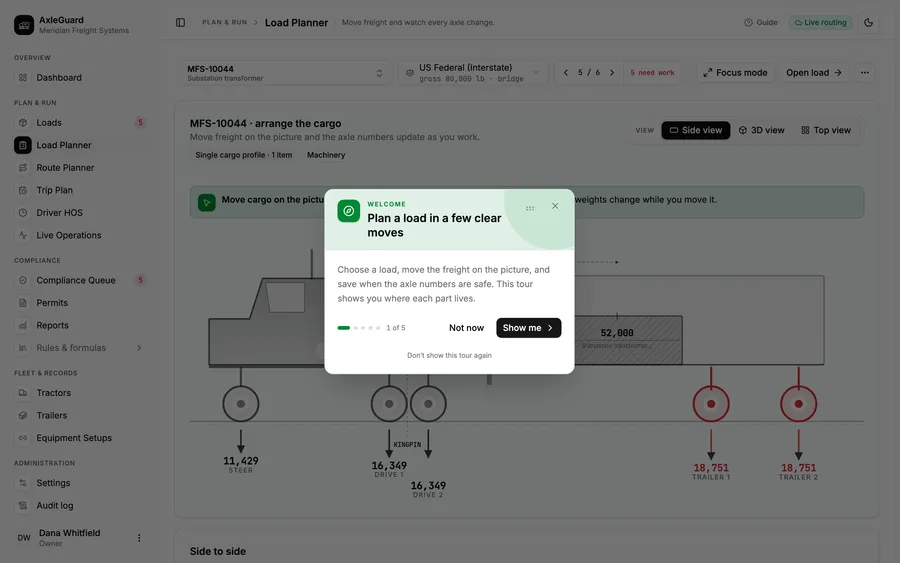
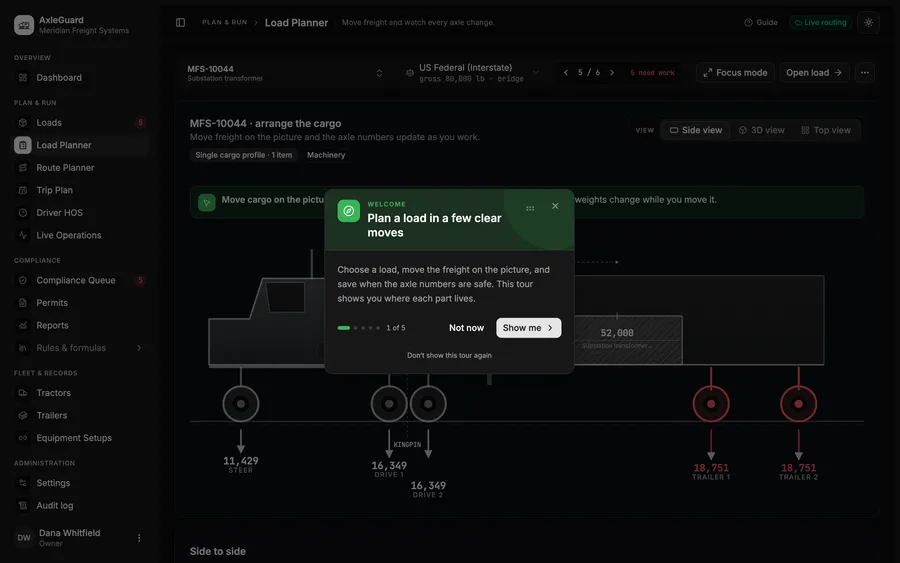
axleguard.app/planner
The same arithmetic, but on every load rather than the ones somebody chose to check. Drag the freight and the gauges move in the same frame.
The tools
Five products, and the job each one was built for.
Where we could not confirm something from published documentation, we say not published instead of guessing. On this page in particular, that happens a lot, and it is deliberate.
TruckScience Axle Weight Calculator
Truck dealers, bodybuilders and specification engineers.
What it does well
The best known name in axle weight calculation, and deservedly so. It uses vehicle and body data to show what each axle carries as equipment and payload are added. It also produces the drawings and reports a dealer needs to prove a specification before anything is built. For deciding where a tank, crane or tail lift can sit on a chassis, this is the tool.
Where the scope ends
It is a specification and sales tool first, aimed at the moment a vehicle is being configured rather than the morning a particular load is being built. It publishes legal limit checking for the regions it covers; the deeper enforcement arithmetic a North American carrier lives with day to day is not the part of the product it advertises.
Load Xpert
Planners loading flatbeds, containers and rail cars.
What it does well
A long-established family of load planning modules, including axle load calculation alongside container and general cargo loading. It handles the awkward freight that defeats a spreadsheet — steel, machinery, mixed dimensions — and produces a load plan a yard can actually work from.
Where the scope ends
It is desk software, planned one load at a time. Whether it re-solves as freight comes off at intermediate stops, and how it treats jurisdiction rule sets, is not something we found published.
MaxLoad Pro
Shippers and 3PLs packing containers and trailers to a cube.
What it does well
Serious cargo load optimisation. Mixed pallet building, container and trailer fill, stacking rules, load sequencing for multi-drop, and the kind of packing arithmetic that saves a container on a large shipment. If the question is how much fits and in what order, this is a strong answer to it.
Where the scope ends
Its centre of gravity is cube and sequence rather than statute. Whether it applies bridge formula arithmetic across every consecutive axle group, or layers tire and axle ratings on top of the legal limit, is not published.
Goodloading
Smaller carriers and forwarders who want a load plan without a licence negotiation.
What it does well
Load space planning in a browser, priced to be picked up by an operation that would never buy enterprise load planning software. It publishes axle load calculation alongside the cargo space planning, and being able to hand a planner a working tool the same afternoon has real value.
Where the scope ends
It is built around European vehicle configurations and load space. How far the axle calculation goes into North American enforcement arithmetic is not something the documentation sets out.
EasyCargo
Anyone who needs a container or truck loaded well, this week.
What it does well
Straightforward, quick and genuinely pleasant three-dimensional load planning. Pallets and cartons into a container or trailer, stacking and orientation rules, and a shareable plan the warehouse can follow. For a forwarder loading boxes, the simplicity is the feature.
Where the scope ends
Enforcement arithmetic is not what it sets out to do. Bridge formula subsets, tire ratings and jurisdiction rule sets are not published capabilities.
Side by side
Fifteen capabilities, and one row we lose.
Body and chassis specification belongs to TruckScience and we mark ourselves no on it, because a dealer speccing a tanker body should buy the tool built for that.
Axle weight calculators and load planning tools compared with AxleGuard across fifteen capabilities
Capability
AxleGuard
TruckScience
Load Xpert
MaxLoad Pro
Goodloading
EasyCargo
Axle weights calculated from payload position
Yes
Yes
Yes
n/p
Yes
n/p
Three-dimensional view of the loaded vehicle
Yes
n/p
Yes
Yes
Yes
Yes
Container and pallet packing optimisation
part
n/p
Yes
Yes
Yes
Yes
Body and chassis specification for dealers
No
Yes
n/p
n/p
n/p
n/p
Legal limit checking by region
Yes
part
n/p
n/p
n/p
n/p
Bridge formula on every consecutive axle group
Yes
n/p
n/p
n/p
n/p
n/p
Tire and axle-rating limits layered on statute
Yes
n/p
n/p
n/p
n/p
n/p
Binding rule named on the verdict
Yes
n/p
n/p
n/p
n/p
n/p
Corrective move in slider holes and inches
Yes
n/p
n/p
n/p
n/p
n/p
Jurisdiction attached to the individual load
Yes
n/p
n/p
n/p
n/p
n/p
Permit pathway when no legal position exists
Yes
n/p
n/p
n/p
n/p
n/p
Re-solved per leg as freight comes off
Yes
n/p
n/p
n/p
n/p
n/p
Truck-legal road planned for the same load
Yes
No
No
No
No
No
Derived replay now; physical axle signal after commissioning
part
No
No
No
No
No
Before-and-after audit on every change
Yes
n/p
n/p
n/p
n/p
n/p
supportedpart partly, or with limits not supportedn/p not published by the vendor
How to read this table
Drawn from publicly published product documentation as of August 2026. Not published means we could not confirm the capability in the vendor's own material, not that the product lacks it. These are active products and several of them are updated often, so check with the vendor before a row here decides anything.
Where the category stops
A calculator answers a question. A load needs a decision.
Three differences, and none of them is about the arithmetic itself. The arithmetic in the good tools here is sound.
It runs when somebody opens it
A desk tool checks the loads a person chose to check. Sitting inside dispatch means every load is checked, including the routine one on the familiar lane that nobody would have opened the calculator for.
The answer stops at the numbers
Knowing the drive tandem is 1,140 lb over is halfway. The yard needs the move: how many holes and which direction. The planner also needs the binding rule and state, because a bridge-formula failure may need a different fix from a statutory-limit failure.
It has no view of the rest of the day
The route, the drop at stop two, the fuel burned by the afternoon and the jurisdiction crossed at lunchtime all change the answer. The journey view can then compare the plan with its named derived replay, or with an approved physical signal after gateway commissioning. A tool that closes when you close it cannot follow any of that.
Why that table is mostly grey
Fifteen capabilities across five tools is seventy-five cells, and fifty-two of them read not published. We will not write a no beside a vendor's name for a capability we could not confirm. Several of these products may well handle bridge formula subsets or jurisdiction rule sets without having written a page about it.
Every competitor cell in the table above, counted
cells
69%
16%
1%
13%
Not published by the vendor52 cells
Published as supported12 cells
Published with limits1 cells
Published as not supported10 cells
Five tools, fifteen capabilities, seventy-five cells, counted from the table above. Our own column is not in this count.
Being fair about this one
If your operation runs one configuration on one lane and somebody competent checks every load, a good calculator plus that person is a genuinely sound system. The case for anything more starts when the configurations multiply, the states multiply, and the person is not always there.
01This is the closest category to what you do. What is actually different?
Where the answer stops. A calculator gives you axle weights for a load you describe to it, and that is a real answer to a real question. We carry the same arithmetic forward into the rest of the day: which rule bound and in which jurisdiction, what physical move fixes it, whether the load stays legal after the drop at stop two and after four hundred miles of fuel burn, and what road the truck can legally take with that freight aboard. The journey view uses a named derived source today and can accept measured signals only after a truck gateway passes commissioning.
02We already own one of these. Should we throw it away?
No. If you use TruckScience to engineer vehicles before they are built, keep using it. AxleGuard can retain the accepted finished-vehicle specification and a planning-grade CG/stability output; it does not replace dealer drawings, chassis reference libraries or certified engineering work. If you use a packing tool to fill containers to a cube, keep that too.
03Why is so much of this table marked not published?
Because we will not write a no next to a vendor's name on a capability we cannot verify. Several of these products may well handle bridge formula subsets or jurisdiction rule sets without having written a documentation page about it. Not published means we looked and could not confirm, and the honest thing is to say that rather than to score them down.
04Can a spreadsheet do this?
For a fixed configuration hauling the same freight every day, a spreadsheet built by someone who understands moments can be genuinely accurate, and plenty of good fleets run on one. It falls over on the load that is not like the last hundred: an unusual trailer, a state you rarely enter, a non-divisible item, a slider that has been moved and not recorded. That is also the load that gets cited.
Next step
Run the same load through both.
Take a load your calculator has already cleared and put it through ours. If the two answers differ, one of us is wrong about your trailer, and that is worth forty-five minutes of anybody's morning.