Truck routing and load planning software that follows the load.
AxleGuard connects cargo placement, per-axle compliance, truck-safe routing, permits, trip planning, HOS records and connected signals. The same operating answer follows the load from dock to destination.
Plan it, prove it, route it and watch it in transit without rebuilding the answer at every handoff.
The board
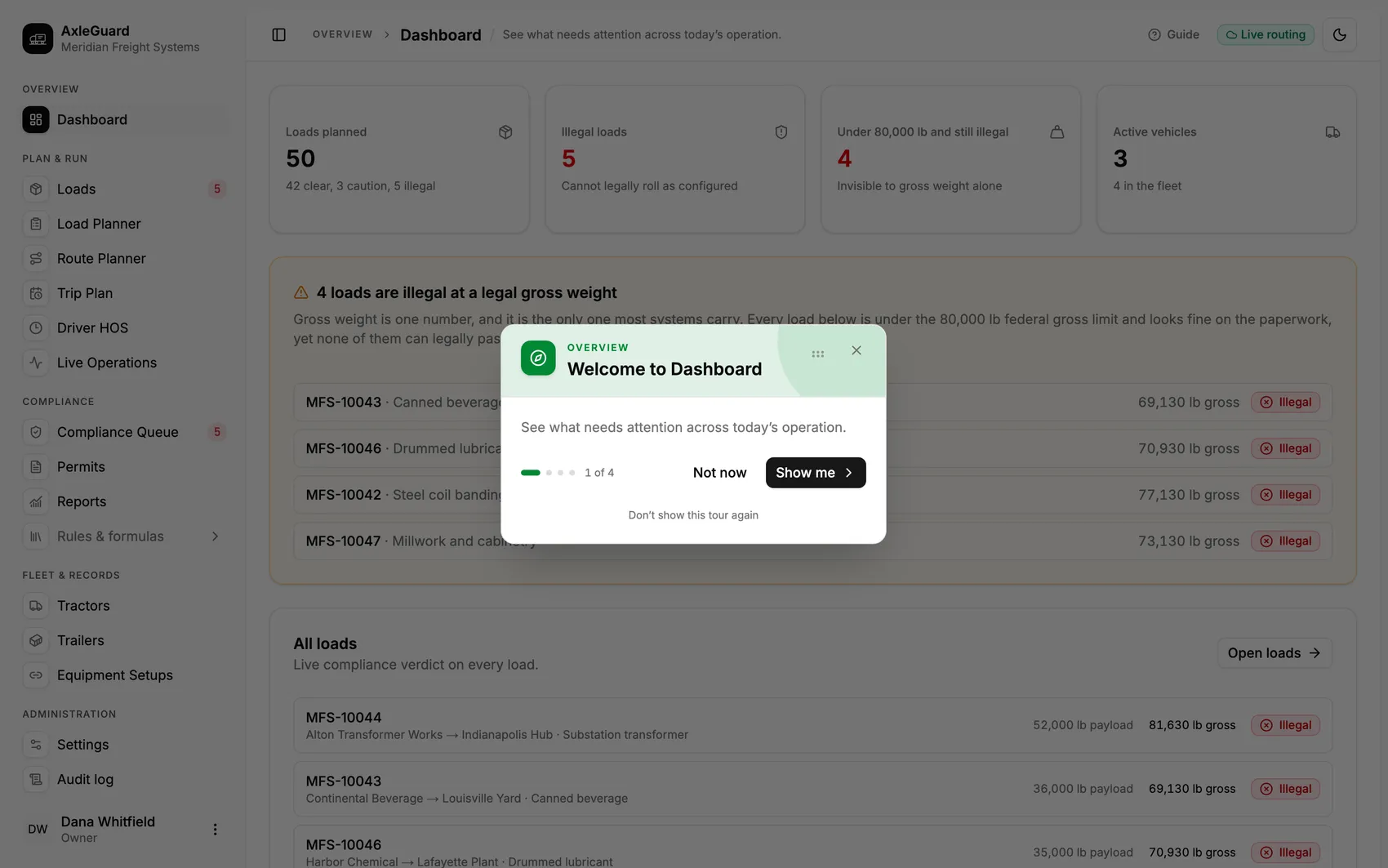
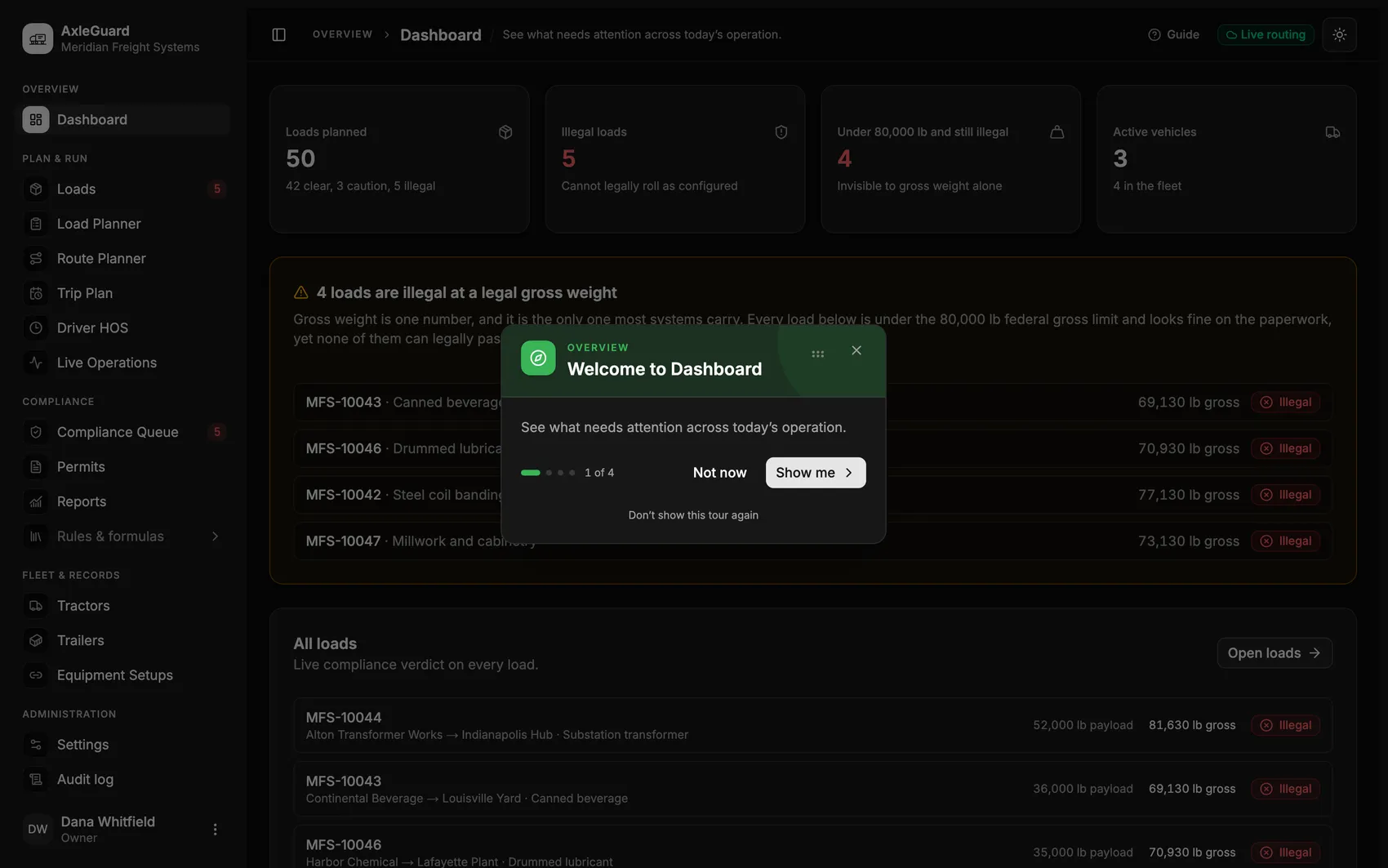
Every load, with its verdict on the row
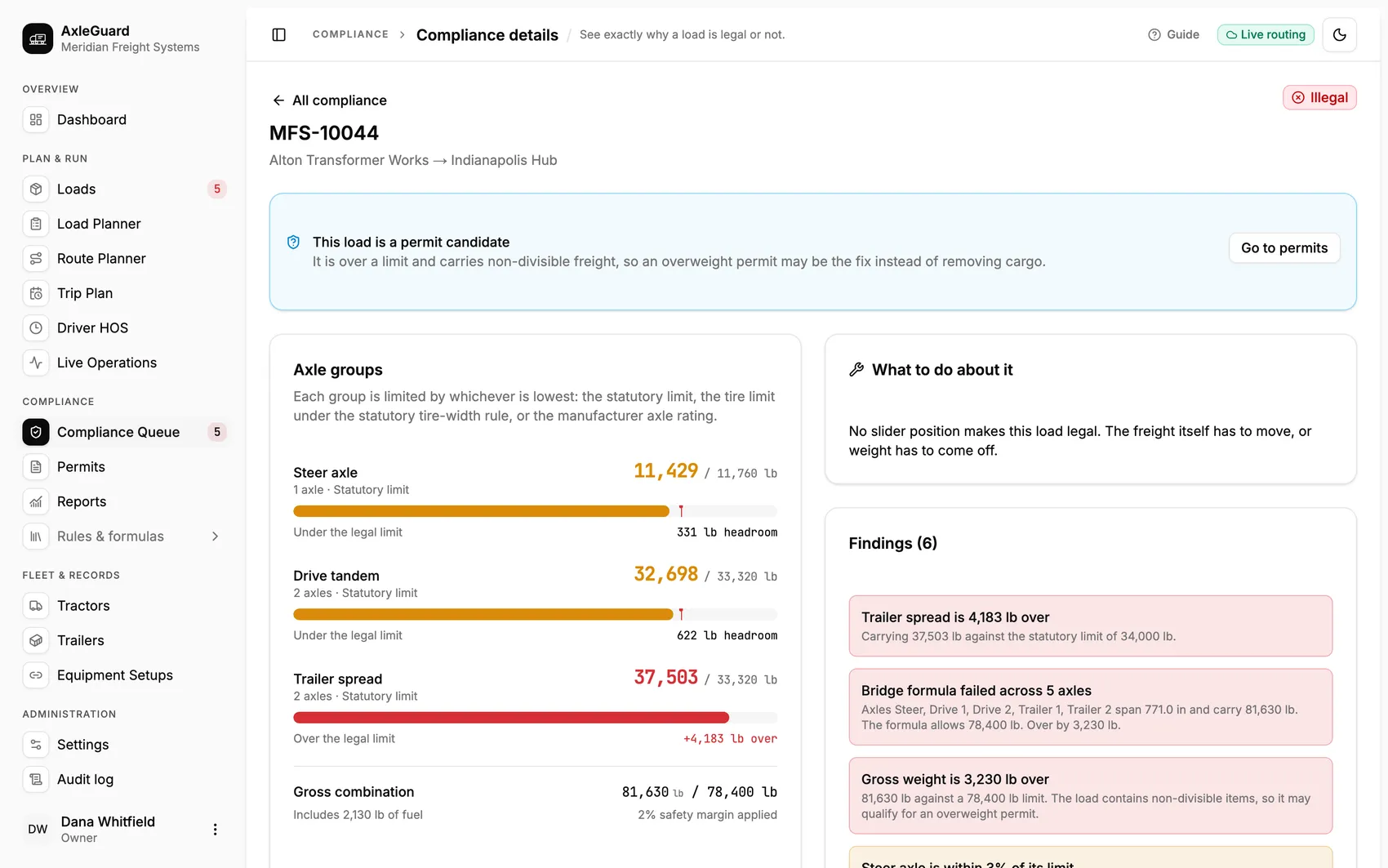
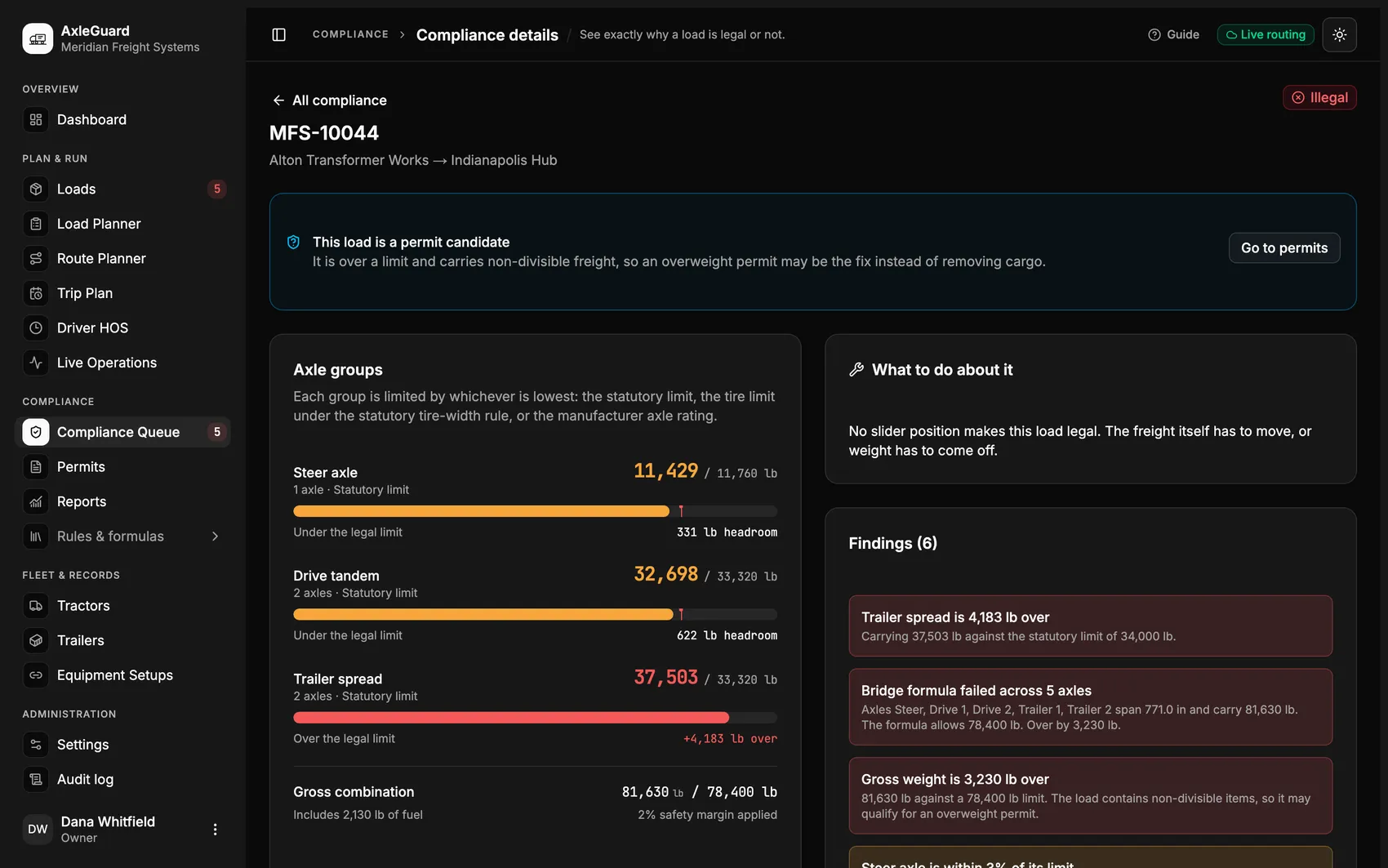
The loads that cannot legally roll are called out before anything else, so the first thing a dispatcher sees in the morning is the problem, not the list.
Look at: the loads that are under the gross limit and still illegal
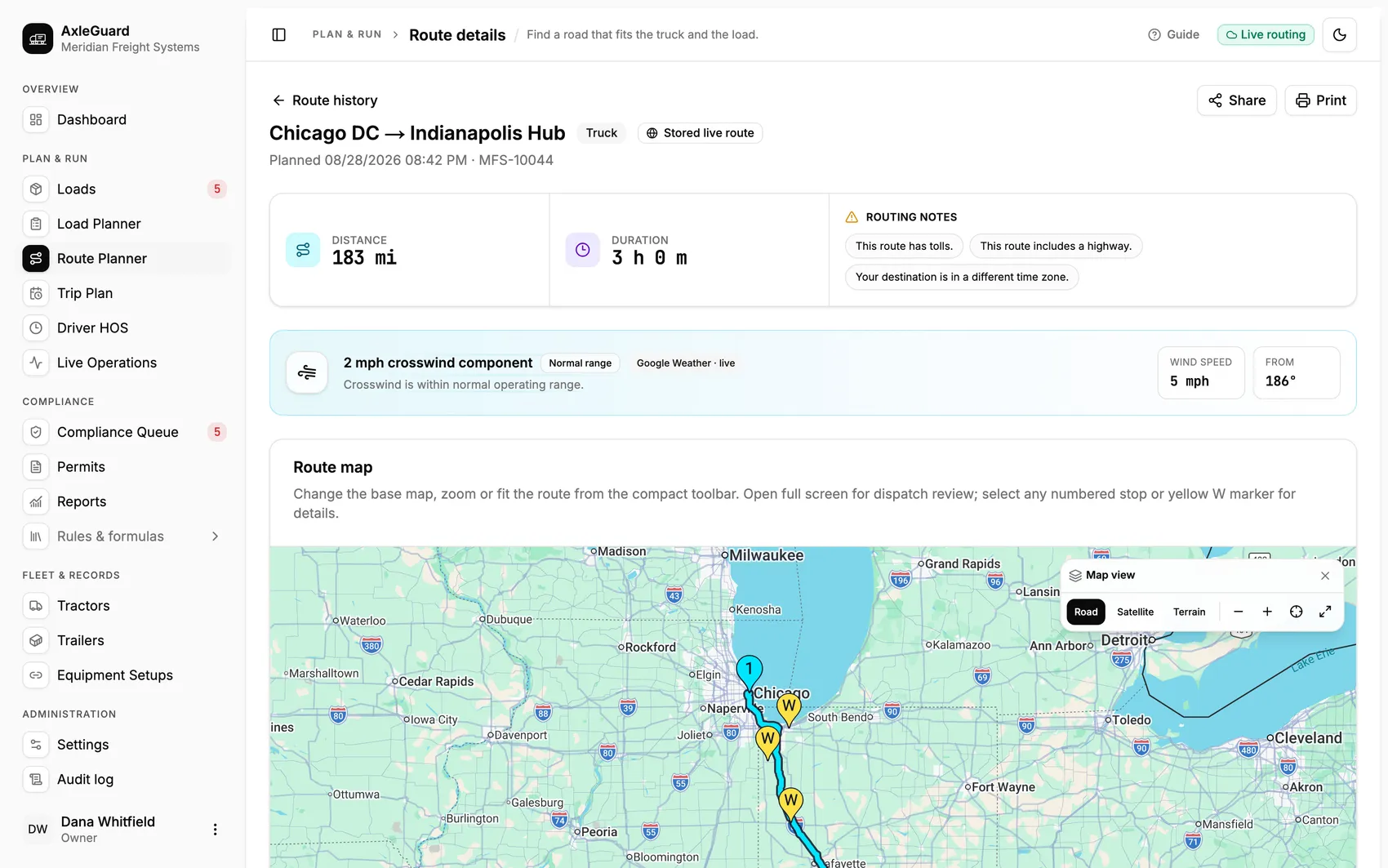
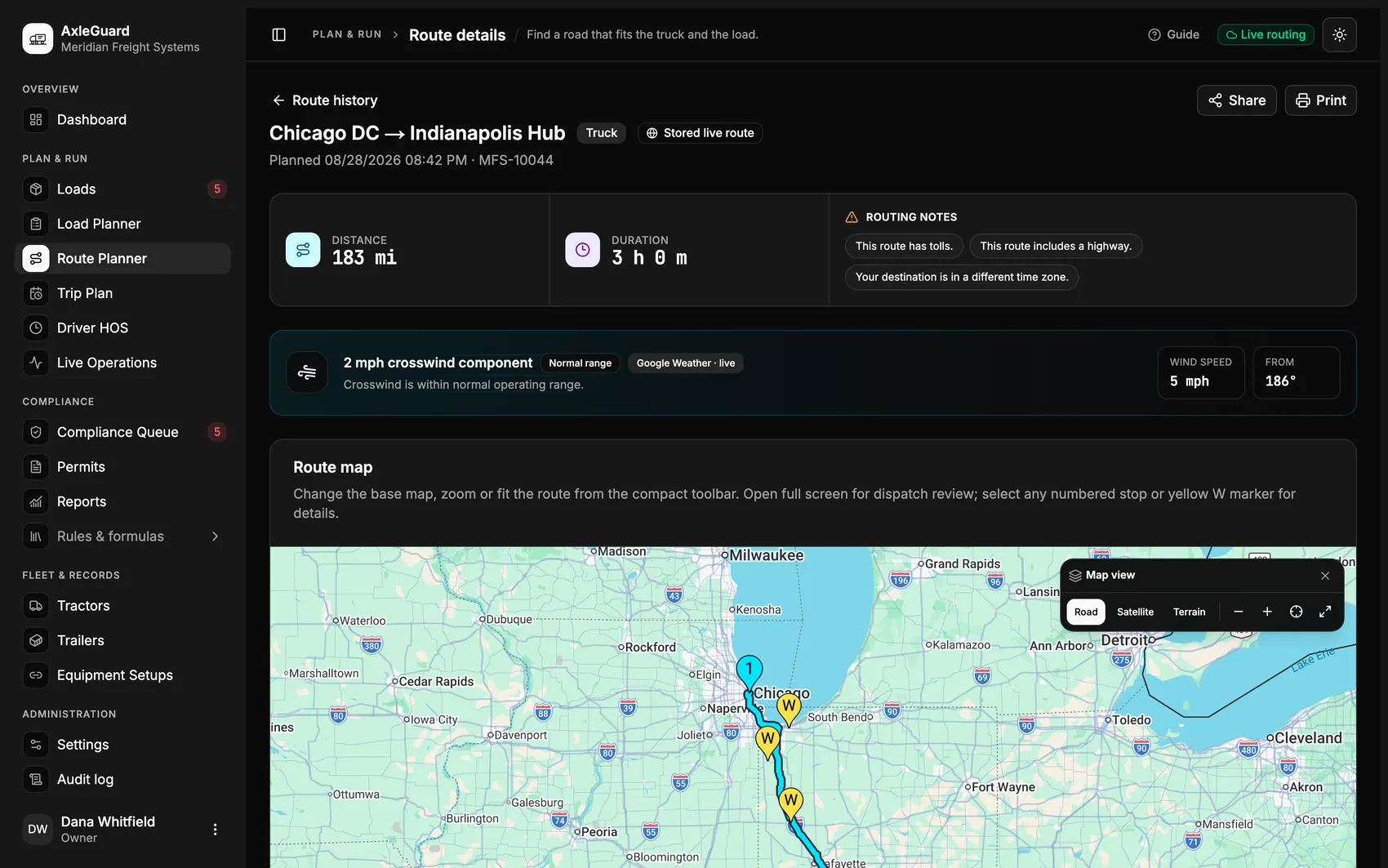
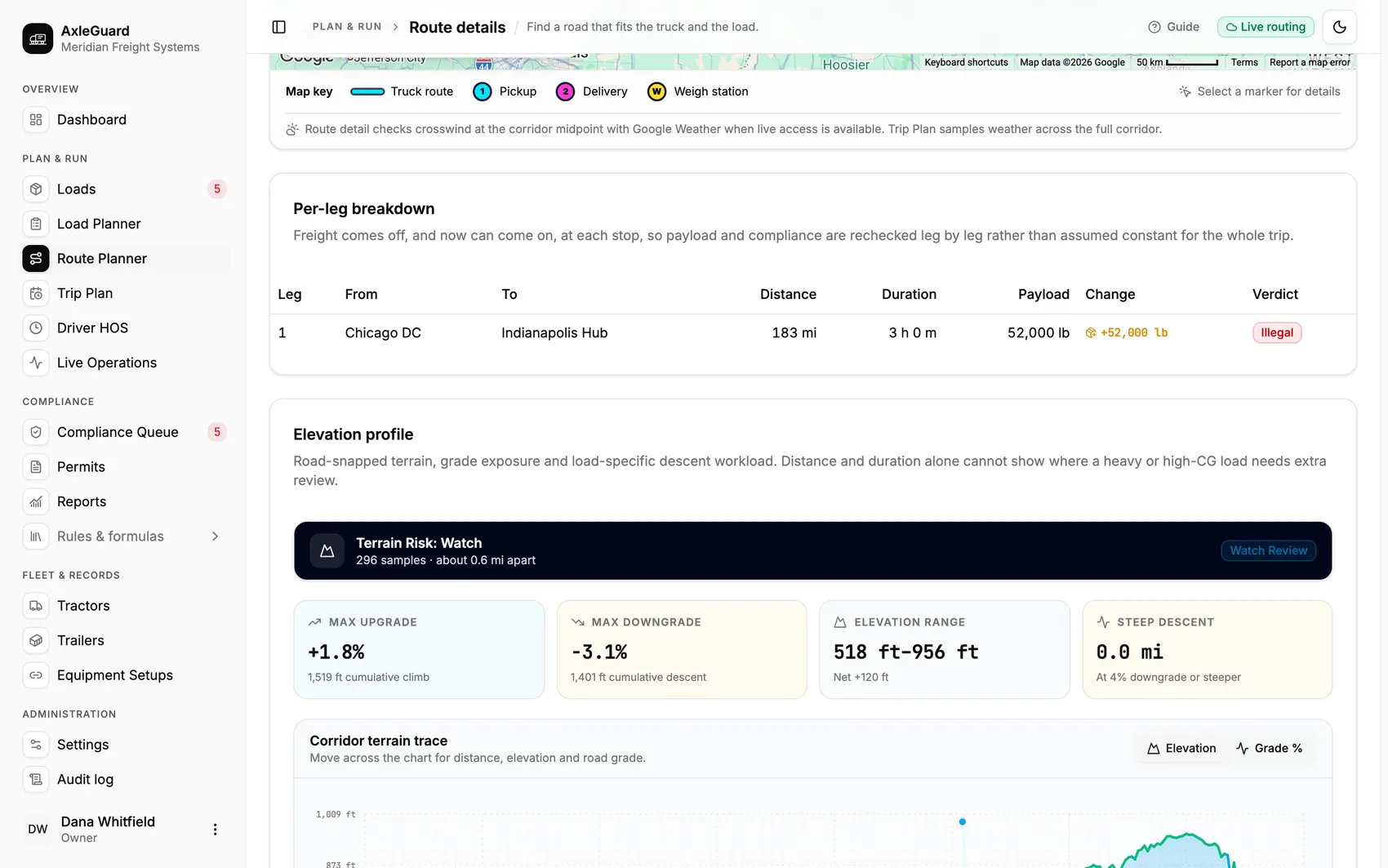
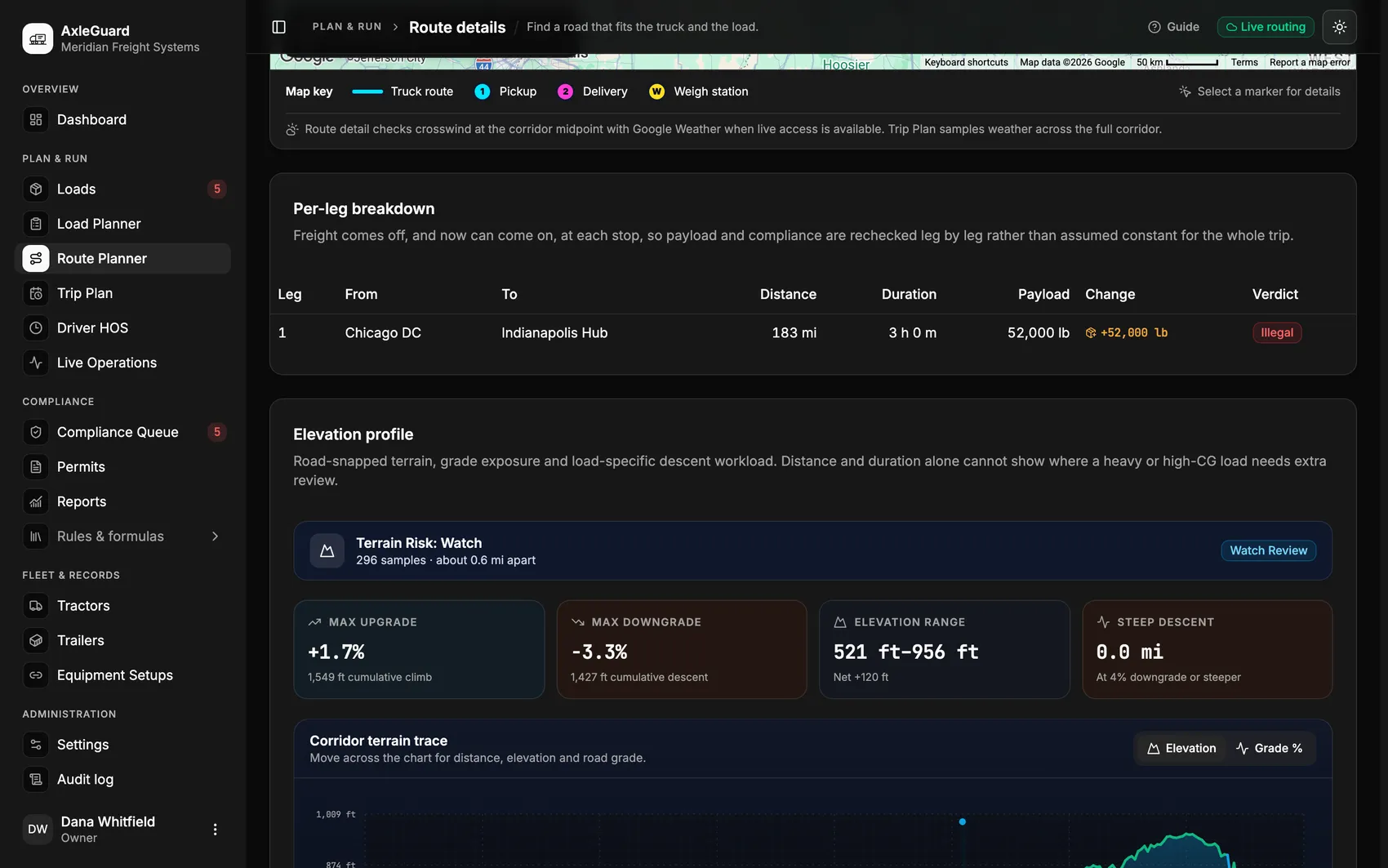
The stored road is snapped and sampled for elevation, grade and current crosswind. Weight and centre of gravity turn those generic conditions into a load-specific review.
Look at: the sustained descent and the load that has to cross it
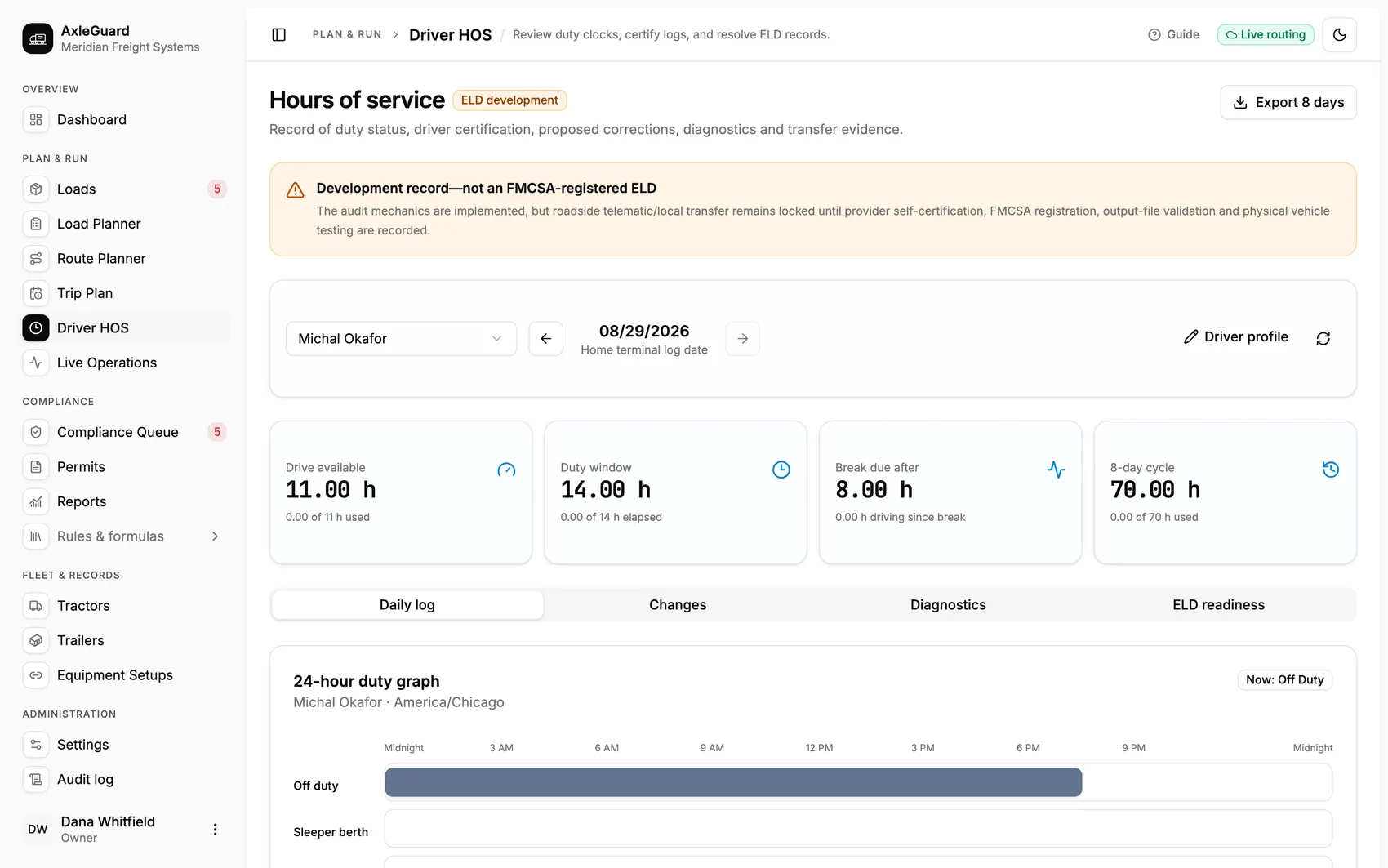
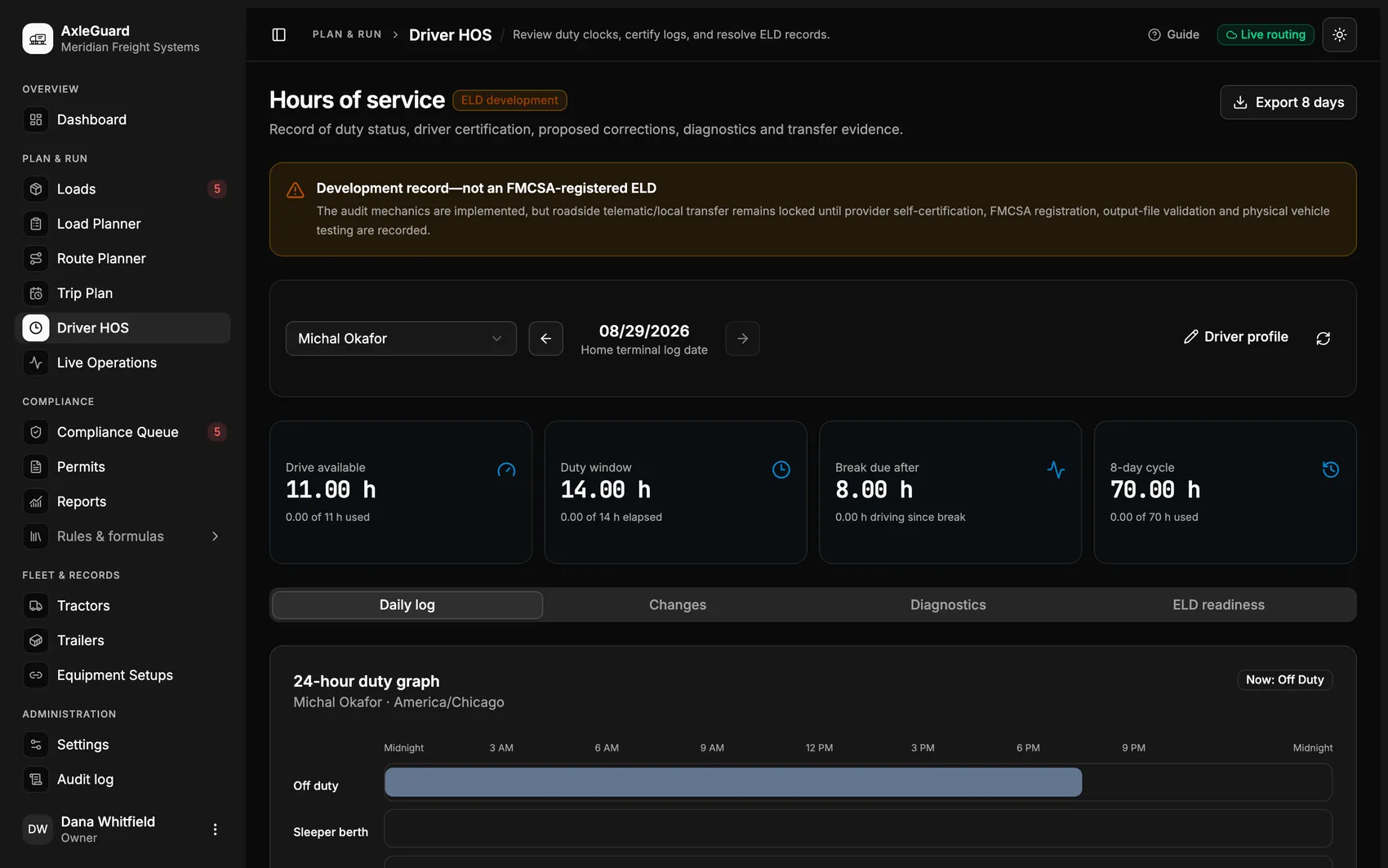
Duty clocks, the daily graph, proposed corrections, driver decisions, diagnostics and readiness evidence share one record. The current workflow is clearly marked as not yet an FMCSA-registered ELD.
Look at: the clock and the registration boundary on the same screen
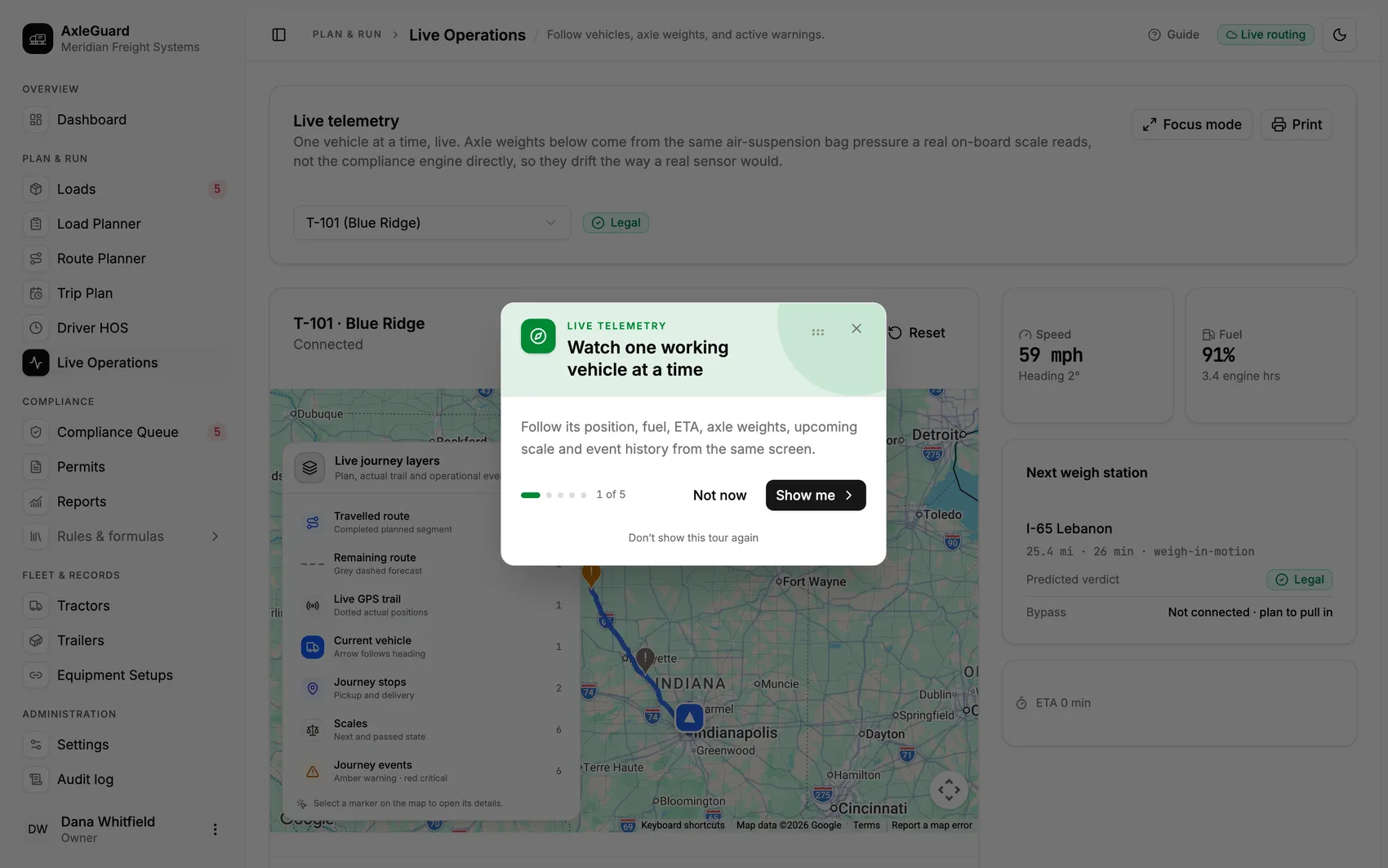
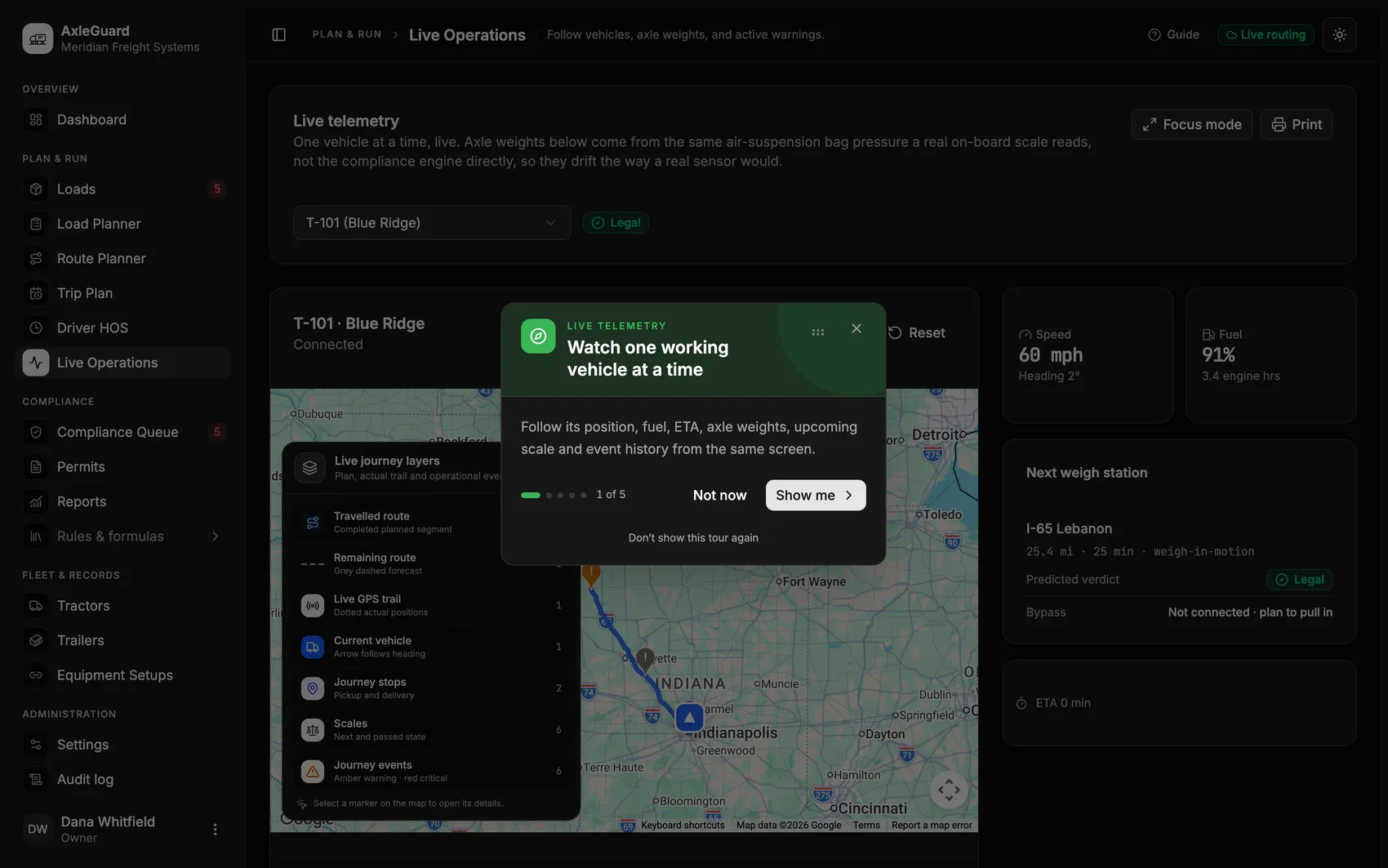
Replay the run without pretending the demo is a sensor
Derived position, events and axle signals move through the same normalized ingest and live view used after a physical truck gateway passes commissioning.
Look at: the travelled route, remaining road and the source of each signal
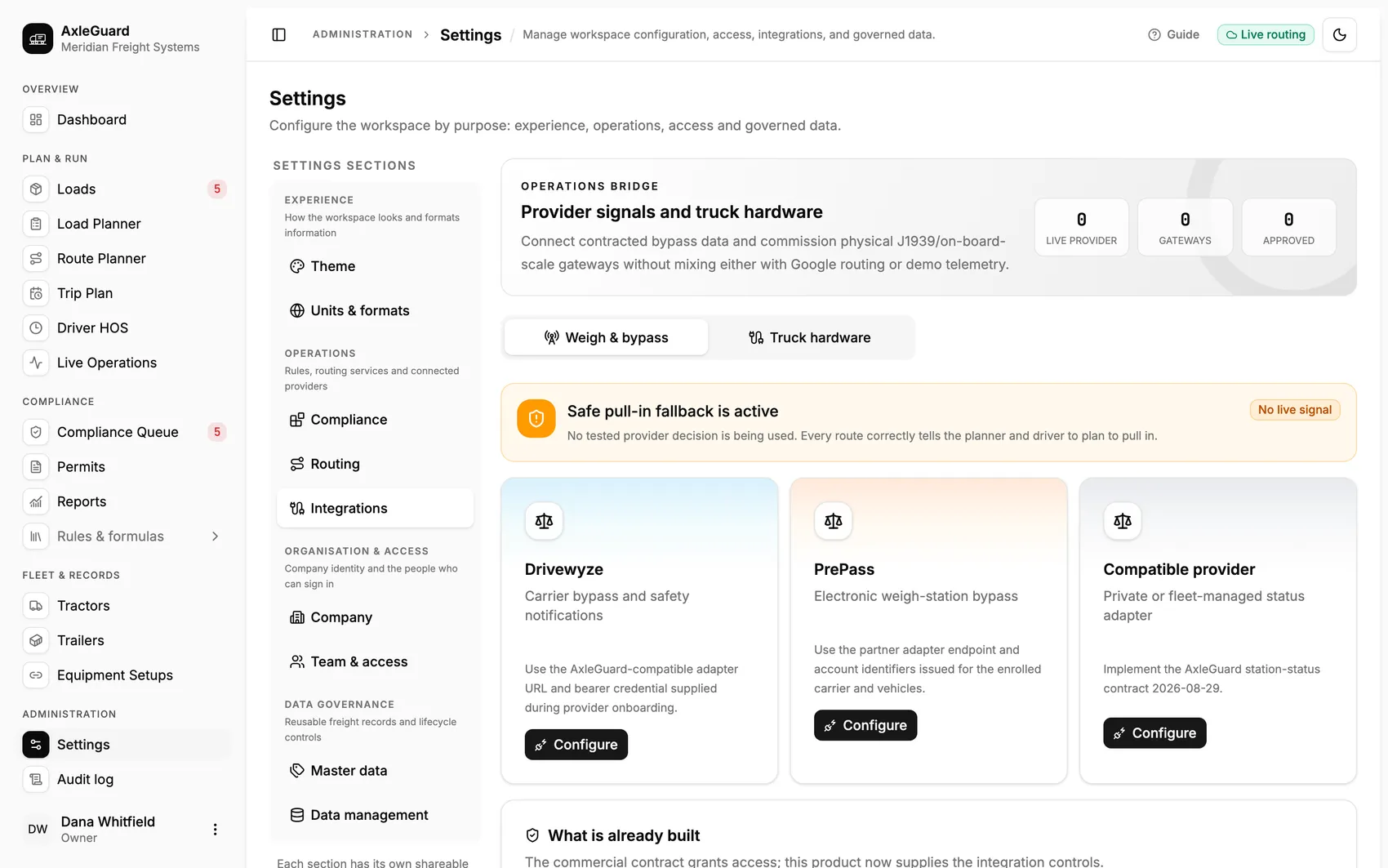
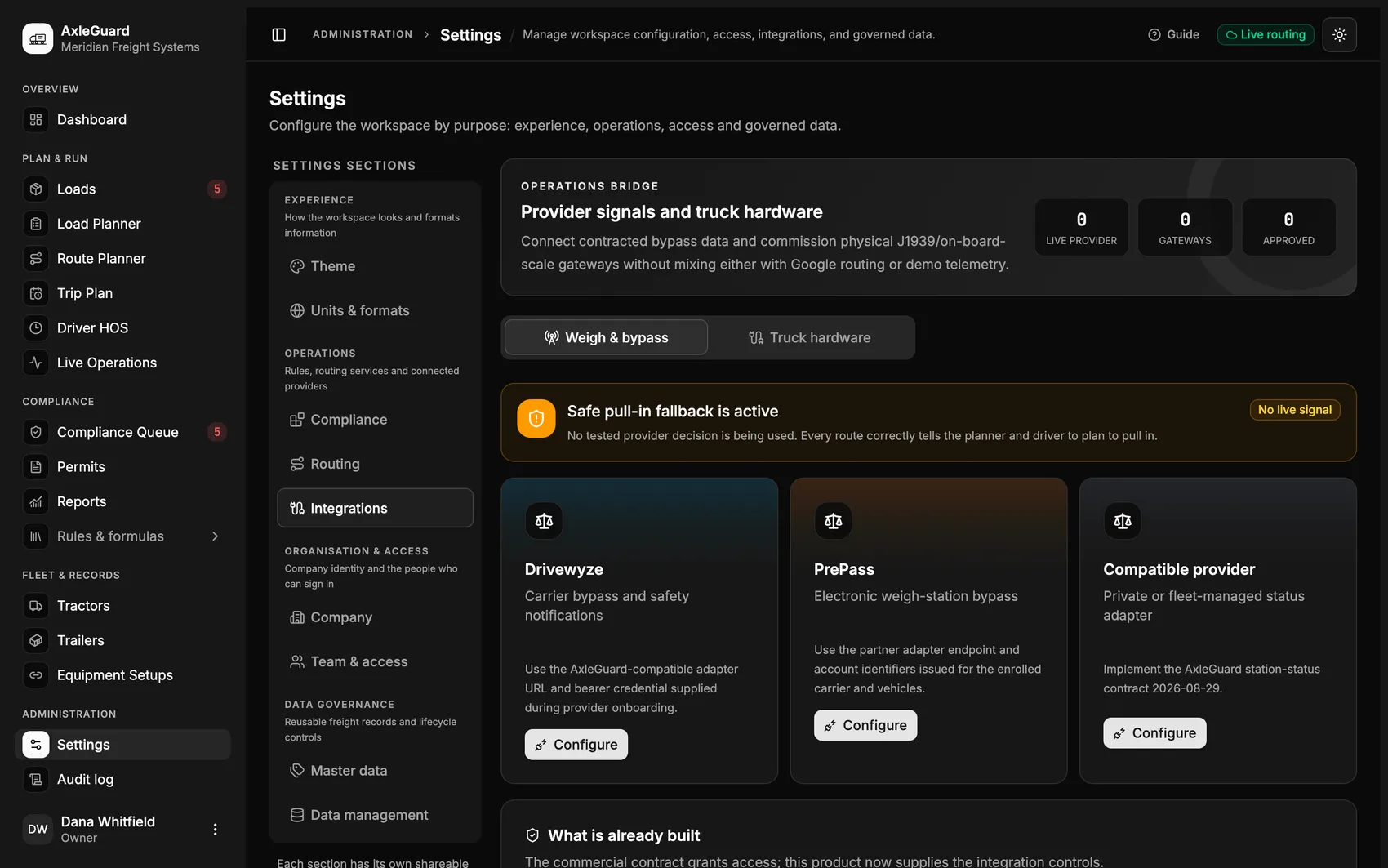
Connect provider signals without guessing when they fail
Drivewyze, PrePass or a compatible adapter can be tested and connected after commercial onboarding. Until a valid decision arrives, the safe answer is to plan to pull in.
Look at: the provider contract, test step and safe pull-in fallback
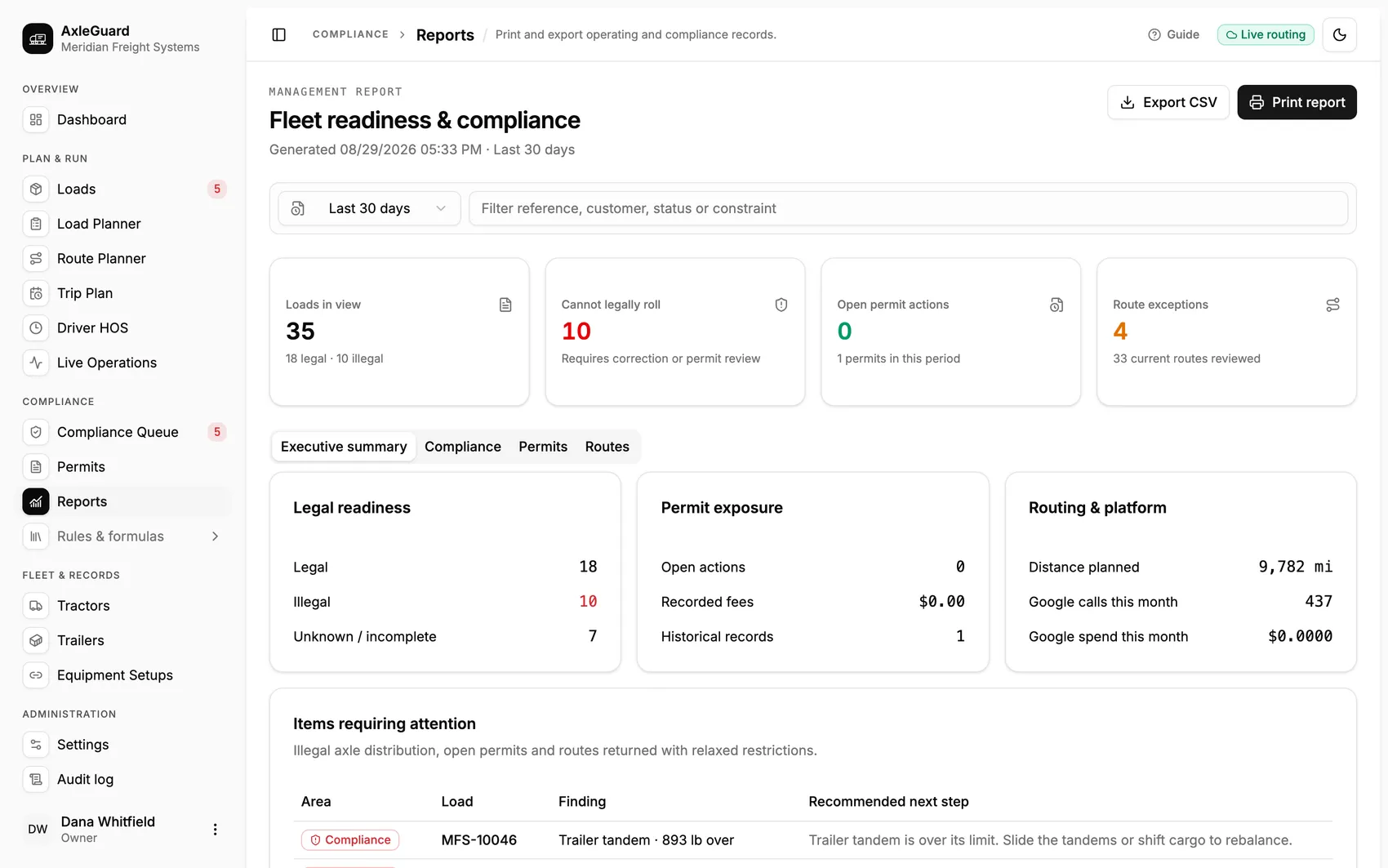
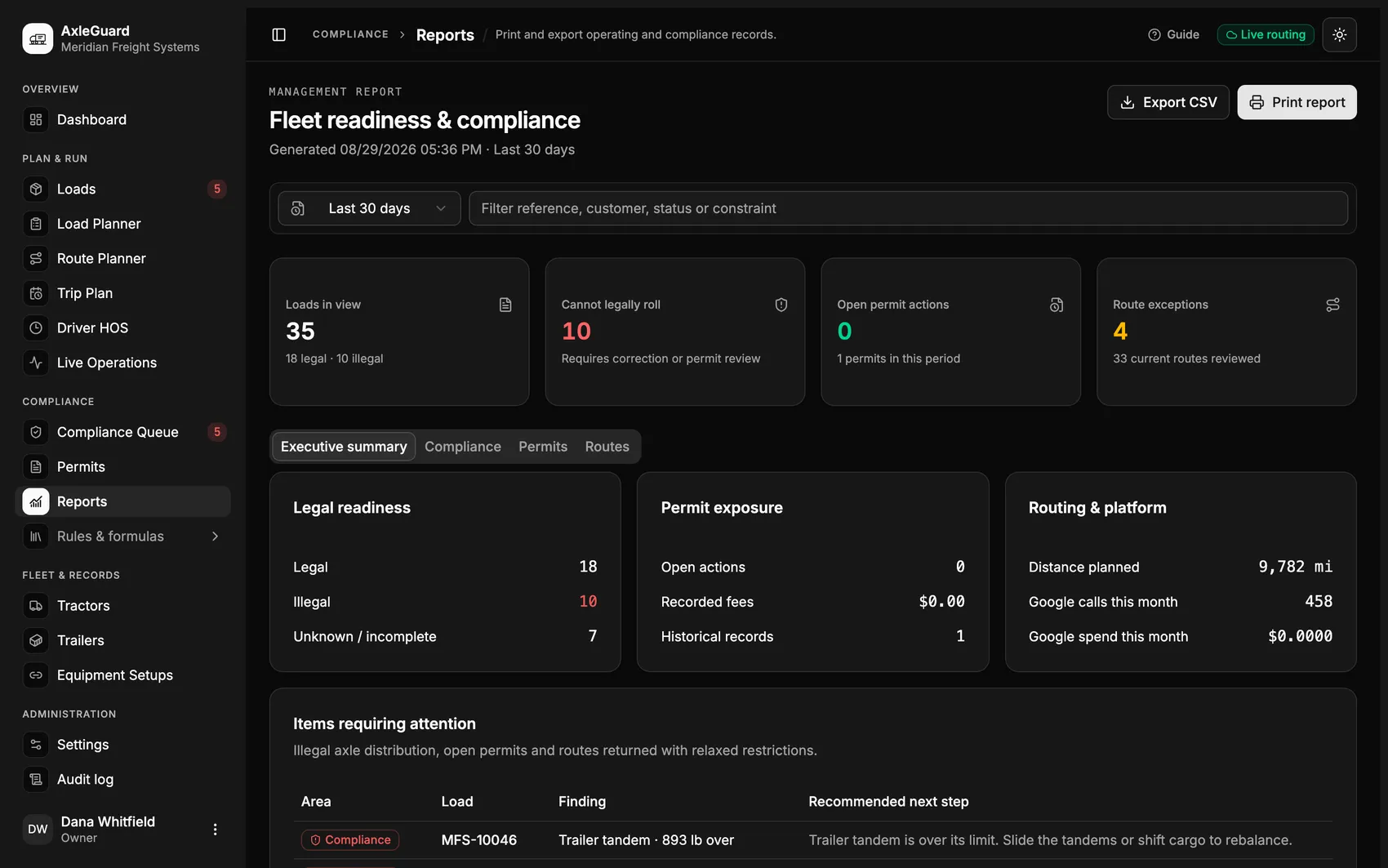
Legal readiness, permit exposure, route exceptions and provider activity share one date-bounded report. Every attention row names the load and the next step.
Look at: the loads and route exceptions that still need action
Your paperwork has one number. The scale reads five.
This is the whole thing, and it takes about thirty seconds to see. The load below is under every gross limit there is, and it will still be written up.
What the bill of lading says
Gross combination weight
77,720 lb
Under the 80,000 lb limit
Everybody in the chain sees this number. The shipper, the broker, the dispatcher and the driver all agree the load is fine, because by the only measure they have, it is.
Signed off by the shipper
Accepted by dispatch
Driver rolls at 06:40
What the scale reads at 11:20
Steer axle
11,820 lb
180 lb to spare
Drive tandem
35,140 lb
Over by 1,140 lb — citation, and out of service until it is fixed
Trailer tandem
30,760 lb
3,240 lb to spare
Nothing was overloaded.The pallets sit fourteen inches too far forward. Moving them would have taken two minutes on the dock. It now takes a citation, a re-load and a missed window.
Where that 77,720 lb actually sits
lb
15%
45%
40%
Steer axle11,820 lb
Drive tandem35,140 lbover
Trailer tandem30,760 lb
One number on the paperwork. Three on the ground, and only one of them is over.
Nobody in the chain was careless. The only number anybody had was the one that could not tell them anything.
What it costs when the answer arrives too late
Overweight citation
per axle, per state
Placed out of service
until it is legal again
Re-load crew and a dock slot
on someone else's schedule
Missed delivery window
and the conversation after it
Safety score points
that follow you for two years
Insurance review
at renewal
Driver hours burned
sitting at the scale
Detention at the receiver
billed to nobody
03
why it happens
Three reasons a careful yard still gets written up.
None of these is carelessness. All three are invisible to the tools most fleets already have.
One load, one day, on the drive tandem
lb
Nothing was added. Freight came off the rear at stop two, the balance moved forward, and the drive tandem went 900 lb over between two deliveries that were both on time.
A truck can be legal on gross weight, legal on every single axle, and still illegal on a group of axles nobody thought to check.
Federal Bridge Gross Weight Formula, 23 CFR 658
One load keeps the same answer
The equipment, freight, rule set and verdict stay connected as the load moves from the dock into the route and through the live run.
Where it sits, not how much it is
Two identical 46,000 lb loads, one built nose-first and one built evenly, produce completely different axle weights. The paperwork cannot tell them apart. The scale can.
A load can be 8,000 lb under gross and still be cited.
The run changes it
Freight comes off at stop two and the balance shifts. Diesel burns off the steer axle over 400 miles. A load that was legal in the yard is not necessarily legal at the scale you reach at four o'clock.
Legal at departure is not the same as legal on arrival.
The rules move with the truck
Limits, bridge rules and even trailer geometry rules change at the state line. The same configuration is fine in one jurisdiction and a citation in the next one on the route.
One load, several rule sets, one wrong answer needed.
04
the claims
Every claim here has to survive three questions.
What do I get. Why is that not what I already have. And what does it look like on a load I recognise. If a claim cannot answer all three, it is not on the page.
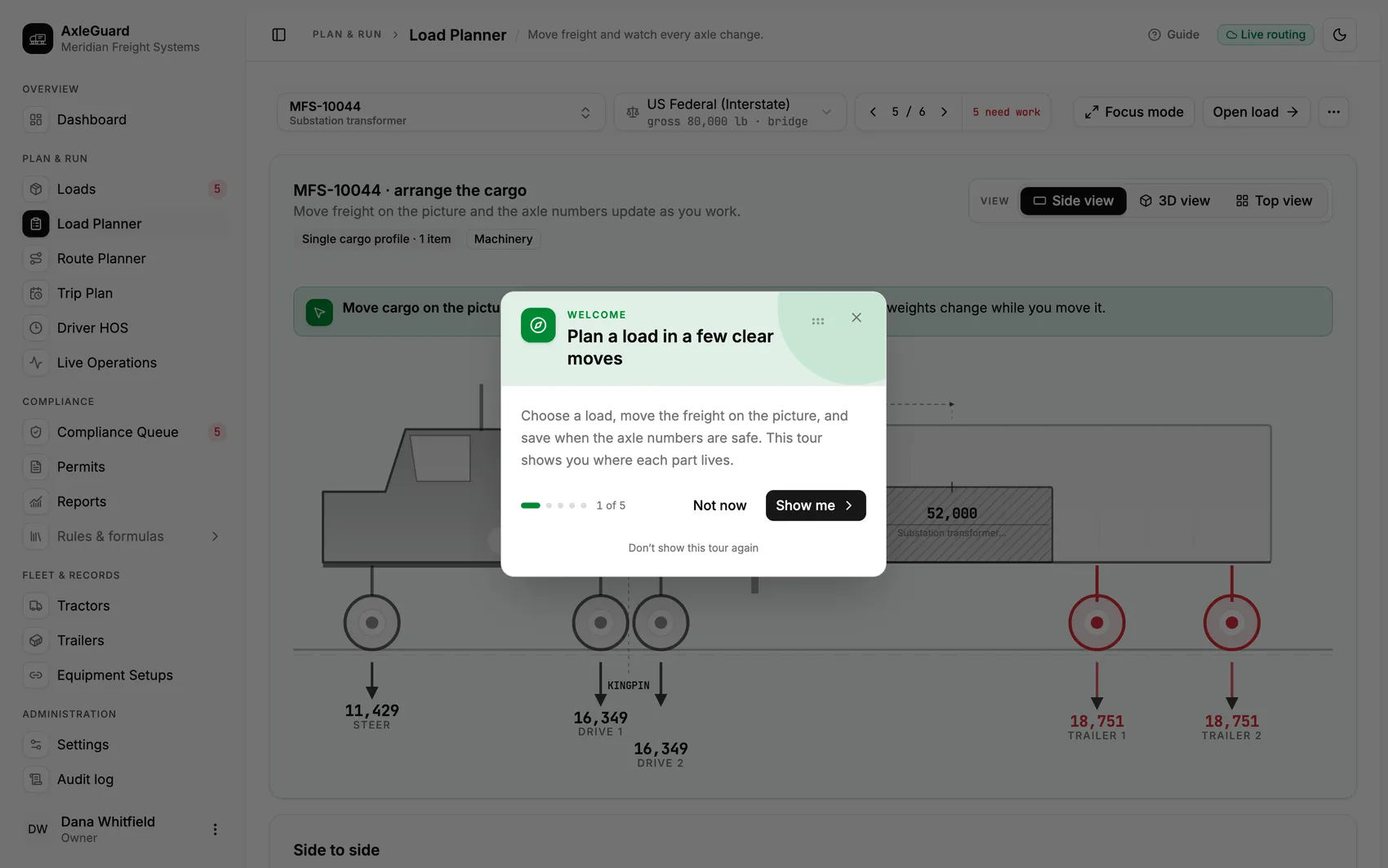
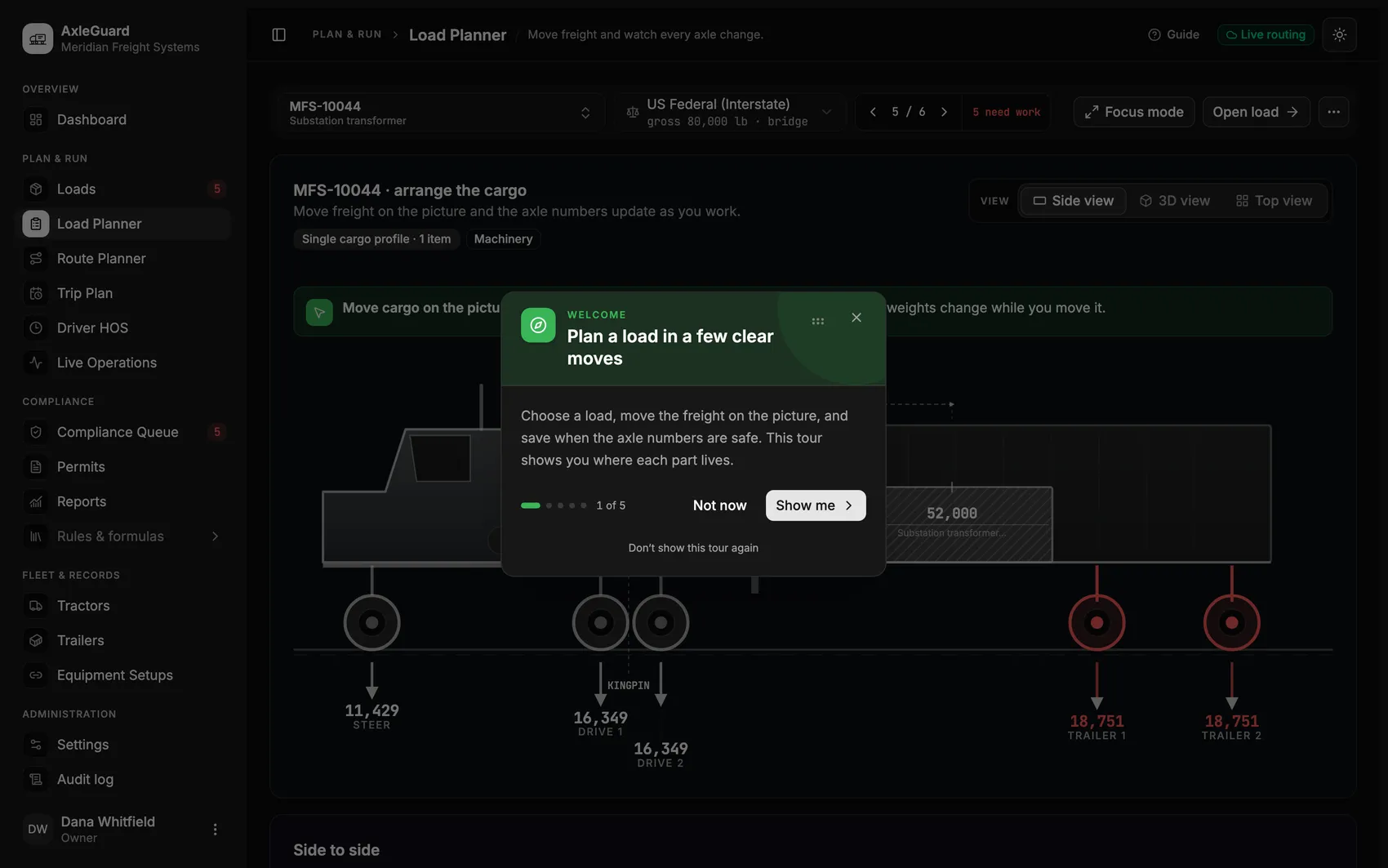
Place the freight on the deck and watch the steer, drives and trailer groups update together.
Why it is different
A gross total can look legal while one group is already over. The board points to the group with the least room before loading is finished.
On a real load
Start with the group that has the least room
Open the axle-engine page for the full 46,000 lb worked load and the calculation behind its drive-tandem result.
Open the example to see the numbers and the corrective move.
02
The outcome
Use the limit that actually binds the truck
What it does
Each axle is checked against the rule book, its tires and the equipment rating at the same time.
Why it is different
The lowest ceiling wins. That keeps a generous statutory number from hiding a lower physical limit on the equipment.
On a real load
See why the published limit is not always the real one
The axle-engine page works through tire width, manufacturer rating and statute with the numbers printed beside each step.
Open the example to see the numbers and the corrective move.
03
The outcome
Give the loader a move, not another warning
What it does
An over-limit result returns the direction and distance to move the tandems, fifth wheel or freight.
Why it is different
The yard gets an instruction it can act on now instead of a red status that starts a phone call after the trailer is sealed.
On a real load
Turn the verdict into slider holes
The detailed page shows how the corrective move is derived and where the spare capacity is available to receive the weight.
Open the example to see the numbers and the corrective move.
Where the numbers come from
The figures on this site come from the engine's own test suite and from AxleGuard in use. Where a number is a worked example rather than a measurement, the page says so.
05
what changes
Four things stop happening.
The difference is operational: the problem moves from the roadside back to the dock, while there is still time to fix it.
01
No re-loads
Before
Found after the doors close.
With AxleGuard
Caught while freight is still on the dock.
02
No lost days
Before
The roadside finds what the plan missed.
With AxleGuard
Corrected before the driver starts the day.
03
No score damage
Before
One violation follows you for two years.
With AxleGuard
Prevented before it reaches the carrier record.
04
No arguments
Before
Planner, driver and yard have different answers.
With AxleGuard
One axle verdict and one corrective move.
06
who it is for
Four people ask this question, and they ask it differently.
Five kinds of tool. None of them is trying to be this.
Navigation gives you the road. Dispatch gives you the paperwork. Telematics gives you the dot on the map. Onboard scales give you the weight after it is loaded.
A fixed platform fee, with connected usage included.
Core load and compliance work is unlimited. Credits cover new live routes and optional road, weather, terrain and fuel data when your team chooses to use them.
For one planning team
Starter
$499 / month
$4,990 yearly · two months free
One planning team, unlimited core compliance checks and a small pool of connected trip solves.
5 users and 25 equipment profiles
300 connected planning credits each month
2 configured jurisdiction rule sets
Unlimited load, axle and permit checks
Turn weather, grade and fuel checks on only when needed
Most asked for
For an active dispatch board
Operations
$1,499 / month
$14,990 yearly · two months free
A shared operating view for dispatch, compliance and daily route intelligence.
20 users and 150 equipment profiles
1,500 connected planning credits each month
10 configured jurisdiction rule sets
Unlimited load, axle and permit checks
API, webhooks, reporting and full audit history
For multi-terminal operations
Network
$3,499 / month
$34,990 yearly · two months free
More terminals, equipment and trip volume without charging for every person who needs the answer.
The eight things people ask in the first ten minutes.
01We already weigh our loads. What does this add?
A scale ticket tells you what you have after the trailer is loaded and sealed. By then the only fix is to break the load down and rebuild it, which costs a crew, a dock slot and usually a delivery window. AxleGuard gives you the same five numbers while the freight is still on the floor, plus the exact move that fixes it.
02Most of our loads are nowhere near 80,000 lb. Does this matter to us?
It matters more, not less. Gross weight is the number people watch, and it is almost never the one that gets cited. A 68,000 lb load with the pallets stacked toward the nose puts the drive axles over while the total looks comfortable. Light loads get tickets for exactly this reason.
03Our planners have been doing this for twenty years. Will they use it?
The good ones already do this arithmetic in their heads and are usually right. What they cannot do in their heads is every consecutive axle group, the tire rating, the state you are crossing into, and what happens after 400 miles of fuel burn. The tool is there for the load that does not look like the last hundred.
04What happens when a load comes back illegal?
You get the fix, not just the verdict. It tells you which axle group is over and by how much, then solves for the correction and gives it in the units the yard uses — move the tandems back four holes. If the freight cannot be split and no position works, it routes the load to the permit pathway instead of asking for something impossible.
05Does this replace our dispatch system?
No. Your dispatch system runs the office: orders, rates, invoices and drivers. AxleGuard sits alongside it to connect the physical load, legal route and live verdict. Loads flow in from what you already run, so nobody re-keys anything.
06We run in several states. Do the limits change?
They do, and so do the units, the date formats and the time zones. Jurisdiction is a field on the load, not a global setting, so the same 44,000 lb configuration can come back legal under one rule set and over under another — and the page tells you which rule bound, not just that something did.
07How long does it take to get going?
A pilot is one lane and one month. We set up your real tractors and trailers with their actual axle positions and slider travel, load one of your real lanes, and you run it beside how you do it today. If the two answers disagree, we work out which one is right before anything else happens.
08How do you prove the answer is right?
Every verdict shows the axle group, the limit that applies and the arithmetic behind it. The screenshots on this site show AxleGuard in use, and the worked examples state their assumptions. During a rollout, we run the same lane beside your current process and resolve any disagreement before the result is used in operation.
Next step
Test the whole workflow on one lane.
Bring a trailer, its freight and the jurisdictions it crosses. We will plan it, check it and show the corrective move using your own operating details.