It runs when somebody opens it
A desk tool checks the loads a person chose to check. Almost nobody opens a calculator for a routine load on a familiar lane, and that is precisely the load that quietly goes over.
Head to head
TruckScience is the best known name in axle weight calculation and it earned that. It answers the question at the moment a vehicle is being specified. We answer it on the load going on that vehicle today.
Who it is for
Deciding how a vehicle should be built is a real trade with real consequences, and this is the software for it.
Start with a chassis. Add a body, a crane, a tail lift, a tank, a fridge unit. Every one of those has a weight and a position, and every one of them changes what the front axle and the rear group carry before a single pallet goes on. Getting that wrong produces a vehicle that is uneconomic or illegal from the day it is delivered, and it is very expensive to discover afterwards.
TruckScience works from vehicle and body data to show exactly that, and produces the drawings and reports a dealer needs to prove the specification to a customer before anything is built. It publishes legal limit checking for the regions it covers, so a specification can be sanity-checked as well as calculated.
If you are speccing vehicles before they are built, buy it. AxleGuard can retain the accepted final-stage/bodybuilder record and the geometry its load model uses; it holds no chassis reference library and produces no dealer build drawings. Those pre-build rows are a plain no in our column below.
The arithmetic is the same in both rooms. Who is asking, how often, and what happens next are not.
Two moments, one arithmetic
The job it was not built for
The calculation in a good axle weight calculator is sound. What differs is when it runs, what it runs against, and what happens with the answer.
A desk tool checks the loads a person chose to check. Almost nobody opens a calculator for a routine load on a familiar lane, and that is precisely the load that quietly goes over.
Knowing the drive tandem is over by 1,140 lb is halfway. The yard needs the move in holes and inches, and the planner needs to know which rule bound it and in which state, because the fix differs.
The route, the drop at stop two, the fuel burned by the afternoon and the jurisdiction crossed at lunchtime. AxleGuard also keeps a named derived journey replay, with physical signals accepted only after gateway commissioning.
One row is a yes on both sides, and it is the row that matters most: axle weights calculated from where the payload sits. Three rows are pre-build specification work we do not do, and stability is a planning-grade partial rather than an engineering output. The remaining ten are the enforcement arithmetic and what happens to it during a working day.
Counted from the table above. A dealer speccing a tanker body should buy the tool built for that, and this page has never argued otherwise.
Side by side
Pre-build specification, reference data and customer drawings belong to the other column. AxleGuard's CG/stability output is planning advice, not an engineering certification, so it stays partial.
The whole axle and load tools category| Capability | AxleGuard | TruckScience |
|---|---|---|
| Axle weights calculated from payload position | Yes | Yes |
| Vehicle and body specification for dealers | No | Yes |
| Chassis and equipment reference data | No | Yes |
| Customer-facing specification drawings and reports | No | Yes |
| Centre of gravity and stability output | part | Yes |
| Legal limit checking by region | Yes | part |
| Bridge formula on every consecutive axle group | Yes | n/p |
| Tire and axle-rating limits layered on statute | Yes | n/p |
| Binding rule named on the verdict | Yes | n/p |
| Corrective move in slider holes and inches | Yes | n/p |
| Re-solved per leg as freight comes off | Yes | n/p |
| Permit pathway when no legal position exists | Yes | n/p |
| Truck-legal road planned for the same load | Yes | No |
| Derived replay now; physical axle signal after commissioning | part | No |
| Runs on every load inside dispatch | Yes | No |
Methodology
When to pick them instead
You are a dealer, a bodybuilder or a specification engineer. AxleGuard records the accepted finished build; it does not decide where equipment should sit on an unbuilt chassis.
You need customer-facing specification drawings and reports to prove a build before it is made.
You need centre of gravity and stability analysis as an engineering output rather than as a compliance check.
You need reference data for chassis and bodies you do not own yet. Our model starts from equipment you actually run.
Working together
A dealer or a bodybuilder works out where the tank, the crane or the tail lift goes, and what that does to the axle loads of the finished vehicle. That is specification work and it is a different trade.
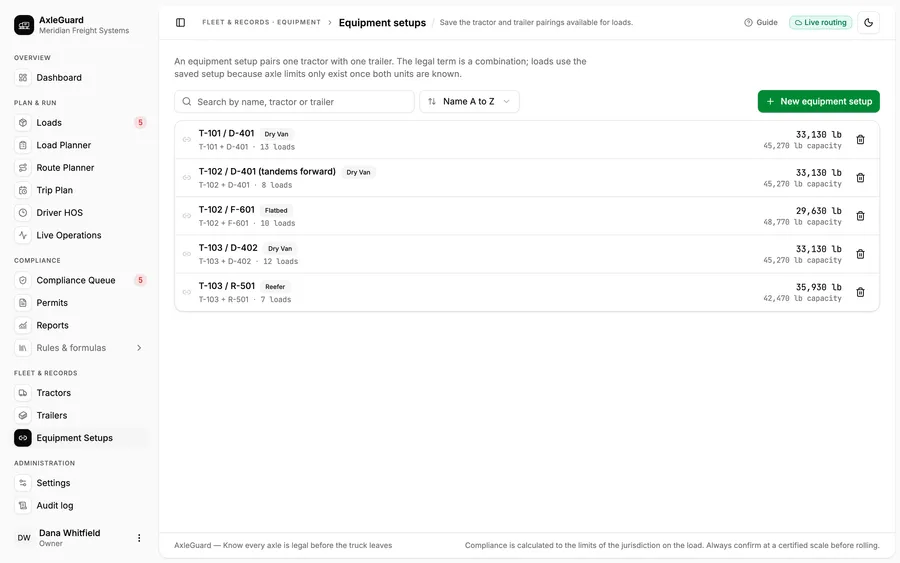
Axle positions in millimetres from the front, tire specifications and ratings, tare weight, kingpin offset, slider hole spacing and travel. Once, per combination.
Not the loads somebody decided to check. Every load, including the routine one on the familiar lane where the pallets happened to be stacked differently this morning.
Through the route, the drops, the fuel burn and the state line at lunchtime. The current journey view uses derived replay; a physical reading joins it only after gateway commissioning.
Related
Next step
Take a load your calculator has already cleared and put it through ours. If the two answers differ, one of us is wrong about your trailer, and that is worth knowing.