Your dispatch system runs the company. It was never asked about physics.
McLeod, Trimble, MercuryGate, Turvo, Rose Rocket and Alvys hold the orders, the rates and the money. None of them was built to work out where the freight has to sit, and none of them should be replaced to get that.
Six systems
14 capabilities checked
Public documentation, August 2026
What the category is for
Everything that happens to a load except the loading.
A transportation management system is the operating system of a freight business, and the good ones are genuinely hard to replace for very good reasons.
A TMS takes an order, prices it, assigns the tractor and driver, tenders it and tracks it. It also proves delivery, handles billing, pays the driver and closes the month. That is a very large amount of software, and the systems on this page do it across thousands of loads a week without dropping any of them.
Weight appears in that flow constantly. It is on the order, it is in the rate, it is on the bill of lading, it is on the delivery paperwork. Every one of those is the same single figure, repeated, because a single figure is all the business process ever needed.
Enforcement does not use that figure. A scale reads the steer axle, the drive group and the trailer group separately, then applies the bridge formula to every consecutive combination of axles, then checks the tires and the axle ratings underneath. The number that travels through your dispatch system is not wrong. It is just not the number being tested at the side of the road.
Everything in the office is repeating one number, and repeating it correctly. The scale at the roadside is measuring five.
Where the gap actually bites
Nobody in the office did anything wrong. The order was right, the rate was right, the dispatch was right. The pallets went on fourteen inches too far forward, and there was no screen anywhere in that chain where that fact could have appeared.
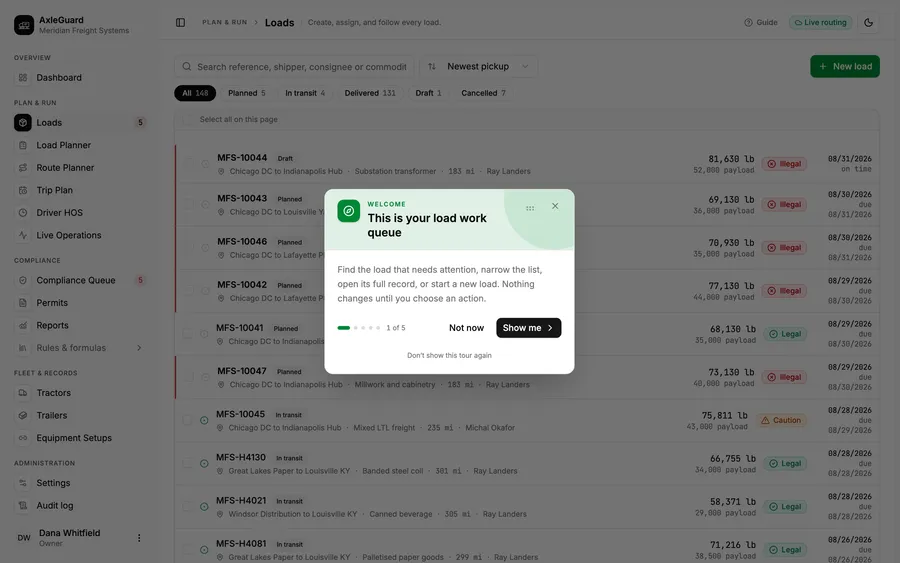
axleguard.app/loads
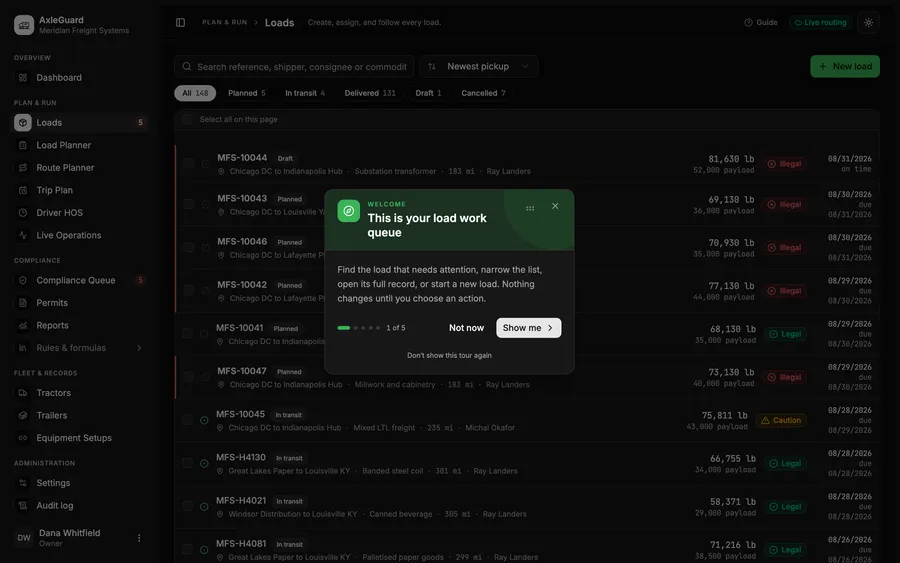
The same board a dispatcher already reads, with one column added: legal, over, or permit required, before anything rolls.
The systems
Six names, and the job each one is very good at.
These are not interchangeable products. They are aimed at different kinds of freight company, and the differences between them matter far more than anything on this page.
McLeod LoadMaster
Established asset-based carriers who run the whole company on one system.
What it does well
One of the deepest transportation management systems in North America. Order entry, dispatch, driver settlements, accounting, imaging, document management, electronic data interchange with shippers, and reporting on all of it. Carriers run on LoadMaster for decades, and that is not inertia — it is a system that genuinely holds the whole operation.
Where the scope ends
Weight is a value on an order because a shipper put it there. It moves through rating, planning and billing as a number. Where that weight ends up on five separate axle groups once the freight is positioned is not a question the system was designed to ask.
Trimble TMS
Carriers who want dispatch and mileage from the same house.
What it does well
A long-established family of carrier systems with dispatch, driver management, maintenance and back office, sitting close to the mileage and routing data the same company publishes. For a fleet that already rates on that mileage standard, having the dispatch board speak the same distance language removes a whole class of argument.
Where the scope ends
The tight routing integration is about distance and road. It does not extend to per-axle load distribution, and the vendor does not present it as doing so.
MercuryGate
Shippers, 3PLs and brokers moving freight across several modes.
What it does well
Strong multi-modal transportation management. Rating and procurement across carriers and modes, truckload and less-than-truckload, parcel, rail and ocean, with optimisation and settlement over the top. If your problem is choosing the cheapest legal way to move a hundred shipments this week, this is a serious answer.
Where the scope ends
Its unit of work is the shipment and the mode. Once a truckload is tendered to a carrier, how the carrier positions that freight on the deck is the carrier's business, and the system does not model it.
Turvo
Brokers and 3PLs who need everyone on the shipment talking in one place.
What it does well
Built around collaboration rather than around a record. Shipper, broker, carrier and driver all see the same shipment, with messaging, documents and status updates in one timeline instead of in six inboxes. For an operation where most of the cost is chasing people, that framing is worth a lot.
Where the scope ends
It coordinates the people on a shipment extremely well. The physics inside the trailer is not part of the conversation it hosts.
Rose Rocket
Growing carriers and brokers who want something modern and quick to adopt.
What it does well
A cleanly designed system that people can actually learn. Orders, dispatch, customer portals, driver communication and a strong appetite for connecting to other software. For a fleet that has outgrown spreadsheets and does not want a two-year implementation, this is a very reasonable place to land.
Where the scope ends
It is a dispatch and customer system. Axle load distribution is not among its published capabilities, and it does not pretend otherwise.
Alvys
Carriers and brokers who want the paperwork to move itself.
What it does well
A cloud system aimed squarely at the administrative drag in a freight office. Workflow automation across load lifecycle, document handling, driver app, and reporting, with the explicit goal of cutting the number of times a human re-types something that already exists.
Where the scope ends
Automating the paperwork around a load does not touch the question of whether that load is physically legal. Those are two different problems that happen to share a record.
Side by side
Fourteen capabilities, and five rows where our own column is no.
Orders, rating, portals, paperwork and multi-modal all belong to this category. We do not do any of them and have no plans to.
Transportation management systems compared with AxleGuard across fourteen capabilities
Capability
AxleGuard
McLeod
Trimble TMS
MercuryGate
Turvo
Rose Rocket
Alvys
Order entry, tendering and the dispatch board
No
Yes
Yes
Yes
Yes
Yes
Yes
Rating, invoicing and driver settlements
No
Yes
Yes
Yes
n/p
Yes
Yes
Customer and carrier portals
No
n/p
n/p
Yes
Yes
Yes
n/p
Document capture and paperwork workflow
No
Yes
n/p
n/p
Yes
n/p
Yes
Modes beyond truckload
No
n/p
n/p
Yes
n/p
n/p
n/p
Gross weight stored on the order
Yes
Yes
Yes
Yes
Yes
Yes
Yes
Truck-legal routing from real vehicle dimensions
Yes
part
part
n/p
n/p
n/p
n/p
Axle weights solved from cargo position
Yes
No
No
No
No
No
No
Bridge formula on every consecutive axle group
Yes
No
No
No
No
No
No
Tire and axle-rating limits layered on statute
Yes
No
No
No
No
No
No
Corrective move in slider holes and inches
Yes
No
No
No
No
No
No
Jurisdiction rule set on the individual load
Yes
n/p
n/p
n/p
n/p
n/p
n/p
Dispatch blocked while a load is over limit
Yes
n/p
n/p
n/p
n/p
n/p
n/p
Derived replay now; physical axle signal after commissioning
part
No
No
No
No
No
No
supportedpart partly, or with limits not supportedn/p not published by the vendor
How to read this table
Drawn from publicly published product documentation as of August 2026. Not published means we could not confirm it in the vendor's own material. Several of these systems connect to third-party routing and mileage software, which is why some routing rows read part rather than yes. Confirm current capability with the vendor.
How the two work together
Four steps, and none of them is a migration.
The dispatch system keeps the record of the business. We hold the physical model of the load and hand the verdict back to it.
01
The order stays where it is
Loads arrive from the dispatch system you already run. Reference, shipper, consignee, commodity, dates and the equipment assigned to it. Nobody re-keys anything, and the record of the business stays in the system that keeps the record of the business.
02
We carry the physical load beyond the order record
We show where the freight has to sit for every axle group to be legal. We name the binding rule in each jurisdiction and give the physical move that fixes an overage.
03
The verdict goes back on the load
Legal, over, or permit required, with the binding rule named. The planner reads it on the board, the driver reads the same thing in the cab, and a status change in the yard is a status change on the board without anyone typing it twice.
04
Nothing about the office changes
Rating, settlements, invoicing, imaging and reporting all carry on exactly as they do today. This is one screen added to a workflow, not a migration.
The 14 rows above, by which system answers them
rows
36%
7%
57%
Office rows, where our own column is a plain no5 rows
Gross weight on the order, where both say yes1 rows
Freight and road rows, where no dispatch system publishes a yes8 rows
Counted from the table above. The eight rows on the right are not a gap in any of these products. They are work nobody in the category set out to do.
Two systems, one load, no migration
Five of those fourteen rows are the reason a carrier will never replace its dispatch system, and we are a plain no on every one of them. Eight of them are the reason a load still gets cited with a correct weight on a correct order.
Questions
What a dispatcher asks first.
01Are you asking us to replace our TMS?
No, and you should be suspicious of anyone who does. A transportation management system holds your orders, your rates, your settlements and years of history. Replacing it is a project measured in quarters and it should only ever happen for reasons that have nothing to do with axle weight. We sit beside it and answer the physical question it was never built to answer.
02Our TMS has a weight field. Is that not the same thing?
It is the same word and a completely different quantity. The weight field holds what the shipper declared, as one number. Enforcement measures what each axle group is carrying, which depends on where the freight sits, where the slider is, how much fuel is aboard and what the trailer geometry is. A load can be well under the number in that field and still be cited on the drive tandem.
03Can it work if our dispatch system is old or closed?
Usually. Loads can be typed in, imported from a file, or pushed across from what you already run. A pilot deliberately starts with one lane, so if the connection has to be manual for the first month that is not a problem worth solving on day one.
04Who owns the load record if there are two systems?
Your dispatch system does. It is the record of the business. We hold the physical model of the load — the equipment, the freight positions, the axle solve and the audit trail behind every change to it — and hand the verdict back. Two systems, one answer, and no argument about which screen is right.
A real order, with the weight your customer declared and the trailer you would have put it on. Forty-five minutes, and you find out whether the board and the scale would have agreed.