Skip to content
AxleGuard
Demo

Category · Bypass and permits

A green light is a statement about your company, not about your trailer.

Drivewyze, PrePass, Bestpass and ProMiles sit between a fleet and the enforcement system, and they take real administrative pain away. None of them knows how today's freight is distributed.

  • Four services
  • 15 capabilities checked
  • Public documentation, August 2026

What the category is for

The paperwork and the roadside, handled.

Bypass, tolls, fuel tax and permits are four different administrative burdens that all live at the boundary between a fleet and a public authority.

A truck crossing several states in a day touches a surprising number of agencies. Weigh stations that can hold it up, tolling authorities that each want their own account, a fuel tax return that depends on miles driven in each jurisdiction, and permit offices for anything out of the ordinary. Handled by hand, this is a full-time job in the office and lost time on the road.

The services on this page take most of that away. Bypass keeps a compliant carrier rolling past sites it does not need to stop at. Toll consolidation turns a dozen statements into one. Fuel tax reporting turns an estimate into a calculation. Permit services turn a phone call into a transaction.

What none of them does — and none of them claims to — is look inside the trailer. Bypass eligibility is a property of the carrier. Tolls are a property of the road. Permits cover a configuration you have already decided you need one for. The question of whether an ordinary load has quietly gone over on the drive tandem sits outside all of it.

Bypass is granted on your safety record and your credentials. Nobody in that decision has looked at today's pallets.

The dangerous version of this

A fleet with good bypass coverage passes a lot of scales without stopping, and slowly stops thinking about axle weights at all. The citation, when it comes, arrives at a random verification pull on a load nobody looked at.
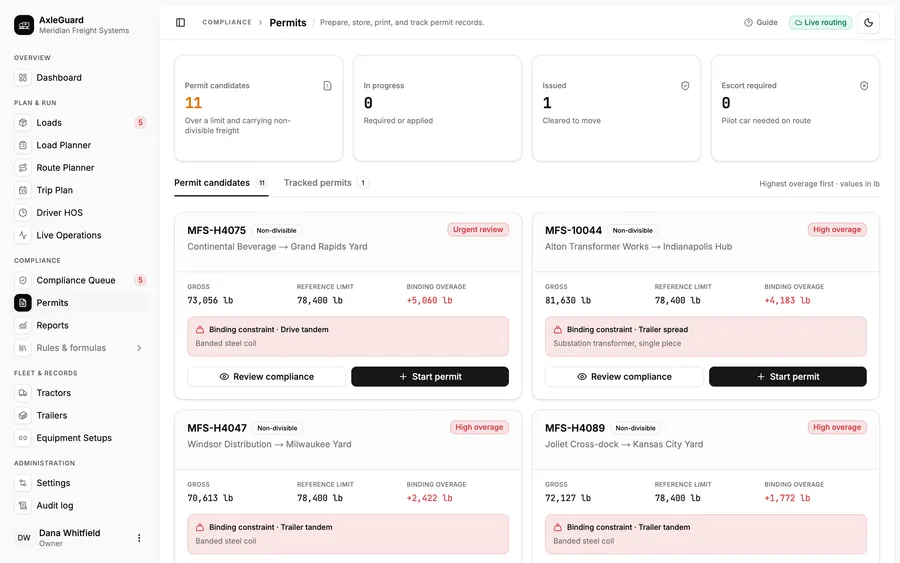
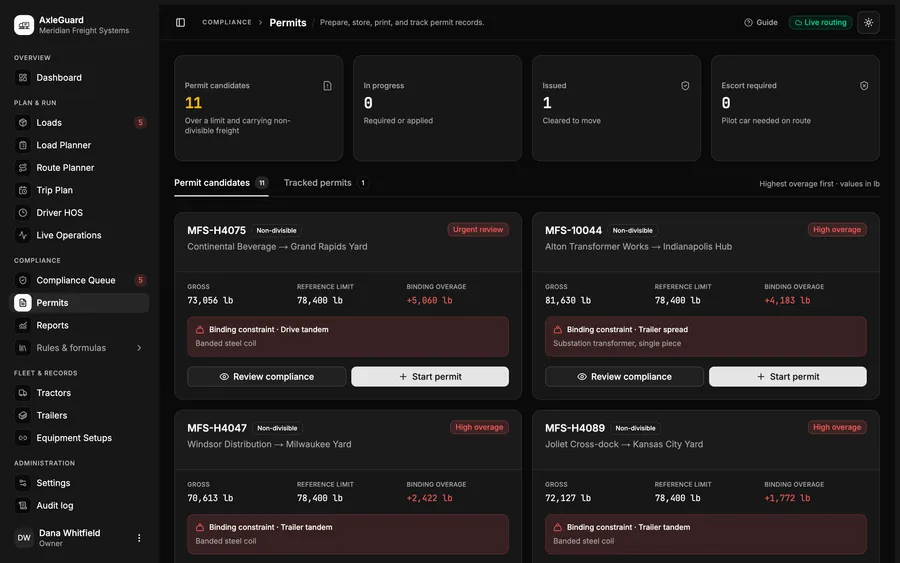
When no legal position exists, the load goes down the permit pathway with the escort requirement and validity window attached to it.

The services

Four names, and the burden each one lifts.

These do not compete with each other as directly as the table suggests. Most fleets end up with more than one, because the burdens are different burdens.

Drivewyze

Fleets that want bypass without another box in the cab.

What it does well

Weigh station bypass delivered through software on hardware the fleet already has, which removes the transponder logistics entirely. Alongside the bypass itself, it publishes in-cab safety notifications ahead of hazards such as steep grades and low-clearance warnings, which is a genuinely useful second product riding on the same channel.

Where the scope ends

A bypass decision is about the carrier and the site, not about today's pallets. It cannot know whether the freight behind the driver is distributed legally.

PrePass

Long-established fleets running national lanes.

What it does well

One of the original weigh station bypass networks, with a very wide site footprint, available through transponder and through an application. Toll payment and safety analytics sit alongside it, so a fleet can consolidate several roadside relationships into one account.

Where the scope ends

Bypass eligibility rests on a carrier's safety and credential record. A green light is a statement about your company, not a verdict on this trailer.

Bestpass

Fleets drowning in toll accounts across a dozen agencies.

What it does well

Toll management done properly. One account across many tolling authorities, transponder administration, violation handling and consolidated reporting. For a fleet that used to reconcile statements from a dozen agencies by hand, this replaces an entire administrative job.

Where the scope ends

It is a commercial and administrative service around tolls and transponders. Load legality is not within its subject.

ProMiles

Fleets optimising fuel spend and filing fuel tax.

What it does well

Fuel routing and fuel purchase optimisation across a network of stops, mileage calculation, fuel tax reporting, and permit services alongside them. For an operation where fuel is the second largest line on the profit and loss, planning where to buy it is a direct financial product rather than a compliance one.

Where the scope ends

Its optimisation is about money and distance. Where the freight sits on the deck is not one of its variables.

Side by side

Fifteen capabilities, and one row where nobody has a tick.

No service on this page, and no product we know of including ours, decides a bypass on the actual axle weights of the load aboard. That row is a no all the way across, and it is the most honest line in the table.

See the full capability matrix
Weigh station bypass, toll and permit services compared with AxleGuard across fifteen capabilities
CapabilityAxleGuardDrivewyzePrePassBestpassProMiles
Weigh station bypass granted at the roadsideNoYesYesn/pn/p
Bypass delivered through existing in-cab hardwareNoYespartn/pn/p
Toll consolidation across many agenciesNon/pYesYesn/p
Transponder and violation administrationNon/pn/pYesn/p
Fuel purchase optimisation along the routeNoNon/pn/pYes
Fuel tax and mileage-by-jurisdiction reportingNon/pn/pn/pYes
In-cab safety alerts ahead of hazardsNoYespartn/pn/p
Oversize and overweight permit orderingpartn/pn/pn/pYes
Bypass decided on this load's actual axle weightsNobody does this, us includedNoNoNoNoNo
Axle weights solved before the trailer is sealedYesNoNoNoNo
Bridge formula on every consecutive axle groupYesNoNoNoNo
Permit case detected automatically from the loadYesn/pn/pn/pn/p
Escort and travel-window rules attached to the loadYesn/pn/pn/pn/p
Dispatch blocked while over limit with no valid permitYesn/pn/pn/pn/p
Hardware or transponder requiredNoNopartpartn/p
supportedpart partly, or with limits not supportedn/p not published by the vendor

How to read this table

Drawn from publicly published product and service documentation as of August 2026. Several of these companies offer more than one service and the packaging changes, so not published is common here. Confirm what your own agreement covers with the vendor.

The permit pathway

What we do when no legal position exists.

Sometimes the answer really is a permit. The useful thing is knowing that at the dock rather than at the scale, and knowing it is the freight rather than the loading.

  1. 01

    The freight is marked non-divisible

    A cargo item that physically cannot be split is flagged as such when it goes on the load. A transformer is not a stack of pallets and no amount of repositioning turns it into one.

  2. 02

    The solver runs out of legal positions

    Every slider setting and every sensible position is tried against the jurisdiction's rules. When the load is over limit, the freight cannot be divided, and no position fixes it, that specific combination is the permit case.

  3. 03

    The permit is opened against the load

    Type, jurisdiction, escort requirement and validity window, attached to the load rather than filed somewhere separate. The load now knows what it is waiting for.

  4. 04

    Dispatch stays shut until it is covered

    An over-limit load cannot be dispatched without a valid permit covering it. That is a rule in the system rather than a note on a whiteboard, so it holds when the person who knew about it is on holiday.

The low column on this page is ours

Nine of the fifteen rows in that table are a plain no in our own column. Bypass at the roadside, toll consolidation, transponder administration, fuel purchase and fuel tax filing are all somebody else's work, and we have no intention of taking any of it on.

A load is non-divisible only if separating it would compromise the intended use of the vehicle, destroy the value of the load, or take more than eight work hours.
23 CFR 658.5, definition of a non-divisible load

Capabilities published as supported, of 15

rows
  • AxleGuard5 rows

    Plus one part, and nine plain no

  • Drivewyze3 rows

    Seven rows not published

  • PrePass2 rows

    Plus three part, seven not published

  • Bestpass2 rows

    Plus one part, nine not published

  • ProMiles3 rows

    Nine rows not published

Counted from the table above. One row is a no all the way across: nobody here, us included, decides a bypass on the actual axle weights of the load aboard.

Permits are for freight that cannot be split

A load that is over because the pallets sit too far forward does not need a permit. It needs the pallets moved. Telling those two cases apart before anybody picks up a phone is most of the value here.

Questions

What fleets with bypass ask.

01If we get bypass, does the axle question go away?
No, and this is the most expensive misunderstanding in this category. Bypass eligibility is granted on your carrier safety record, your credentials and the site's own rules. It says nothing about whether today's pallets are distributed legally. Fleets are pulled in for verification regardless, and an overweight axle found that way is the same citation it would have been at the scale.
02Does a permit make an overweight load legal?
A permit makes a specific over-limit configuration legal on a specific route for a specific window, usually with conditions attached such as travel hours or an escort. It is not a general exemption, it costs money and lead time, and it applies to freight that genuinely cannot be split. A divisible load that is over because the pallets sit too far forward does not need a permit — it needs the pallets moved.
03Do you order permits from the state for us?
Not today. We detect the permit case, record the permit with its type, jurisdiction, escort requirement and validity window against the load, and block dispatch until a valid one covers it. Ordering it from the issuing authority is still done the way you do it now, including through a permit service if that is what you use. That row reads part in our own column for that reason.
04Where does this actually save money?
In the loads that get permitted when they did not need to be. If a load is over only because of where the freight sits, and it is divisible, the permit is being bought to avoid a re-load rather than because the freight requires one. Knowing which of those you are looking at, at the dock, is the difference between a two-minute move and a permit fee with a travel window attached.

Next step

Find out which of your permits you did not need.

Bring a load you permitted last month. If the freight was divisible and a position existed, that is a fee and a travel window you can stop paying for.