Skip to content
AxleGuard
Demo

Compliance

Some freight does not come apart.

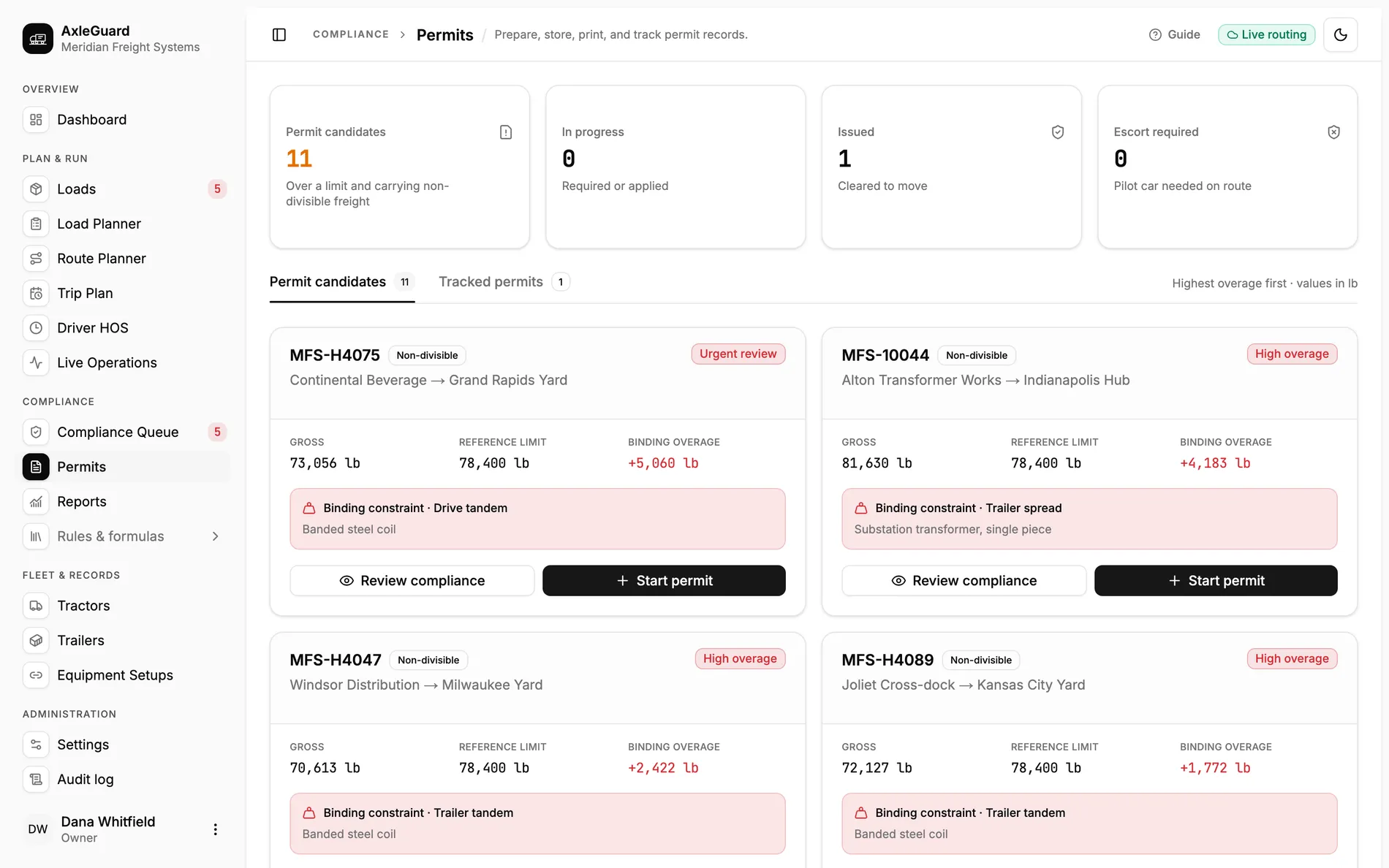
A transformer is one piece. It cannot be split to get under an axle limit, so the answer is not 'move a pallet' — it is an overweight permit, an escort, and a route the permit allows. AxleGuard recognises the non-divisible case and sends it down the permit pathway instead of telling a planner to do something impossible.

Trigger
Non-divisible + over limit
detected, not declared
Tracked fields
Type, jurisdiction, escort, window
plus the covered load
Link
Two-way
permit ↔ compliance check

In the product

The screen where this work happens.

Open AxleGuard
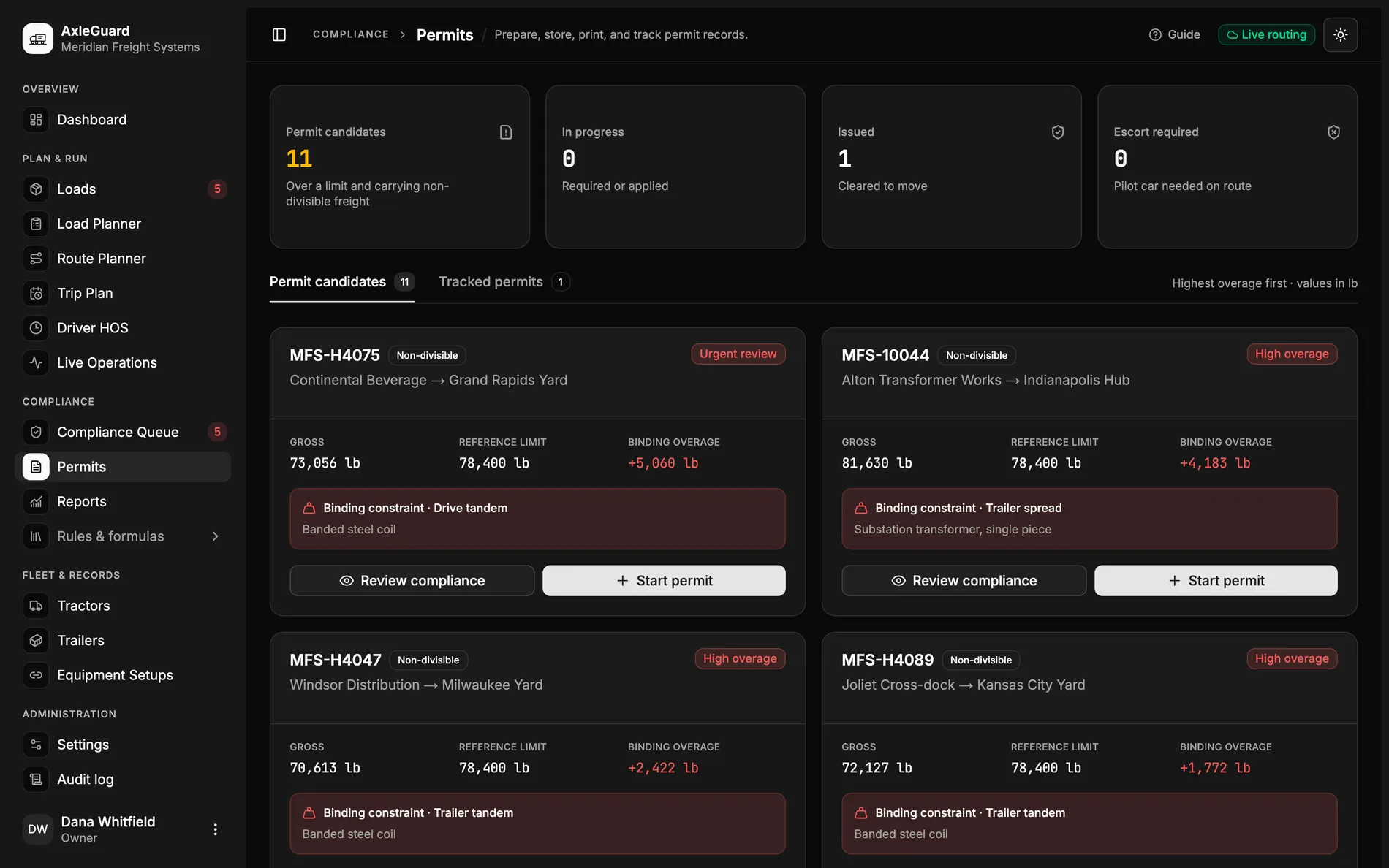
The permit register: type, jurisdiction, escort requirement, status and expiry, drillable to the load it covers.

What changes

Three outcomes that matter in the operation.

Each outcome connects what the software does to the decision a planner, loader or driver can actually make.

01

The advice you get is advice you can actually take

Freight is marked as splittable or not. When a load is over the limit and cannot be split, the permit route opens instead of a suggestion to move a pallet that is bolted to the deck.

Why this is different

A generic checker gives the same instruction to a pallet of copier paper and a 60,000 lb transformer: move some of it. For one of them that is not an instruction, and after the second time a planner stops reading what the tool says.

A 92,000 lb gross with one piece on the deck

Tractor 17,500 lb, trailer 14,500 lb, a single transformer at 60,000 lb. That is 92,000 lb gross, 12,000 lb over the federal limit, and nothing about it can be fixed by moving freight, because there is one item and it is chained down. What the planner needs is an overweight permit, an escort requirement and a road the permit allows — which is what comes back.

02

An expired permit turns up in the office, not at the roadside

Each permit is held with its type, who issued it, whether an escort is required, the dates it is valid between, and the load it covers.

Why this is different

Permits normally live in a shared drive and a folder behind the seat. Whether the one in the folder is still current is a question nobody asks until an officer asks it.

A permit that expires on day two of a three-day run

The trip is planned to arrive on the 14th. The permit runs out on the 13th. Because the dates sit on the same record as the load, that shows up while the run is still being planned, when a renewal is a form. Found on the road, it is a parked truck and a missed appointment.

03

Two years later you can still say why you permitted it

The permit is tied to the compliance check that made it necessary, and the check is tied back to the permit. Either one opens from the other.

Why this is different

A permit log that lives on its own can tell you a permit existed. It cannot tell you what the load weighed, which axle was over, by how much, or who decided the freight could not be split.

An insurer asking about a run from two years ago

The question is why an over-limit load was moved at all. The answer is one record: the load, the freight on it, the axle that failed and by how much, the flag saying it could not be split, the permit that covered it, and the person who dispatched it. Reassembling that from email takes a week and still leaves gaps.

How it works

From input to answer.

The logic is visible. There is no “AI decided” step between the load and the verdict.

Important boundary

AxleGuard identifies candidates and tracks the filing record. It does not issue a government permit or guarantee approval; authority submission and issuance remain outside the product.

  1. 01

    Flag the freight

    A cargo item is marked non-divisible when it physically cannot be split.

  2. 02

    Detect the case

    Over limit, non-divisible, no slider position fixes it — that combination is the permit case.

  3. 03

    Open the permit

    Type, jurisdiction, escort requirement and validity window, attached to the load.

  4. 04

    Gate the dispatch

    The load cannot be dispatched over-limit without a valid permit covering it.

Where to test it

Hard cases worth checking.

  • An over-limit load with no legal slider position at all.
  • A permit that expires inside the planned trip window.
  • A route crossing a jurisdiction the permit does not cover.
  • An escort requirement that changes the trip plan's hours.