Skip to content
AxleGuard
Demo

On the driver's phone

A verdict that never reaches the dock changes nothing.

The most accurate answer in freight is worthless if it stops at an office screen. This page is about the last two hundred yards, between the person who knows and the person holding the forklift.

  • Nothing to install
  • Their loads only
  • The same three words as the desk

The last two hundred yards

Three ways a correct answer fails to arrive.

None of these is a technology problem. They are all the same problem: the information exists in a place the freight is not.

The planner sees it and the dock does not

The verdict appears on a screen in an office. The freight is two hundred yards away being loaded by somebody with no screen. Between those two facts sits a phone call that has to interrupt the right person at the right minute.
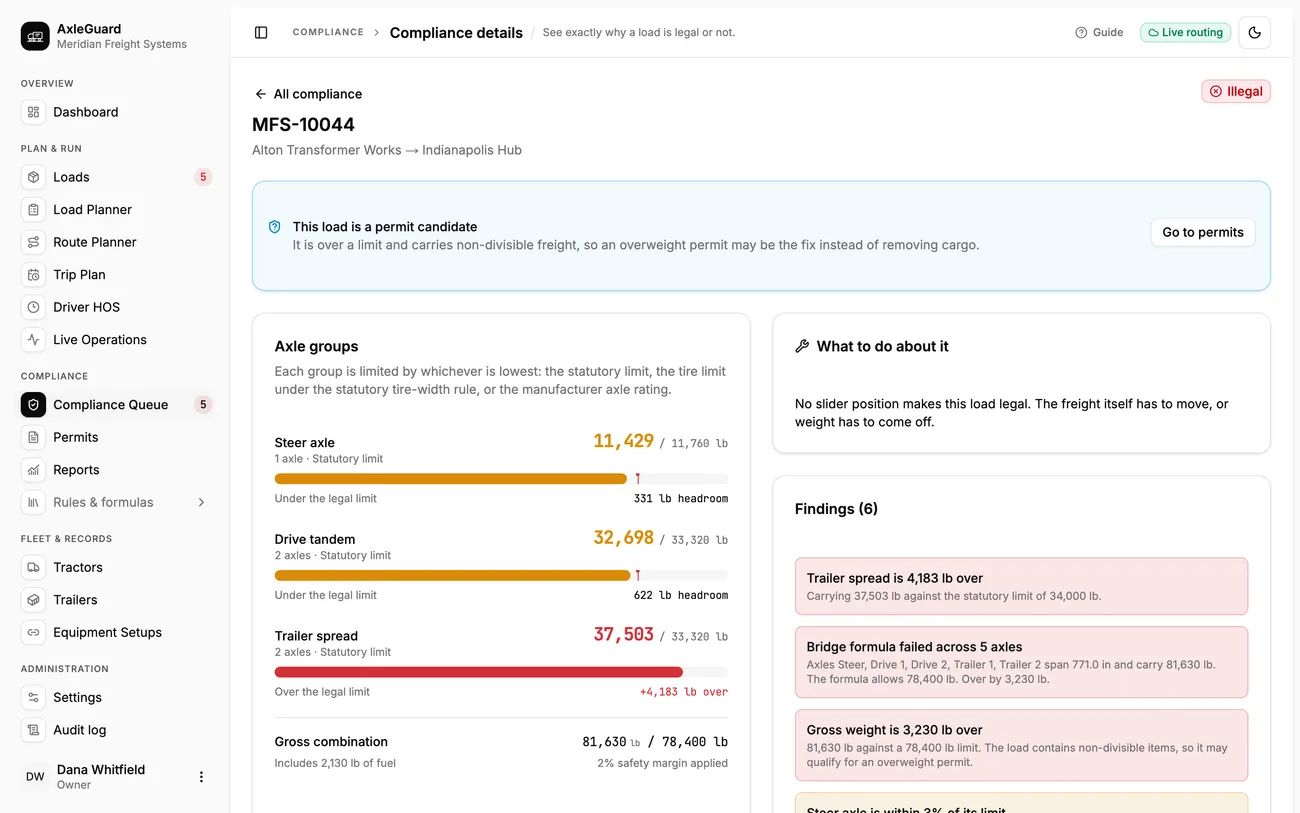
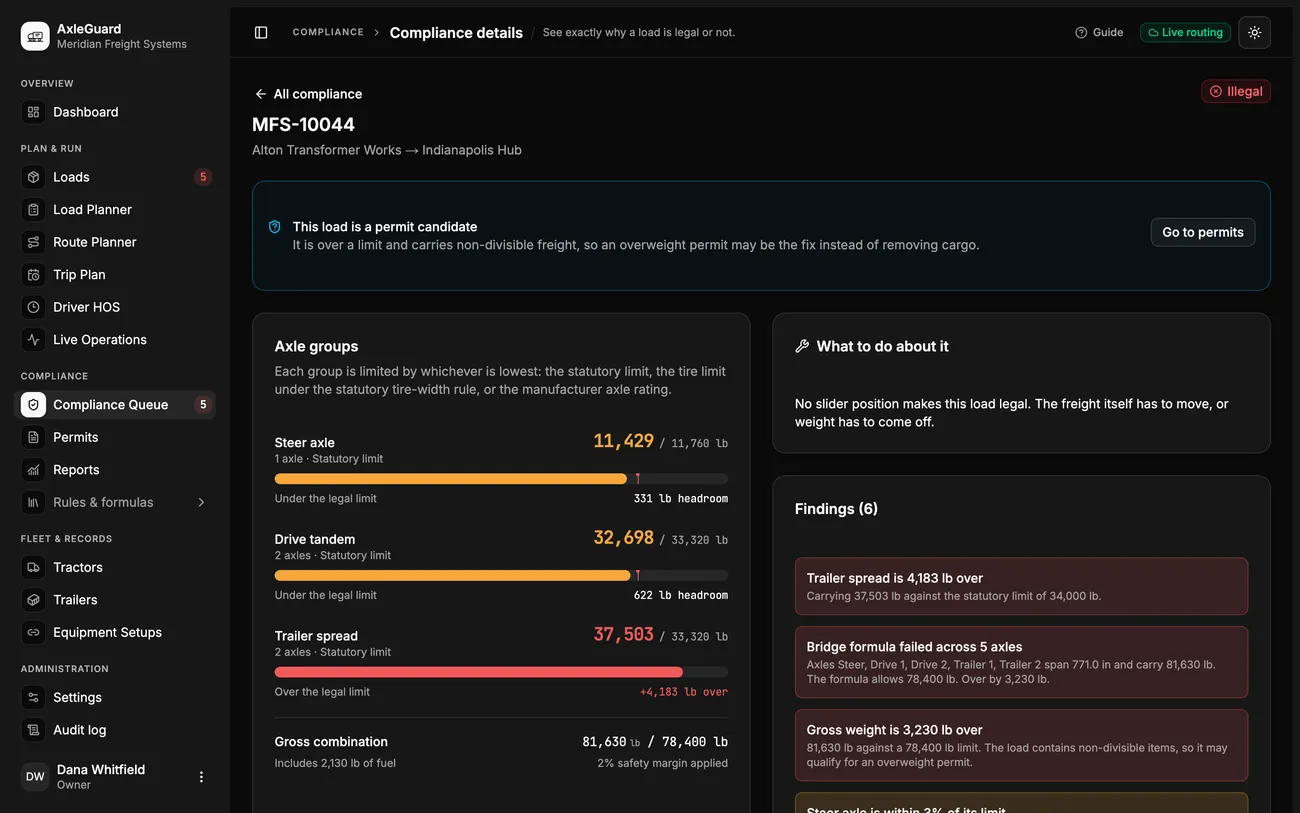
By the time the message lands, the doors are shut

A forklift driver is loading something else. A yard hand takes the message and passes it on. Ten minutes later the trailer is sealed and the fix that cost two minutes now costs a re-load.

Two versions of the same load

The office is looking at the plan and the yard is looking at the trailer. When they disagree, somebody has to be overruled, and being overruled at six in the morning is how a tool stops being used.

The same load, answered in two places

lb
  • Steer axle11,820 lb

    Planner and driver read the same figure

  • Drive tandem35,140 lb

    Over by 1,140 lb — and the person holding the forklift has to be the one who knows

  • Trailer tandem30,760 lb

    Fixed by moving the tandems, not by a phone call

A verdict that stops at the desk changes nothing. The correction has to reach the yard while the freight is still on the floor.

Why this page exists at all

Everything else on this site is about getting the answer right. This is the only page about getting it to the person who can act on it, and in practice that is where most of the value is either collected or lost.

In the cab

Six things, and no planning.

A driver's screen is deliberately the smallest thing that still lets them act. Everything a driver does not need is not there, which is also why nothing has to be learned.

  • The loads that belong to that driver, and nothing else on the board
  • The verdict on each one, in the same three words the planner sees
  • The axle group that failed, and by how much
  • The correction as an instruction — slide the tandems back four holes
  • Whether the load is cleared to move, and if not, why not
  • A way to report what actually happened, which lands in the record

What a driver cannot do is change a limit, edit a rule set or send a load that is over. Those are refused by the system, not hidden from the screen, and every attempt is recorded.

The same detail the planner has, cut down to what one person needs in order to move two pallets.

The last two hundred yards

The verdict existed. Getting it to the forklift is the problem.

The same correction on the same load, reaching the person who can act on it three different ways.

From verdict to fix

How long the same two-pallet fix takes to happen

minutes
  • Read on a phone, where the freight is2 minutes

    The person holding the forklift is the person reading the verdict

  • Relayed by telephone to the yard20 minutes

    Office, then a yard hand, then the forklift — if everyone is free

  • Found after the doors are sealed90 minutes

    The same two pallets, now a crew, a dock slot and a re-load

A worked example of the shape of it rather than a stopwatch on anybody's yard. The freight, the correction and the trailer are identical in all three: the only variable is how far the answer had to travel to reach somebody who could act on it.

A verdict that never reaches the person holding the forklift changes nothing at all.

Why it stays right

There is one copy of the rules, and the phone reads from it.

Nothing about the limits is carried on the device. That matters more than it sounds: when rules are baked into an application, a change waits for the next version to reach every handset, and in the meantime some of your fleet is confidently wrong.

Here a limit is changed once by somebody allowed to change it, and everyone is correct the same afternoon. There is nothing to install, nothing to update and no version to check.

The same is true of a shared screen at the dock. It is the same record, showing each person what their role allows, with sessions that expire so that walking away is not the same as handing over your authority.

Nothing about the limits is carried on the device, so there is no version of the rules going stale in somebody's pocket.

Who can change what

Nobody has to decide which answer to believe while a receiver is waiting, because there is only one answer.

The driver sees the same verdict, on the same load, computed from the same rules as the planner's screen.

The usual arrangement is a plan in the office and a rule of thumb in the cab, which agree until the day they matter.

The fix happens where the freight is, in the two minutes it takes, instead of becoming a phone call and then a re-load.

The correction is stated as a physical move in the units the yard works in, not as an overage figure or a percentage.

A verdict that needs translating into yard instructions gets translated by somebody who is already late, or not at all.

Straight answers

Five questions from the people who run the yard.

Connection requirements

Live telemetry and newly issued instructions require a data connection. Coverage, reconnection behaviour and the driver's fallback procedure are agreed during rollout for each corridor.
01Is there an app to install?
It runs in the phone's browser. There is nothing to install, nothing to update on a fleet of devices, and no version of the rules sitting stale on somebody's handset. When a limit changes it changes for everyone the same afternoon.
02What can a driver actually change?
Their own loads, and only the things a driver should change: reporting status and what happened. A driver cannot alter a limit, edit a rule set or dispatch an over-limit load, and that is enforced by the system rather than by hiding a button.
03Our drivers will not learn another tool.
They are not being asked to plan anything. It is a list of their loads, a verdict, and a sentence saying what to move. If it takes more than a glance, we have built the wrong thing and we would rather find that out in week two of a pilot.
04What about signal on the road?
This is the honest limit worth naming: it is a connected screen, and a dead spot is a dead spot. The place it matters most — a loading dock — almost always has coverage or wifi, and that is where the fix has to happen anyway.
05Is this the same on a yard terminal?
Yes, and that is the point. A shared screen at the dock, a phone in a cab and the planner's desk are all reading the same record. Each person sees what their role allows, and sessions expire so that walking away is not the same as handing over your authority.

Next step

Put it on a phone during the call.

Open your own load in the cab view while the planner view is on the screen beside it. Ten seconds tells you whether a driver would actually use it.