Skip to content
AxleGuard
Demo

Compliance

The check most implementations get wrong.

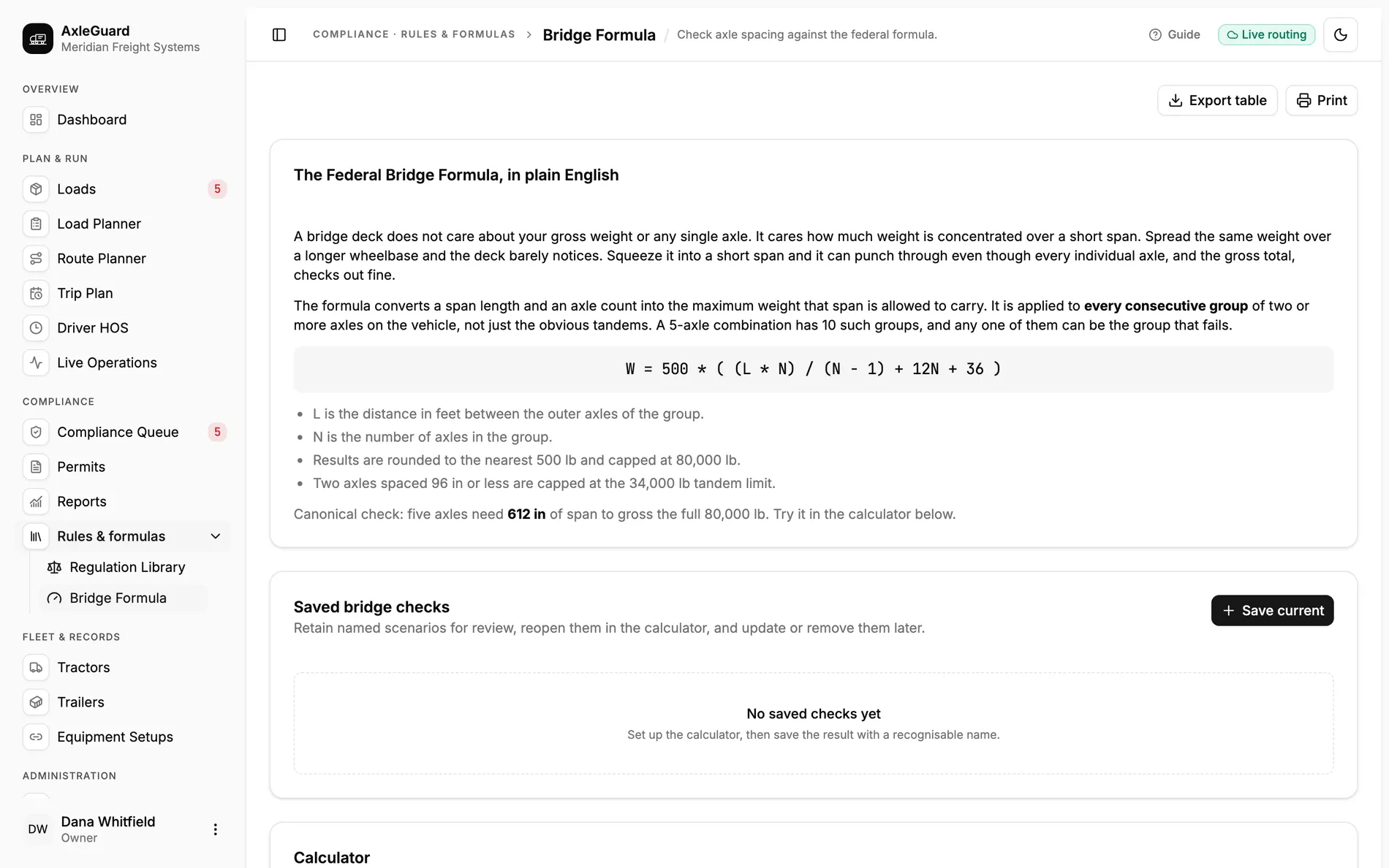
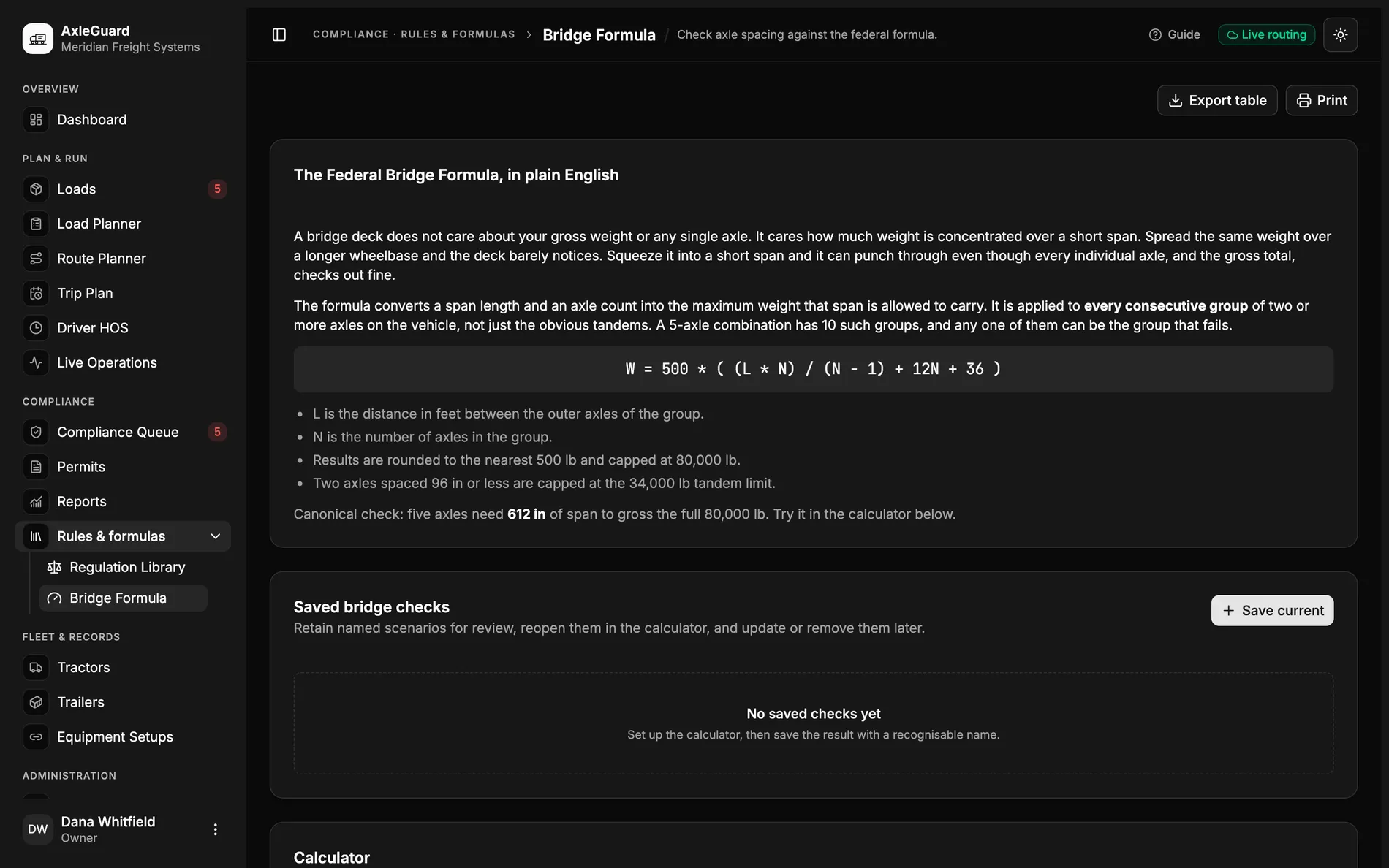
The Federal Bridge Gross Weight Formula does not only apply to axle pairs. It applies to every consecutive group of axles on the vehicle — steer-to-drive, drive-to-trailer, and the full outer spread. A five-axle truck has ten of those groups. Checking three of them is how a legal-looking load gets a citation.

Subsets on a 5-axle unit
10
all of them evaluated, every time
Formula
W = 500 × ((L×N)/(N−1) + 12N + 36)
rounded to 500 lb, capped at 80,000
Tandem cap
34,000 lb
applied when spacing is 8 ft or less

In the product

The screen where this work happens.

Open AxleGuard
The full enumeration, with the formula's inputs and result printed for every subset so an auditor can follow the arithmetic.

What changes

Three outcomes that matter in the operation.

Each outcome connects what the software does to the decision a planner, loader or driver can actually make.

01

The group that fails is usually not the one you checked

Every run of consecutive axles on the combination is measured and tested against the federal bridge formula — W = 500 × ((L×N)/(N−1) + 12N + 36), rounded to the nearest 500 lb and capped at 80,000. A five-axle tractor-semitrailer has ten such groups, and all ten are checked.

Why this is different

The normal check is the two tandems and the gross, because that is what fits on a clipboard. The interior groups — steer to drives, drives to trailer — are where the formula usually bites, and they are the ones nobody works out by hand.

Every axle group legal, and the truck still fails

Steer 11,800 lb, drive tandem 33,900 lb, trailer tandem 32,200 lb. Gross is 77,900 lb, under 80,000, and no group is over its own limit. But the drives and the trailer tandem together are four axles spanning 36 ft, and the formula allows 500 × ((36×4)/3 + 48 + 36) = 66,000 lb. Those four are carrying 66,100 lb. The truck is 100 lb over on a group nobody measures.

02

Close-coupled tandems get the number the officer actually uses

Two axles spaced 8 ft or less are capped at 34,000 lb rather than at whatever the formula produces. The exception is applied everywhere it fits, so the tandem verdict matches the table the officer is reading from.

Why this is different

Run the raw formula on a standard tandem and it hands back a number that looks generous and is wrong. A load built to it is legal on your spreadsheet and over at the scale.

A drive tandem spaced at 4 ft 4 in

Two axles, 4.33 ft apart. The formula gives 500 × ((4.33×2)/1 + 24 + 36) = 34,330 lb, which rounds to 34,500 lb. The exception says 34,000 lb, because the axles are closer than 8 ft. Build to 34,300 lb and you are 300 lb over, on a number your own arithmetic said was fine.

03

You have a worksheet to hand over, not a red badge

Every group shows its spacing, how many axles it has, what the formula allows it, what it is actually carrying, and how much room is left. The group with the least room is named.

Why this is different

A pass/fail badge cannot be argued at the roadside and cannot teach a new planner anything. The only worksheet most yards ever see is the inspector's, and they see it for the first time after the ticket is written.

Ten groups on a five-axle unit, printed in full

Steer to drives, drives to trailer, each tandem on its own, the full outer spread and the rest — ten consecutive groups in all. Nine have room. One has 100 lb. The page names that one, shows the arithmetic that produced its 66,000 lb allowance, and the planner moves freight before anyone signs for the load.

How it works

From input to answer.

The logic is visible. There is no “AI decided” step between the load and the verdict.

Important boundary

US federal bridge formula. State bridge tables that differ from federal — a handful do — are entered as jurisdiction overrides rather than as their own formula.

  1. 01

    Take the axle positions

    From the tractor and trailer configuration, in millimetres from the front.

  2. 02

    Enumerate the subsets

    Every run of consecutive axles of length two or more, from tightest pair to full outer spread.

  3. 03

    Evaluate each one

    Spacing L in feet, axle count N, formula limit, then the tandem exception where it applies.

  4. 04

    Report the binding group

    The subset with the smallest margin is the one that will fail, and it is named.

Where to test it

Hard cases worth checking.

  • A load legal on gross and on every single axle, and illegal on an interior three-axle subset.
  • Spread axles that gain capacity as they separate.
  • Loads at exactly the 80,000 lb cap, where rounding decides the verdict.