Skip to content
AxleGuard
Demo

Platform

A compliance record is only worth what you can prove.

If a load is disputed two years from now, the question is not what the system says today. It is what it said then, who changed it, and what the numbers were before they touched it. AxleGuard writes a before-and-after record on every change, with roles enforced on the server.

Roles
4
owner, dispatcher, driver, viewer
Audit record
Before + after
structured, not a message string
Dispatch guard
Server-side
an illegal load is refused by the API

In the product

The screen where this work happens.

Open AxleGuard
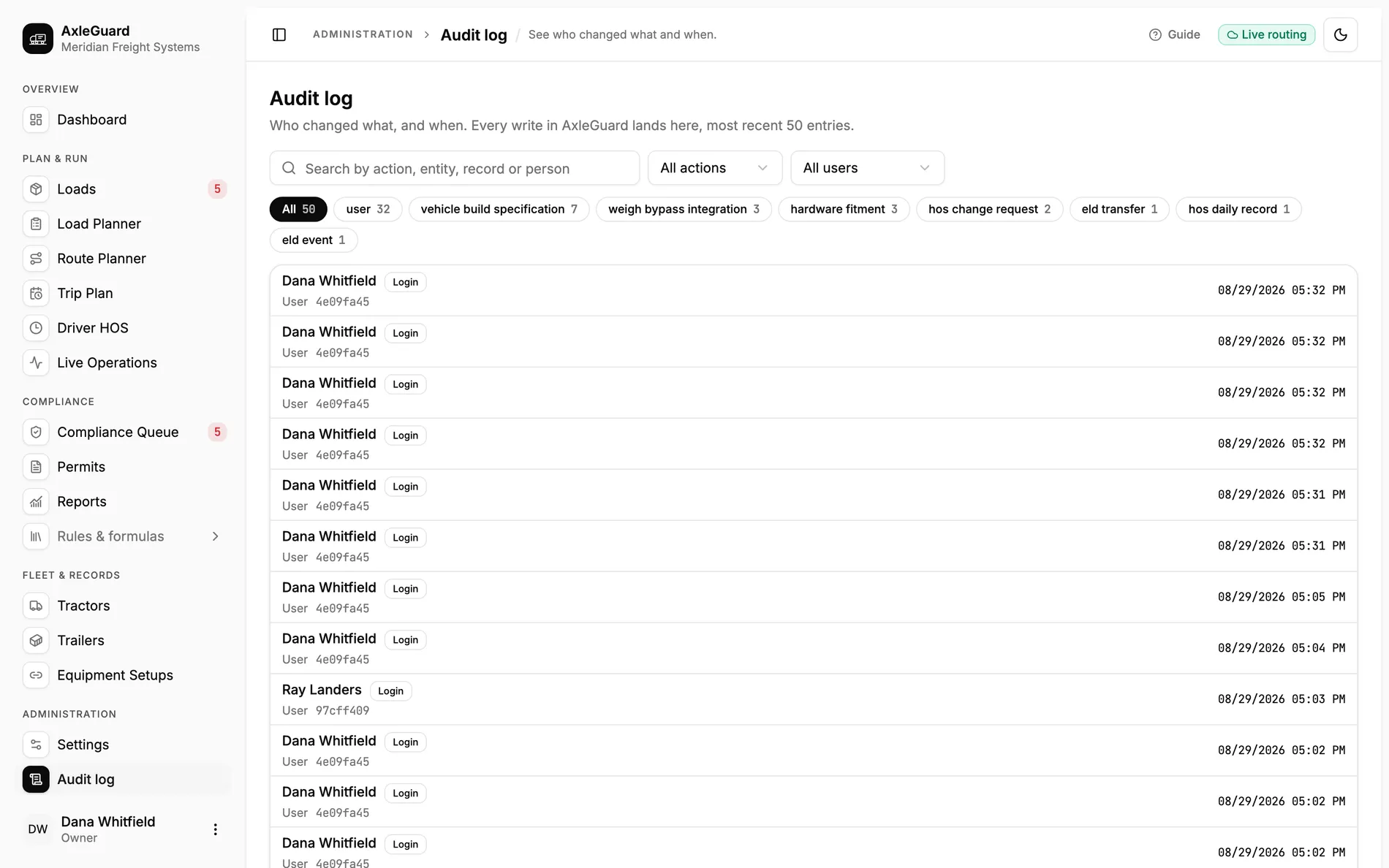
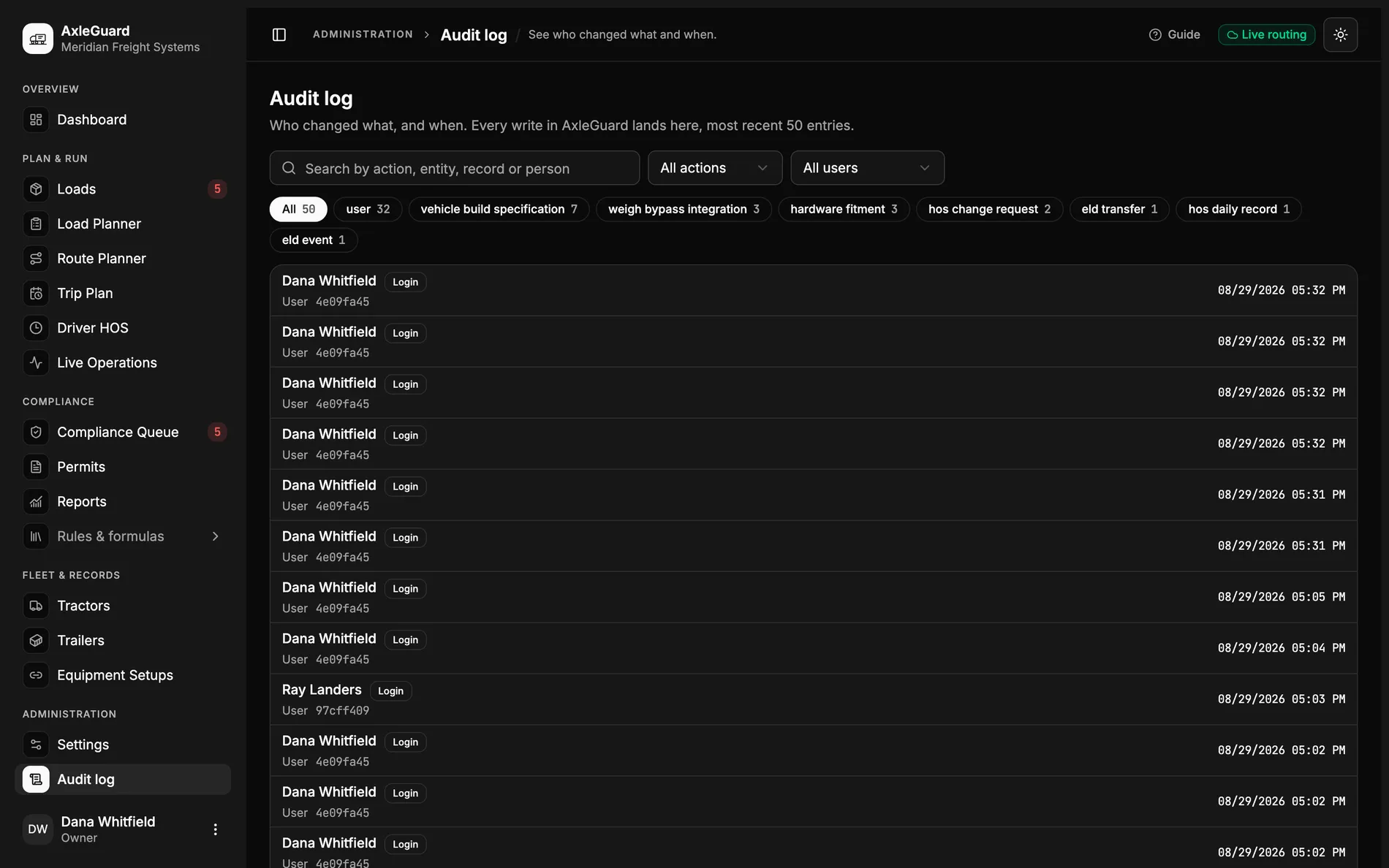
Every change, with the actor, the entity, and the full before-and-after state, drillable to the record it changed.

What changes

Three outcomes that matter in the operation.

Each outcome connects what the software does to the decision a planner, loader or driver can actually make.

01

A dispute is settled with a record instead of a recollection

Every change to a load, a vehicle or a rule is written down with what it looked like before, what it looks like after, who made it, and when.

Why this is different

Most systems record that something was changed, not what it was changed from. Two years later that tells you a change happened and nothing at all about whether the load was legal when it left the yard.

A claim about a load moved in March

The question is what the drive axles read at the moment the load was dispatched, and whether anyone edited the weights afterwards. The record shows the load at dispatch with 33,900 lb on the drives, and a weight edit made two days later by a named person. Both facts sit in the same place, and neither depends on anyone's memory.

02

A driver's login cannot change a limit, however it asks

Four roles — owner, dispatcher, driver, viewer — and what each of them may do is enforced on the server, not decided by which buttons the screen happens to draw.

Why this is different

Hiding a button is not access control. If the rule lives only in the screen, anyone who reaches the system another way can still do the thing the button was hidden for, and nothing records that they did.

A driver account and an edited axle limit

The driver's screen offers no way to change a jurisdiction's axle limit. If the same account tries anyway, from anywhere, it is refused and the attempt goes on the record. That matters because the limit is the number every other figure on every load is measured against.

03

An over-limit load cannot be dispatched, however busy the yard is

A load moves through a defined set of states, and moves that are not allowed are refused. Dispatching a load that is over the limit is one of the refused ones.

Why this is different

A free-text status field lets anything become anything. At five o'clock on a Friday, planned becomes dispatched because somebody typed it, and the check that said no is no longer part of the story.

1,140 lb over, and the dispatch button

Steer 11,300 lb, drives 35,140 lb, trailer tandem 31,280 lb — 77,720 lb gross, well under 80,000, and it would pass any glance at the gross. The drive tandem is 1,140 lb over. The dispatch is refused, the reason names the drive tandem and the amount, and the refusal itself goes on the record. The load leaves twenty minutes later with the tandem slid five holes forward.

How it works

From input to answer.

The logic is visible. There is no “AI decided” step between the load and the verdict.

Important boundary

Each guided workspace belongs to one carrier organisation, uses invited users and has no public registration. Enterprise tenant isolation is agreed and tested during rollout.

  1. 01

    Every write is intercepted

    The prior state is captured before the change is applied.

  2. 02

    The record is written

    Actor, action, entity, entity id, before, after, timestamp.

  3. 03

    Transitions are checked

    The status change is validated against the state machine and the current compliance verdict.

  4. 04

    The trail is drillable

    Any audit row opens the record it changed, in the state it is in now.

Where to test it

Hard cases worth checking.

  • A dispatch attempt on an over-limit load, refused and logged.
  • A role escalation attempt against the API directly.
  • A deleted load whose audit trail survives it.
  • A share link that exposes a read-only view with no session.